If you’ve ever stood at a deli counter and heard someone ask for capicola, then watched the person next to them order coppa, and then overheard the guy behind the counter call it capocollo — you’re not losing your mind. They’re all pointing at the same general thing. More or less. The truth, as with most Italian food traditions, is slightly more complicated and a whole lot more interesting than a simple yes or no.
I’m José Villalobos, and this question has followed me for years — through Italian markets in Sacramento, through the back roads of Calabria, and all the way back to my childhood watching my grandmother Julia cook in Valparaíso, Chile, where Italian food was treated with a reverence that made an impression on me before I even understood why. So let me break this down the way I wish someone had broken it down for me.
What Is Capicola, Exactly?
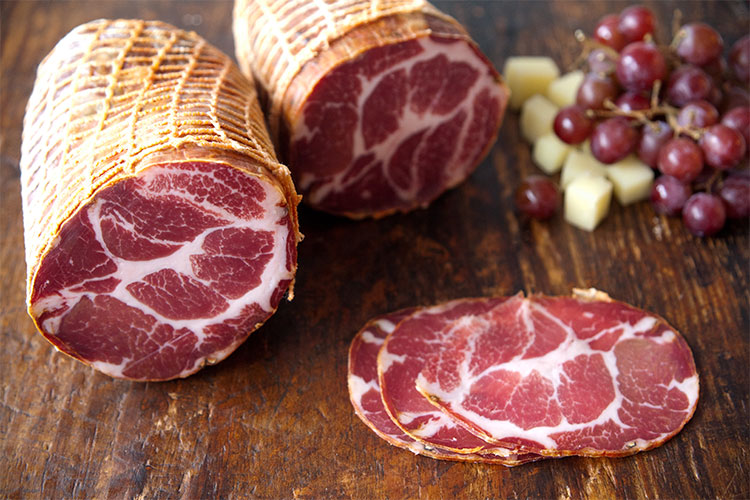
Capicola is a whole-muscle Italian cured pork product made from the muscle that runs from the pig’s neck down to roughly the fourth or fifth rib of the shoulder. The name itself tells you where it comes from: capo means head, collo means neck. It’s a salume — a salt-cured meat — and it belongs to the same proud family as prosciutto and salami, though it has its own distinct character.
What makes capicola different from a lot of other cured meats is its ratio of fat to lean: roughly 30% fat to 70% lean muscle. That fat isn’t a flaw — it’s the point. It gives the meat a tender, almost silky quality when sliced thin, somewhere between the richness of lardo and the chewiness of a leaner salami. The texture is closer to prosciutto than to a salami, but the flavor is more forward, more complex, closer to actual pork.
You might also know it as gabagool, which is how Italian-Americans in the Northeast — particularly those with Neapolitan roots — pronounce it. Southern Italian dialects have a habit of dropping final vowels and softening hard consonants, so capicola becomes gabagool. If you watched The Sopranos, you heard this word a lot. It’s the same product wearing a different accent.
How Capicola Differs from Prosciutto and Salami
People often lump these together on a charcuterie board without thinking too hard about the differences, but they’re worth knowing. Prosciutto comes from the hind leg of the pig and is brined rather than dry-rubbed in the traditional sense. Salami is ground meat packed into a casing. Capicola is neither — it’s a whole muscle cut, dry-cured, and aged as a single intact piece. That whole-muscle structure is what gives it that particular melt-in-your-mouth quality that you don’t get from salami.
Capicola vs. Coppa vs. Capocollo — Let’s Sort This Out
Here’s where people get tangled up, understandably so. The short answer: yes, they refer to the same cut and the same general preparation. The longer answer is that the name changes depending on where in Italy you are, and those regional differences carry real meaning.
Coppa — The Northern Name
In northern Italy, particularly in regions like Emilia-Romagna, Lombardy, and Liguria, this product is almost universally called coppa. The spice profiles and curing traditions shift accordingly — northern versions tend to be more restrained, with subtle seasoning and a cleaner finish. When I visited Liguria, the coppa I tasted at a small salumeria outside Genoa was delicate, lightly seasoned, and almost sweet. The fat was ivory white and the slices practically dissolved on the tongue. It was exceptional in a quiet, unfussy way.
Capocollo — The Southern Name
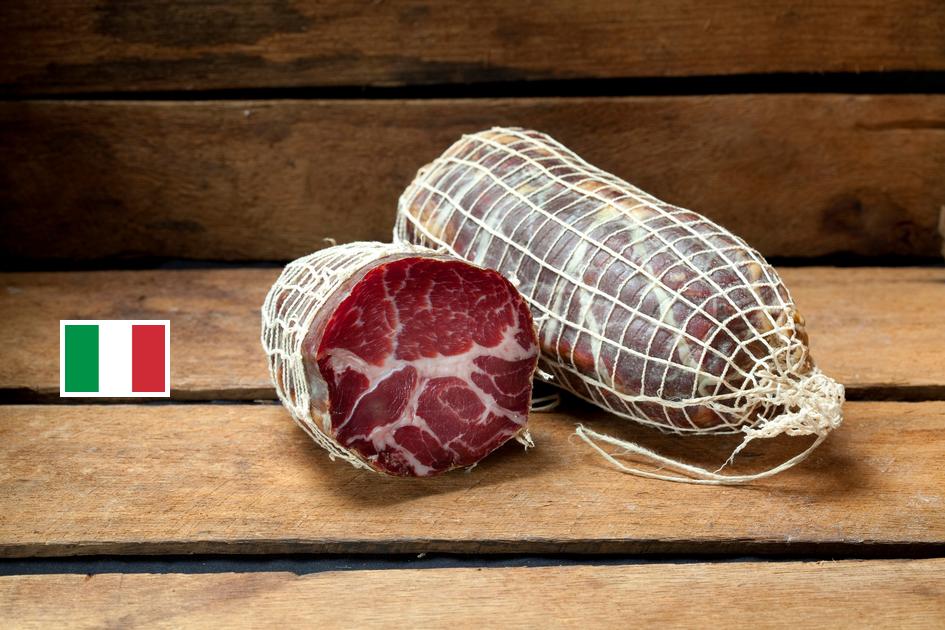
Head south into Campania, Calabria, Basilicata, and Puglia, and the name shifts to capocollo or capicollo. So does the character of the product. Southern Italian versions tend to be bolder — often rubbed with chili, sometimes smoked, more assertive in flavor. In Calabria specifically, the use of local peperoncino gives the capocollo a red-tinged exterior and a heat that lingers pleasantly. When I visited Calabria and tasted capocollo made by a small producer in the hills near Cosenza, it had a depth I hadn’t encountered before — smoky, spicy, and somehow also sweet from the quality of the pork itself.
In the Itria Valley in Puglia, around the town of Martina Franca, there’s a particularly celebrated tradition. Local pigs are slow-marinated and then smoked with fragno oak bark, a regional variety that imparts a distinctive forest aroma to the finished product. Producers like Salumi Cervellera, a family-run operation in Martina Franca, have kept these methods intact for generations. The result is something you’d recognize as capocollo, but with a smokiness and complexity that’s entirely its own.
Capicollu — Corsica’s Version
Cross the water to Corsica and you’ll find capicollu, the island’s take on this same tradition. Corsican charcuterie has deep Italian roots — the island was Genoese for centuries before becoming French — and capicollu reflects that heritage while incorporating local mountain pork and island-specific curing methods.
Lonza — The One That’s Actually Different
You’ll sometimes see lonza mentioned in the same conversation as coppa and capocollo. This one is actually a different cut — made from the loin or shoulder rather than the neck — and it’s leaner, with a firmer texture and a milder flavor. If you’re looking for that rich, marbled character that defines capicola at its best, lonza is not your answer. Worth trying on its own terms, but don’t confuse them.
The History Behind the Name
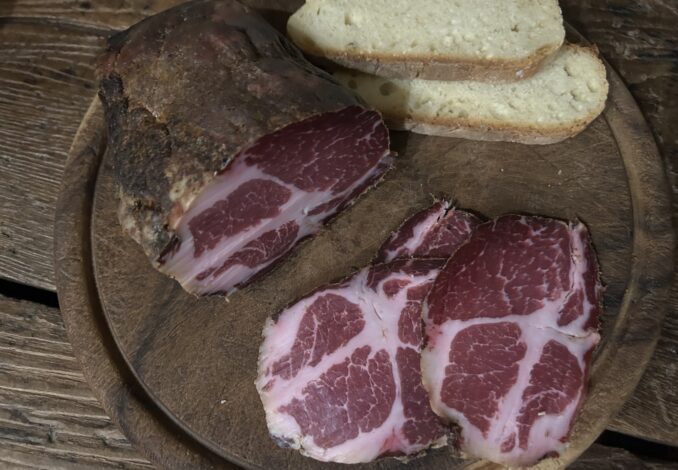
Capicola is not a recent invention. It traces back to ancient Rome, where cured pork was a practical solution for feeding soldiers on long campaigns — portable, shelf-stable, and dense with calories and protein. It required no refrigeration, which made it ideal for armies moving through the Italian peninsula and beyond.
Over time it moved from military ration to table delicacy. By the medieval period, it had become associated with wealth and celebration in southern Italy, where the tradition of using large, mature pigs — at least eight months old and over 300 pounds — was established as the standard for quality. The bigger, older pig carries more intramuscular fat, which translates directly into tenderness and flavor in the finished product.
Italian emigrants carried the tradition with them. In Argentina, a version called bondiola became embedded in the local food culture. In the United States, particularly in cities like New York, Philadelphia, and Boston where southern Italian immigrants settled in large numbers, capicola took root — and eventually became gabagool, adapted to the phonetics of Neapolitan dialect spoken by those communities.
My grandmother Julia encountered Italian food through the Italian immigrant community in Valparaíso, Chile, and while she didn’t make capicola herself — that’s a project requiring weeks and specialized conditions — she understood instinctively how to use it. Thin slices layered onto bread with good olive oil, or draped over a plate of olives and cheese. She treated it as something to be respected, not buried under other flavors.
How Capicola Is Made
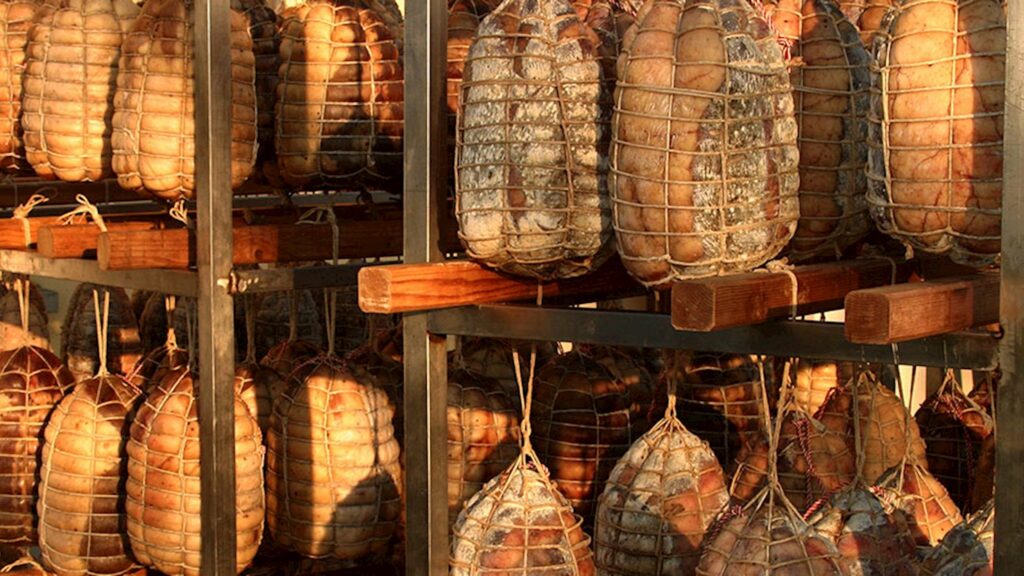
The production process is slower than you might expect, and that patience is exactly what creates the final result.
Step 1: Selecting and Trimming the Cut
The neck and upper shoulder muscles are separated from the carcass. Quality producers pay close attention to breed here — pigs with more intramuscular fat, like the Mangalitsa, produce superior results. The muscle is trimmed but not stripped of its fat cap.
Step 2: Salting
The meat is packed in salt and left for anywhere from four days to two weeks, depending on the producer and regional tradition. Black peppercorns are almost always part of this cure. The salting draws out moisture and begins the preservation process. After salting, the meat is typically wrapped in the pig’s diaphragm — a traditional casing that helps regulate moisture loss during curing.
Step 3: Spicing and Rubbing
Once the initial cure is complete, the exterior gets rubbed with spices. This is where regional character takes shape. In Calabria, that means peperoncino. In Puglia, it might mean fennel, black pepper, and wine. In the north, the rub is lighter, often just pepper and perhaps a touch of wine. Some producers return to rub the casing by hand every few days during the early aging period.
Step 4: Binding and Piercing
The wrapped meat is tied with natural twine into its characteristic cylindrical shape, then the casing is perforated with a needle to allow gases to escape and air to circulate during the long aging period.
Step 5: Drying and Aging
This is the slow part. Minimum aging is 100 days in a ventilated room with controlled temperature and humidity. Many traditional producers go longer. Southern-style capocollo may also undergo smoking with fragno or other woods during this phase. The controlled environment is everything — too much humidity invites the wrong molds, too little dries the exterior too fast and prevents proper aging in the interior.
How to Buy Capicola
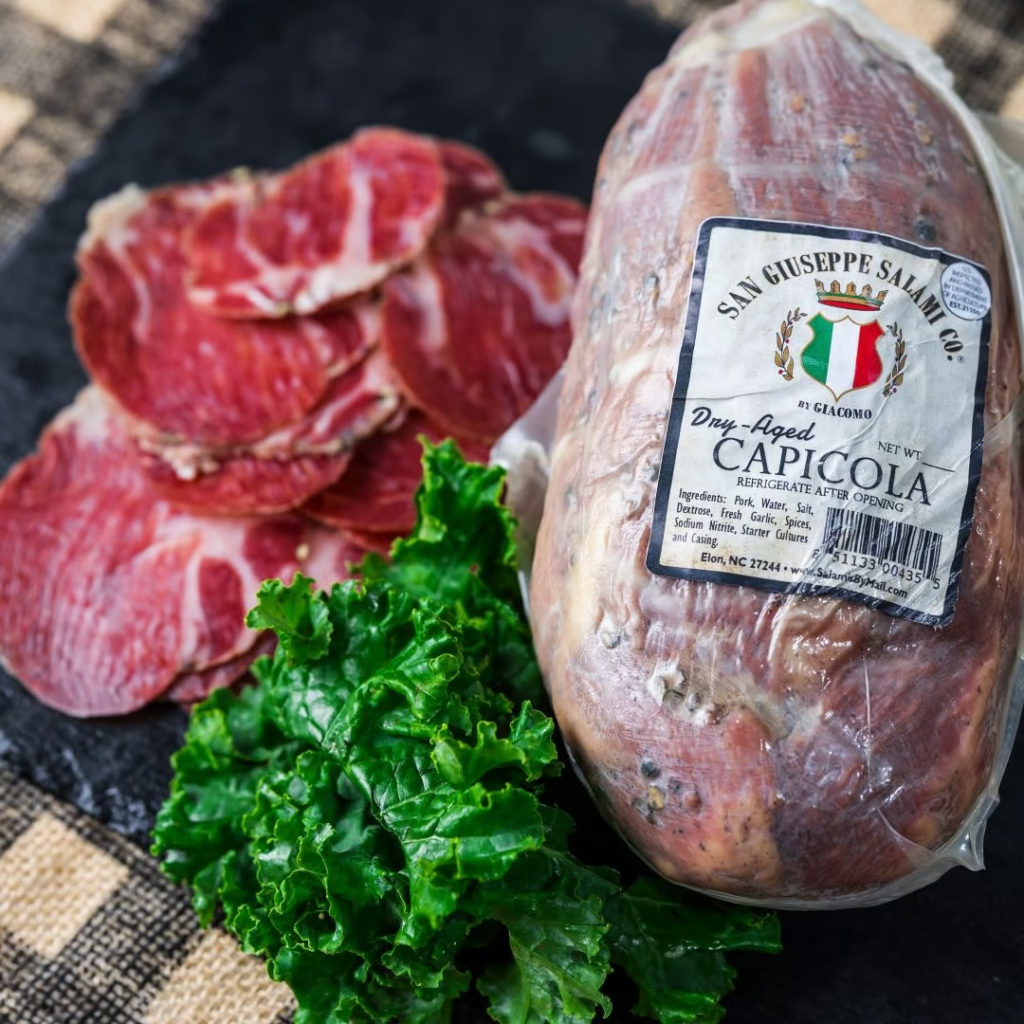
At the Sacramento Italian market, I’ve compared several brands side by side over the years, and the differences between a quality capicola and a mediocre one are significant enough to be worth paying attention to when you’re shopping.
Look for these things:
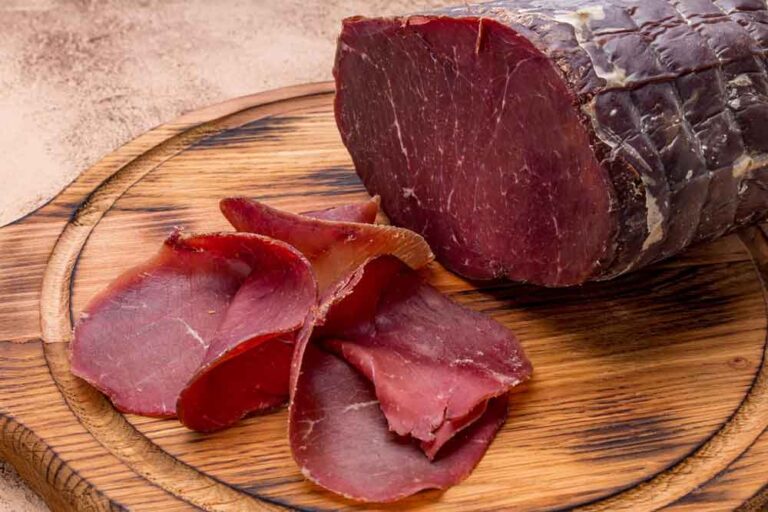
- Color: A good capicola has a vivid, deep red color in the lean sections, not brown or grey. The fat should be creamy white or very pale pink, not yellow or waxy.
- Marbling: You want to see fat running through the lean in irregular veins, not concentrated only in one section. That marbling is what delivers tenderness.
- Origin: If you can find southern Italian capocollo from producers who use traditional methods and local pigs, start there. Salumi Cervellera from Martina Franca is worth seeking out if you can find it through specialty importers.
- Slice thickness: Ask the counter to slice it thin — paper thin if possible. This cut is not meant to be eaten in thick chunks. The texture and fat distribution only work properly when it’s sliced correctly.
- Smell before you buy: If you’re at a counter where you can ask for a sample, the aroma should be clean, slightly nutty, faintly sweet from the fat. Any sour or off notes are a red flag.
After testing several brands side by side, I’ve found that imported Italian capocollo consistently outperforms domestic versions, not because American producers can’t make good cured meat — they can — but because the traditional southern Italian versions built around specific pigs, specific regional spices, and specific curing environments have a depth of flavor that’s genuinely hard to replicate.
How to Use Capicola
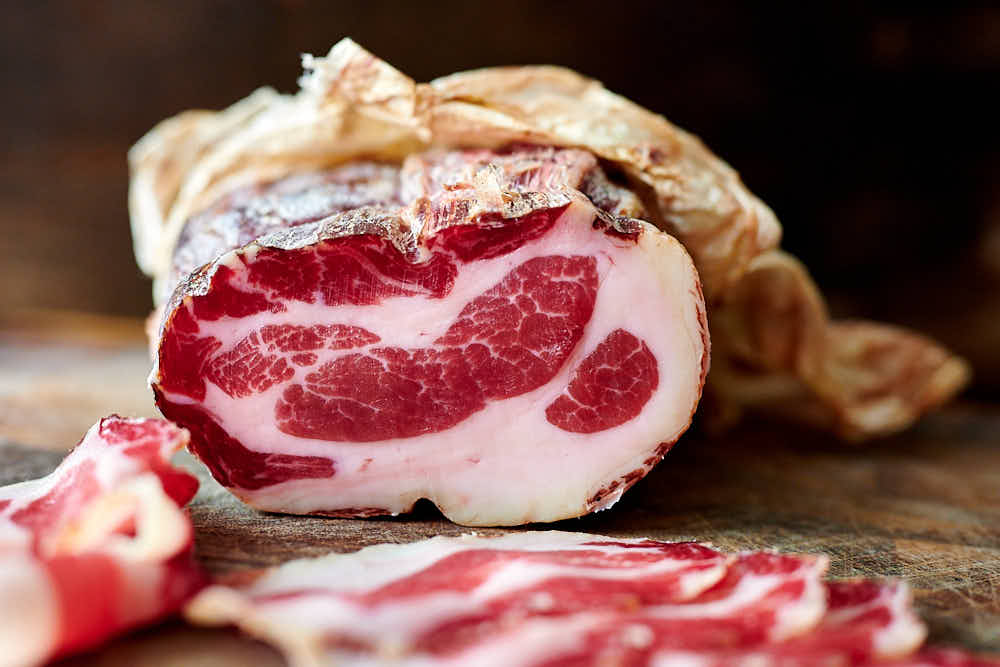
The one I keep in my kitchen is almost always eaten the simplest way possible: thin slices laid out at room temperature with some good bread, maybe a few olives, and a glass of something worth drinking. That’s not laziness — it’s respect for a product that took months to make.
That said, here are the most useful applications:
- Charcuterie boards: Capicola is a natural anchor for any Italian-focused board. Its fat content means it holds up well at room temperature for an hour or two, while prosciutto tends to dry out faster.
- Sandwiches: Layer it thin onto good bread — ciabatta, a sesame semolina loaf — with fresh mozzarella and roasted peppers. This is the Italian-American sandwich at its best.
- Antipasto plates: Alongside pickled vegetables, olives, and hard cheeses, capicola functions beautifully. The fat in the meat balances the acidity of the pickles.
- Pizza: Added after baking rather than before, so the delicate fat doesn’t render off under high heat. Lay slices over a hot pizza fresh from the oven and let them just warm through.
- Pasta: Torn into small pieces and added to a simple tomato sauce, capicola adds a complexity that’s different from guanciale or pancetta — more fragrant, slightly more assertive.
My grandmother Julia would have used it exactly the way she used any good cured meat: sparingly, without apology, as the main event rather than a supporting player.
How to Store Capicola
If you’ve purchased a whole unsliced piece, keep it hanging in a cool, well-ventilated spot — a cellar or cool pantry works well. Wrap the cut end in wax paper or butcher paper rather than plastic to allow the meat to breathe.
Once sliced, the rules change. Store sliced capicola in the refrigerator, wrapped well, and eat it within three to five days for the best quality. The fat begins to oxidize once the surface is exposed, and while it won’t hurt you after a few days in the fridge, the flavor starts to go flat. Remove it from the refrigerator at least 20 to 30 minutes before eating — cold fat is muted fat, and you want that richness to be present when you eat it.
Vacuum-sealed packaged capicola keeps longer — follow the date on the package — but always let it come to room temperature before serving. This is non-negotiable.
Common Mistakes People Make with Capicola
Slicing It Too Thick
This is the most common error. Capicola sliced at sandwich-meat thickness loses its textural character entirely. You end up with something chewy and one-dimensional. Thin, almost translucent slices let the fat and lean interact properly in your mouth.
Eating It Cold Straight from the Fridge
Already mentioned above, but worth repeating: cold fat doesn’t express itself. The flavor of capicola opens up dramatically at room temperature. Give it time.
Confusing It with Coppa di Testa
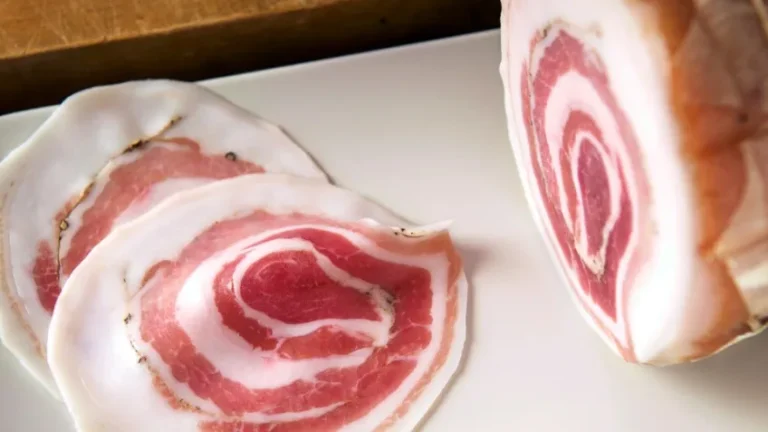
Coppa di testa is headcheese — a completely different product made from the meat and gelatin of the pig’s head, pressed into a loaf. The word “coppa” appears in the name, which causes endless confusion. If you order coppa expecting sliced cured muscle and get a gelatinous terrine, you ordered the wrong thing. Know your coppa.
Cooking with It When You Don’t Have To
Capicola is a finished product. It doesn’t need heat to be safe or to taste good — it’s already cured and aged. When people cook it aggressively, they lose the delicate fat and the nuance that makes it worth buying. Use heat only when the recipe specifically benefits from it, and even then, use gentle heat.
Buying Pre-Sliced When You Can Get It Cut Fresh
Pre-sliced, pre-packaged capicola is convenient but inferior. The exposed surface area in a package of pre-sliced meat means faster oxidation and moisture loss. When you have access to a counter that will slice it fresh, use it.
In the end, whether you call it capicola, coppa, capocollo, or gabagool, what you’re dealing with is one of the great achievements of Italian curing tradition — a product built on patience, quality pork, and regional knowledge that goes back centuries. José Villalobos has eaten versions of this in Italian markets in Sacramento and in small towns in Calabria and Puglia, and the thread that connects them all is that same fundamental craft: good pig, good salt, good time. Everything else is accent.
For more on Italian cured meats and how they fit together, head back to the full guide.
Frequently Asked Questions
How should I ask for capicola at my local deli to make sure I get the right thing?
Use “capicola” or “coppa” — most American delis recognize both. If you want to be specific about quality, ask if they carry Italian-made versions versus domestic. The name doesn’t matter as much as knowing whether it’s been properly aged and sliced thin. That’s what separates good capicola from mediocre stuff.
Can I use capicola and prosciutto interchangeably in recipes?
Not really. Prosciutto is leaner and more delicate, while capicola has that 30% fat content that gives it richness and body. In a sandwich, they work differently — capicola’s texture holds up better to other ingredients. For wrapping around fruit or melon, prosciutto’s lighter flavor is more traditional.
What’s the difference between how Northern and Southern Italian capicola are made?
Northern versions tend to be more heavily spiced and sometimes include wine in the curing process. Southern Italian capicola, especially from Calabria, relies more on heat and smoke during aging, which deepens the flavor. The cut itself is the same, but the finishing techniques create distinct taste profiles.
Why do some capicola have a reddish color and others look darker?
The color depends on the curing spices used and how long it’s aged. Red-tinted versions typically use paprika or other red peppers in the rub. Darker capicola usually means heavier spicing or smoke exposure during aging. Both are legitimate — it’s just a reflection of regional style preferences.
Is “gabagool” really just a mispronunciation, or is it something different?
It’s the same product — just how Southern Italian dialects sound when spoken. Neapolitan speakers drop final vowels and soften consonants naturally, so capicola becomes gabagool. It’s not wrong or lesser; it’s the actual way people from that region have always said it.
Written by José Villalobos
José Villalobos is a food writer and the founder of Calitalia Food. He grew up in Valparaíso, Chile, where his grandmother Julia cooked Italian food daily from memory and instinct. Based in Sacramento, California, he visits local Italian markets weekly and writes about ingredients, sauces, and regional food culture with the kind of detail that comes from years of sourcing, testing, and eating. Every product he recommends, he has personally bought and tested.