If you’ve eaten carbonara, amatriciana, or cacio e pepe, you’ve already tasted the DNA of pasta alla gricia without knowing it. This is the dish those famous Roman pastas were built on — older than the tomato’s arrival in Europe, older than carbonara by centuries, and somehow still the least talked-about of the four great Roman pastas. That’s a shame, because Gricia is extraordinary on its own terms. Salty cured pork jowl, sharp Pecorino Romano, black pepper, and nothing else. No eggs. No tomatoes. No shortcuts. Just technique and quality ingredients doing exactly what they’re supposed to do.
I first started paying close attention to gricia after a conversation at my local Sacramento Italian market, where the owner slid a vacuum pack of imported guanciale across the counter and said, “You know what this is really for, right? Not carbonara. Gricia.” That sent me down a months-long research spiral that eventually shaped everything I cook and write about Roman pasta.
My grandmother Julia cooked Italian food in Valparaíso, Chile, and while she never made gricia by name, the instinct she had — fat, cheese, pepper, pasta water — was exactly right. She just didn’t know what to call it.
This guide covers everything: where pasta alla gricia came from, how to make it properly, what to buy, what to avoid, and why it deserves a permanent spot in your cooking rotation.
What Is Pasta alla Gricia?
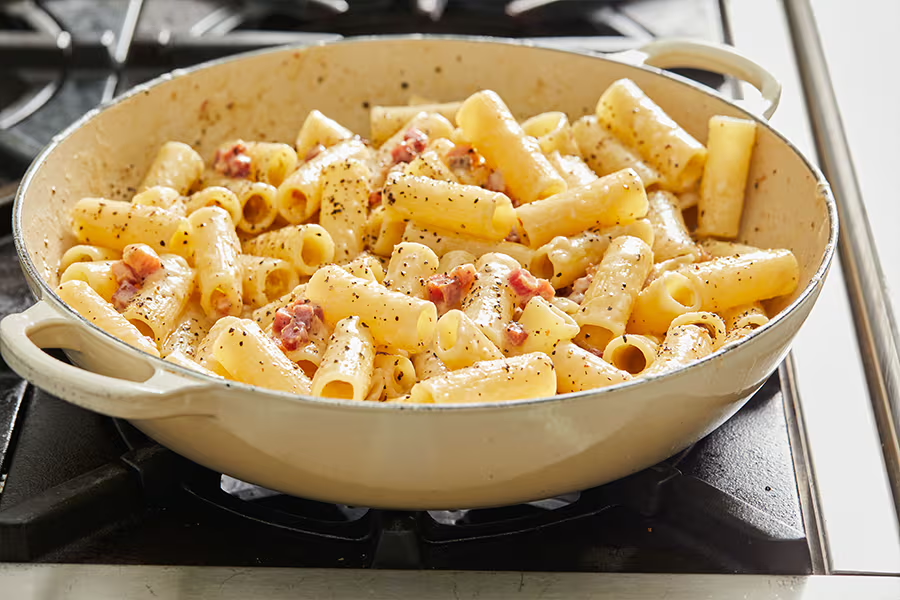
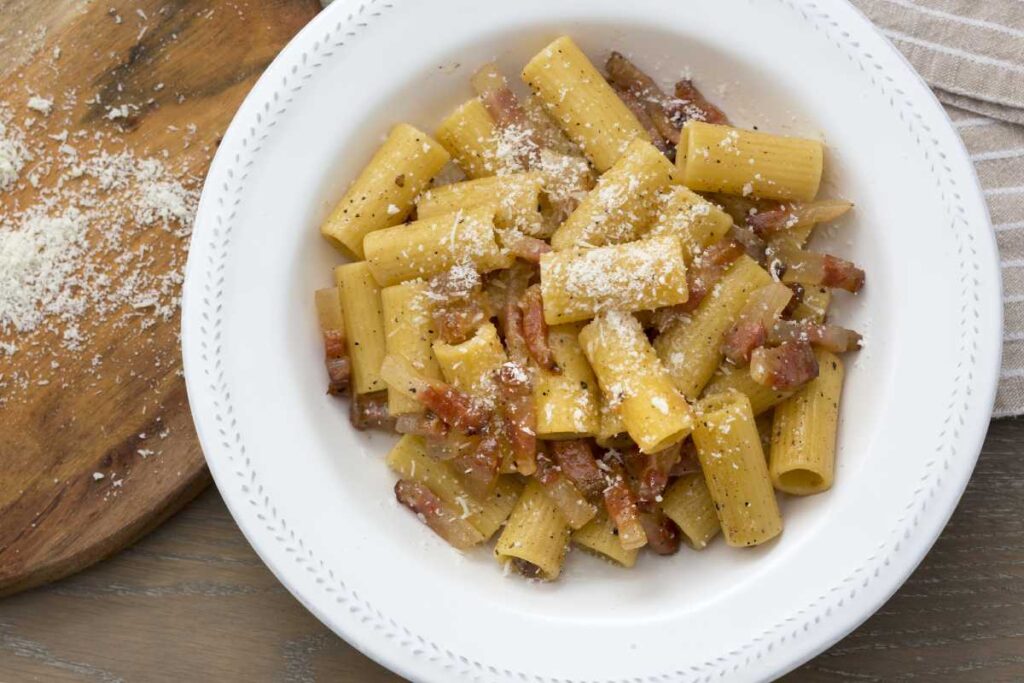
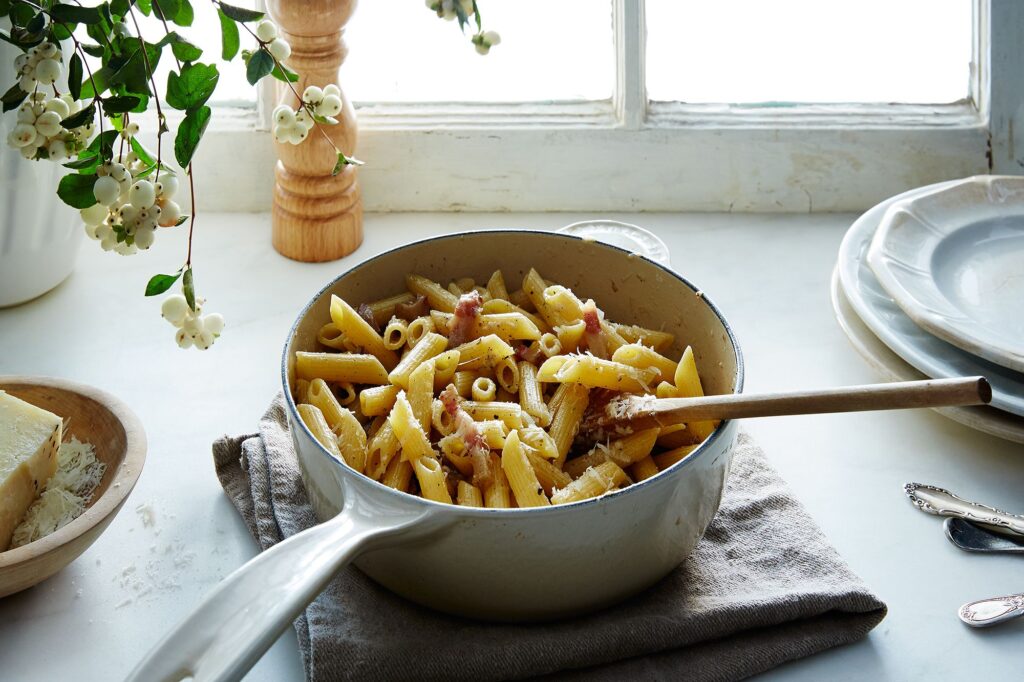
Pasta alla gricia is a Roman pasta dish made from exactly four components: guanciale (cured pork jowl), Pecorino Romano cheese, black pepper, and pasta. That’s it. No cream, no butter, no garlic, no onion. The sauce is built from rendered guanciale fat emulsified with starchy pasta cooking water and grated cheese, creating a coating that’s rich and silky without being heavy.
It’s often described as “amatriciana bianca” — white amatriciana — because it’s essentially the same dish as amatriciana before tomatoes entered the picture. That framing is useful, but it also undersells gricia a little. This isn’t a stripped-down version of something else. It’s the original, and it stands completely on its own.
The texture is the first thing that surprises people. Done right, pasta alla gricia isn’t dry or clumpy — the rendered fat and cheese combine into something almost glossy, clinging to every ridge and curve of the pasta. Done wrong, it’s a pile of oily noodles with cheese stuck to the bottom of the pan. The difference between those two outcomes is almost entirely about temperature control and pasta water. More on that in a moment.
The History and Origins of Pasta alla Gricia
The history here is genuinely interesting, and a little contested, which is exactly what you’d expect from a dish this old.
Where Did Gricia Come From?
The dish almost certainly originated in and around Amatrice, a town sitting at the geographic border between Lazio and Abruzzo in the province of Rieti. Today Amatrice is better known internationally for the devastating 2016 earthquake that largely destroyed it, but culinarily it’s always been the epicenter of this particular corner of Roman food culture.
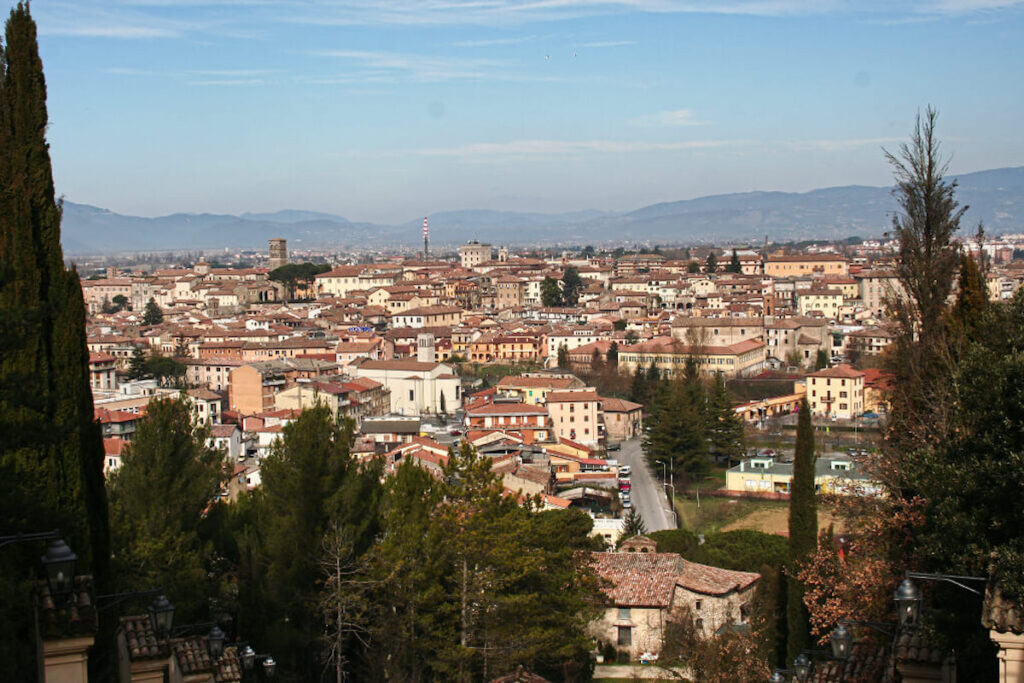
The most widely accepted origin story links the dish to Grisciano, a small hamlet near Amatrice. Every August 18th, Grisciano holds its own food festival — the Sagra della Gricia — celebrating the dish as local heritage. That’s a pretty strong territorial claim.
There are competing etymological theories, though. One school of thought traces the word “gricia” to “gricio,” a term used in ancient Rome for street food vendors and bread sellers — people who made simple, portable food from a handful of inexpensive ingredients. Another theory points to “griscium,” a gray flour-dusted garment worn by Roman mill workers. All three theories have their advocates, and none completely cancels out the others.
How Old Is This Dish, Really?
Most food historians place the likely origin of pasta alla gricia somewhere in the 1400s, though some push it back much further — as far as the 5th century A.D., when the basic ingredients (cured pork, aged cheese, black pepper) were all available and in regular use in central Italy. What’s not disputed is that gricia predates both carbonara and amatriciana significantly. Carbonara as we know it dates to the 1940s. Amatriciana couldn’t have existed before tomatoes arrived in Europe in the 16th century. Gricia has neither of those constraints.
The most credible origin narrative positions gricia as shepherd food — specifically the food of Lazio’s pastori laziali, the shepherds who practiced transhumance, the seasonal migration of livestock between lowland and mountain pastures. These men needed food that was calorie-dense, non-perishable, and simple to prepare over a fire in the mountains. Dried pasta, a piece of guanciale, a wedge of aged Pecorino, black pepper. Everything they needed fit in a pack and kept for weeks without refrigeration. This is peasant ingenuity at its most practical and delicious.
Gricia’s Place in Roman Pasta Tradition
Roman food culture treats pasta alla gricia as the foundational recipe — the root from which the other three famous Roman pastas branch out. Add tomatoes to gricia and you get amatriciana. Add eggs and you get something close to carbonara. Strip out the guanciale and focus entirely on the cheese and pepper, and you move toward cacio e pepe (though food historians still argue about which of those two came first — it’s genuinely unresolved, a true chicken-and-egg situation). Some culinary traditions document up to 50 regional variations built on the gricia template. The point is that you can’t really understand Roman pasta as a system without understanding gricia first.
How to Make Pasta alla Gricia
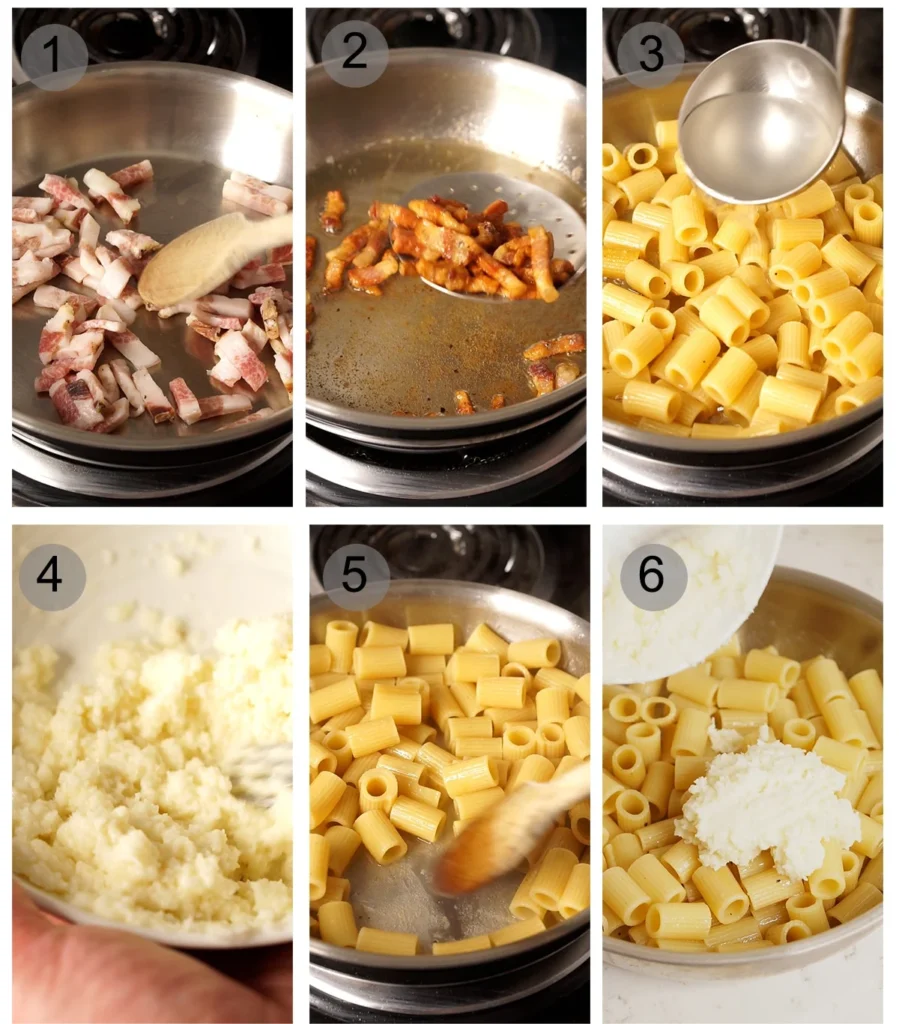
The technique here is everything. The ingredient list is so short that there’s nowhere to hide if something goes wrong, and the most common problems all trace back to the same source: heat management and pasta water timing.
The Ingredients You Need
- Guanciale: Not pancetta, not bacon. Guanciale, which is cured pork jowl. The fat-to-meat ratio is higher than pancetta, and the flavor is distinctly different — richer, more deeply porky, slightly sweeter. This is non-negotiable for an authentic result. At the Sacramento Italian market, I’ve compared several brands, and imported Italian guanciale consistently outperforms domestic versions in both flavor and the quality of fat rendered. The one I keep in my kitchen is from a small Italian producer that the market imports directly — the fat runs clear and sweet, and it crisps without turning tough.
- Pecorino Romano: Aged, sharp, salty sheep’s milk cheese. It needs to be grated very finely — almost powdery — so it dissolves into the sauce rather than clumping. Avoid the pre-grated canisters entirely; they contain anti-caking agents that will break your sauce.
- Black pepper: Freshly ground, and more than you think you need. The pepper isn’t a garnish here — it’s a structural flavor. Toast whole peppercorns briefly in a dry pan before grinding for a noticeably deeper result.
- Pasta: Rigatoni and spaghetti are the most traditional choices. Rigatoni’s ridges and hollow center catch the sauce exceptionally well. Tonnarelli (thick square-cut spaghetti) is another Roman classic. Whatever shape you choose, cook it in well-salted water — though note that guanciale and Pecorino are both quite salty, so taste before adding any additional salt at the end.
The Method, Step by Step
Cut the guanciale into thick lardons or strips — somewhere between a quarter and half an inch wide. Start them in a cold pan over medium-low heat. This slow start allows the fat to render gradually without burning the meat. As the fat runs and the guanciale begins to crisp at the edges, you’ll build the base of your sauce. Once it’s golden and slightly crispy, remove the guanciale from the pan and set it aside, leaving the rendered fat behind.
While the pasta cooks, grate your Pecorino very finely and combine it with freshly ground black pepper. Add a few tablespoons of pasta cooking water to make a loose paste. This is what creates the creamy texture — the starch in the water suspends the cheese fat in a stable emulsion.
When the pasta is two minutes from done, pull it directly into the pan with the guanciale fat over very low heat. Add a good ladle of pasta water. Toss constantly. The goal is to finish cooking the pasta in the fat while the starch thickens the liquid. Remove from heat entirely before adding the cheese mixture — this is critical. If the pan is too hot, the cheese seizes and turns grainy. Off the heat, with constant movement and a splash more pasta water if needed, you build the sauce. Return the guanciale. Serve immediately.
How to Buy the Right Ingredients
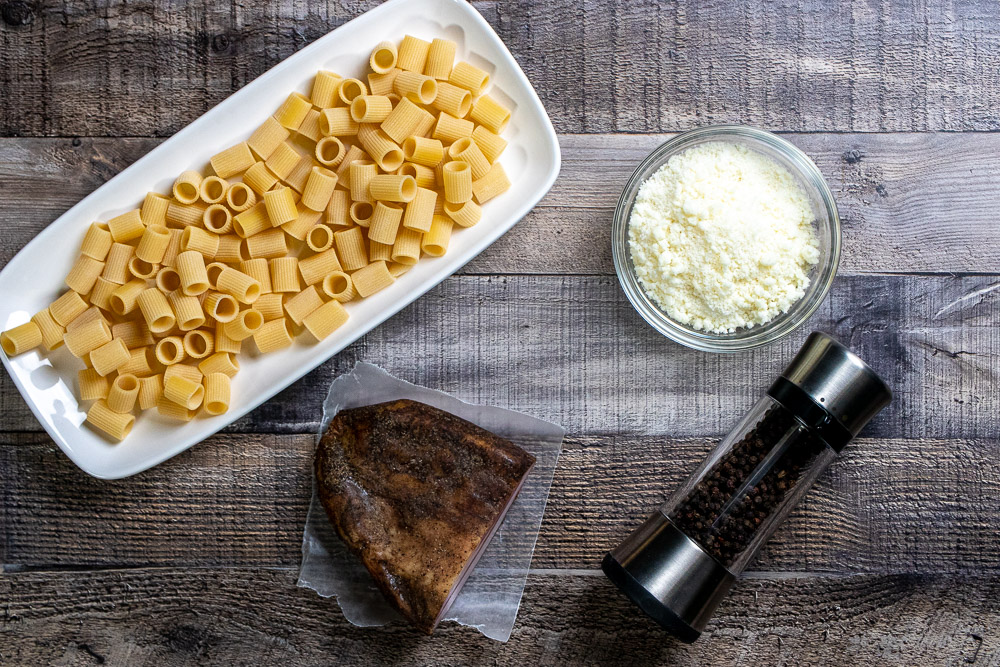
For a dish this simple, sourcing matters more than almost anything else. After testing several brands side by side over the past year, I’ve landed on a few consistent conclusions.
For guanciale, buy imported Italian if you can find it. Domestic artisan options are improving, but there’s still a gap. A well-stocked Italian deli or specialty market is your best source. The guanciale should be firm and well-cured with a thick cap of white fat and a layer of dark, cured meat. Avoid anything that looks wet or smells overly acidic.
For Pecorino Romano, look for wheels or wedges labeled “DOP” — that designation protects the name and guarantees the cheese was produced in Lazio, Sardinia, or the Grosseto province of Tuscany under regulated conditions. The cheese should be hard and dry, with a sharp, almost briny flavor. Brands like Fulvi (from Lazio) and traditional Sardinian Pecorino are both excellent. My grandmother Julia would have recognized this kind of cheese immediately — she kept something very similar in Valparaíso, imported through the Italian community there.
For the pasta, use a bronze-die-extruded brand. The rough surface created by bronze dies holds sauce dramatically better than the smooth surface from Teflon-coated industrial dies. Brands like Rustichella d’Abruzzo, Benedetto Cavalieri, or De Cecco’s better lines are all widely available and reliably good.
How to Store Gricia Ingredients
Guanciale keeps well. An unopened vacuum-packed piece will last weeks in the refrigerator and months in the freezer without significant quality loss. Once opened, wrap it tightly in parchment and then plastic and use it within ten days to two weeks.
A wedge of Pecorino Romano, wrapped in parchment and then loosely in plastic, keeps for several weeks in the coldest part of your refrigerator. Don’t seal it airtight — the cheese needs to breathe slightly. If a little white mold appears on the surface, simply cut it off; the interior is fine.
Cooked pasta alla gricia does not store particularly well, and I’d argue it’s not worth attempting. The sauce is a delicate emulsion that breaks as it cools and doesn’t recover properly when reheated. Make what you’ll eat. This is a dish built for the moment it’s served.
Common Mistakes to Avoid
- Using pancetta or bacon instead of guanciale: The fat composition is genuinely different. Pancetta is leaner, cooks differently, and produces a less characteristic flavor. Bacon adds smoke, which completely changes the profile. Guanciale is not interchangeable here.
- Adding the cheese over high heat: This is the most common technical mistake. Pecorino Romano will clump and turn grainy if the pan is too hot when you add it. Always take the pan off the heat completely before adding the cheese mixture.
- Not saving enough pasta water: The starchy cooking water is the emulsifier that holds everything together. Save at least a full cup before you drain, and don’t be shy about using it.
- Using pre-grated cheese: Anti-caking agents prevent the cheese from melting smoothly into the sauce. Grate it yourself, fine.
- Under-seasoning with pepper: This isn’t a dish where pepper is background noise. It should be present and assertive. If you taste it and think “that’s about right,” add more.
- Overcrowding the pan when rendering guanciale: Give the pieces space. Crowded guanciale steams instead of crisping and doesn’t develop the right texture or depth of flavor.
Why Pasta alla Gricia Deserves More Attention
When I visited Calabria and spent time with local cooks, what struck me most was how much respect they had for dishes that asked for very little but demanded your full attention. Pasta alla gricia is exactly that kind of dish. Four ingredients, one pan, twenty minutes. But every one of those twenty minutes matters. The temperature when you render the guanciale matters. The moment you take the pan off heat before adding the cheese matters. The amount of pasta water you add and when you add it matters.
That’s not a reason to be intimidated by it — it’s a reason to find it interesting. There’s real craft inside something this stripped-down, and once you understand what you’re doing and why, you’ll find that the same logic applies to cacio e pepe, to carbonara, to every dish that asks fat and starch to become something unified and smooth.
I make pasta alla gricia probably once a week at this point. I pick up guanciale at the Sacramento Italian market on my regular Saturday run, I keep a wedge of DOP Pecorino Romano in my refrigerator almost always, and there’s never a night when I can’t put together something genuinely excellent with those two things and thirty minutes. José Villalobos has eaten in some beautiful restaurants across Italy and eaten some extraordinary food, but there’s something specifically satisfying about this one — a dish that shepherds made in the mountains, that predates the tomato, that forms the foundation of an entire regional pasta tradition, and that you can make in your home kitchen on a Tuesday night with ingredients that fit in a grocery bag.
My grandmother Julia used to say that the best Italian food was always the food that looked the simplest. She was right about that. She usually was.
Back to the full Italian pasta sauces guide
Frequently Asked Questions
Can I substitute guanciale with bacon or pancetta if I can’t find it?
Technically you can, but you’re fundamentally changing the dish. Guanciale has a different fat composition and flavor profile — it’s more delicate and complex than bacon. Pancetta is closer, but still not quite right. I’d rather see someone order guanciale online than settle for a substitute that compromises what makes gricia special.
Why does my gricia end up oily and separated instead of creamy?
Temperature control is everything. If your pan is too hot, the cheese breaks and the fat separates. Keep the heat moderate, add your pasta water gradually while tossing constantly, and finish with a bit of reserved starchy water off the heat. The emulsion needs gentle handling — think of it like making mayonnaise.
Is pasta alla gricia actually eaten in Rome today, or is it just a historical curiosity?
Romans still eat it regularly, though carbonara and amatriciana overshadow it on most menus. You’ll find it in traditional trattorias, and locals definitely order it. It’s less about curiosity and more about regional preference — people gravitate toward the more famous variations because that’s what they grew up with.
How is gricia different from cacio e pepe if they’re both made without tomato or meat?
Cacio e pepe has no meat at all — it’s cheese and pepper on pasta. Gricia adds rendered guanciale fat, which creates richness and umami that changes the entire character. Think of gricia as the meatier, more indulgent cousin. Both are spectacular, but they’re solving different flavor problems.
What type of Pecorino Romano should I buy, and does the brand really matter?
Look for Pecorino Romano DOP (Protected Designation of Origin) from Italy — it has stricter production standards. Domestic versions vary wildly in quality and sharpness. I’ve found that imported blocks grated fresh work better than pre-grated cheese, which often has anti-caking agents that prevent proper emulsification with the fat and water.
Written by José Villalobos
José Villalobos is a food writer and the founder of Calitalia Food. He grew up in Valparaíso, Chile, where his grandmother Julia cooked Italian food daily from memory and instinct. Based in Sacramento, California, he visits local Italian markets weekly and writes about ingredients, sauces, and regional food culture with the kind of detail that comes from years of sourcing, testing, and eating. Every product he recommends, he has personally bought and tested.