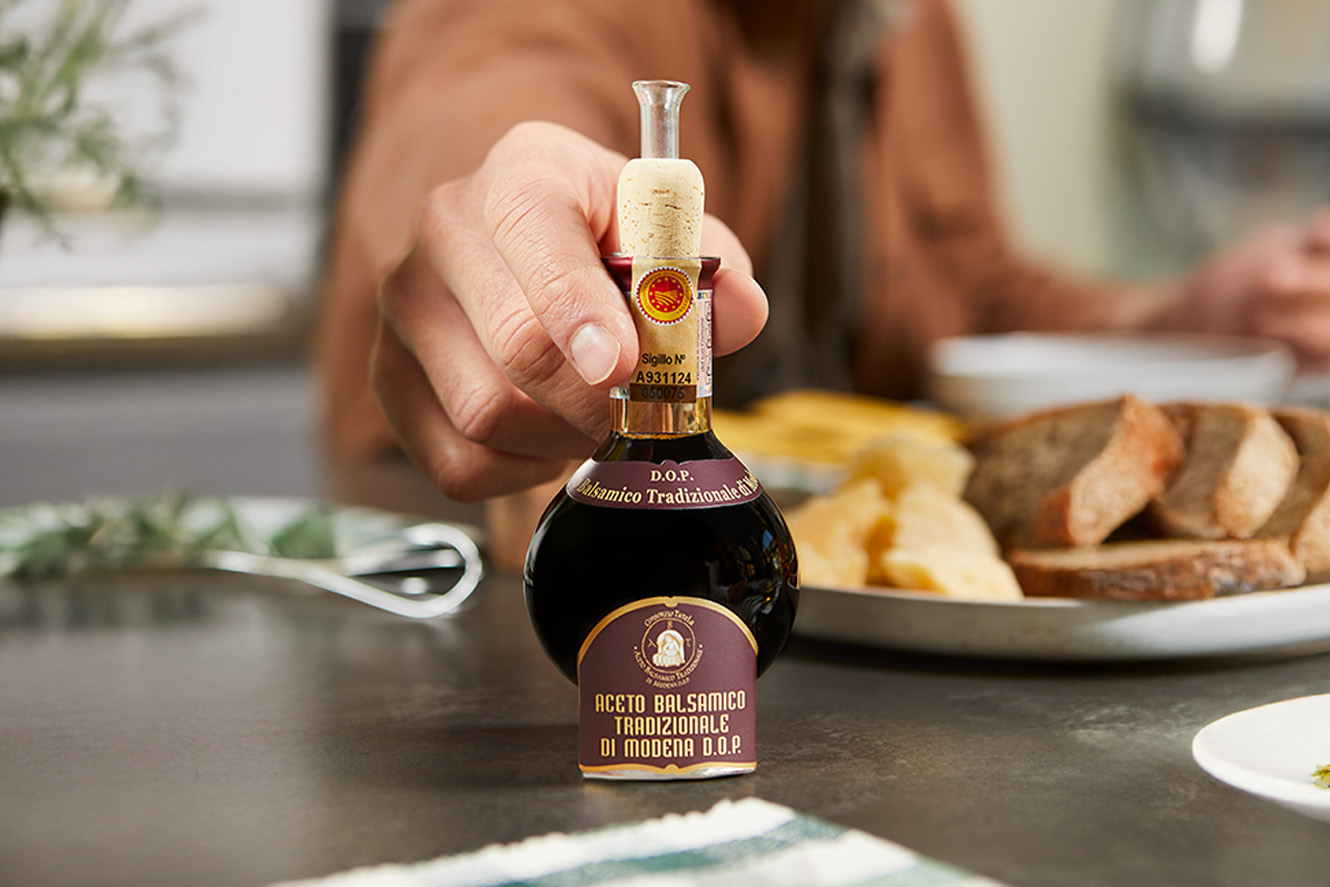
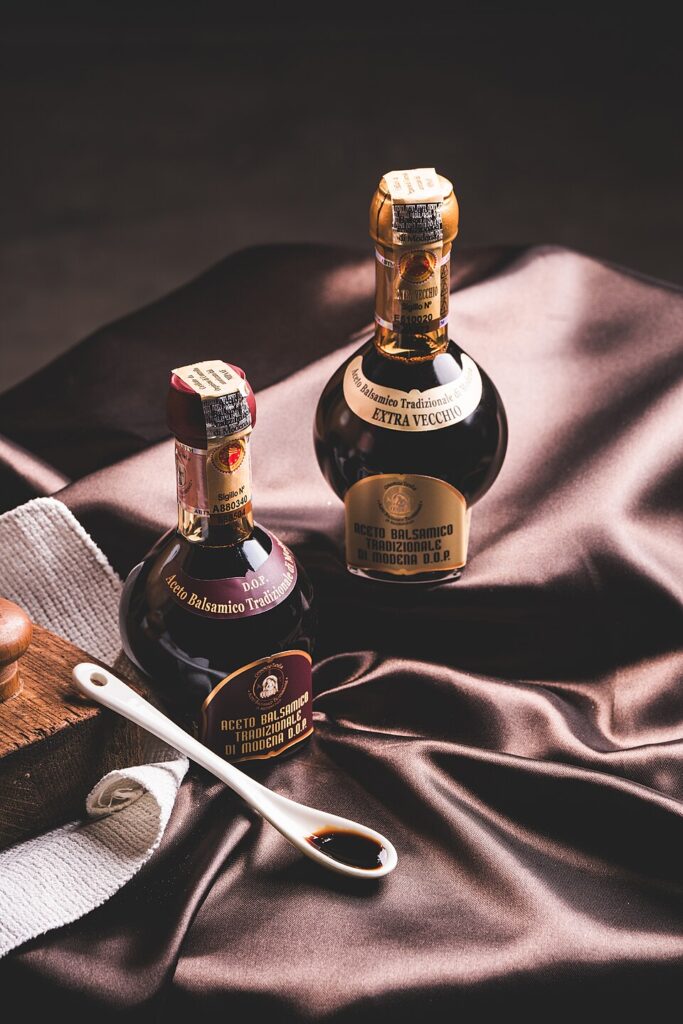
If you’ve ever stood in a grocery store aisle staring at a wall of bottles labeled “balsamic vinegar,” wondering why they range from $3.99 to $180, you’re not alone. The answer lives in three words: aceto balsamico tradizionale. What’s in that tiny, distinctive bottle — shaped like an upside-down tulip — has almost nothing in common with the dark, syrupy stuff sold next to the salad dressings. One is a centuries-old artisan product from Emilia-Romagna, aged for a minimum of 12 years and tasted by a panel of experts before it ever touches a bottle. The other is, frankly, a marketing exercise.
I’m José Villalobos, and I’ve been writing about Italian food for years — shaped in large part by my grandmother Julia, who cooked Italian food in Valparaíso, Chile, with a seriousness that I didn’t fully appreciate until I was an adult. This guide is going to settle the confusion once and for all.
What Is Aceto Balsamico Tradizionale?
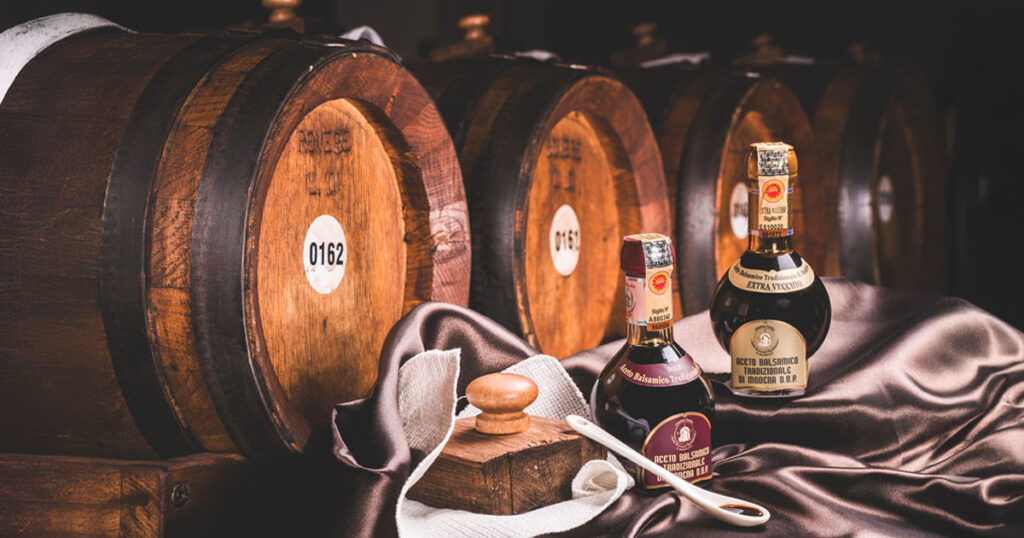
Aceto balsamico tradizionale is a protected condiment produced exclusively in two areas of the Emilia-Romagna region in northern Italy: Modena and Reggio Emilia. It is made entirely from cooked grape must — freshly crushed grape juice, skins, seeds, and stems — that is slowly reduced over heat, then fermented, acidified, and aged for a minimum of 12 years in a series of progressively smaller wooden barrels called a batteria.
That’s it. No wine vinegar added. No caramel coloring. No thickeners. No shortcuts. Just grape must and time.
The result is a complex, viscous, dark condiment with a perfect balance of sweet and sour — something that genuinely cannot be replicated industrially, no matter how hard the food industry tries. And believe me, they try.
A History That Goes Back Further Than You Think
Ancient Roots in Roman Cooking
The story of aceto balsamico tradizionale doesn’t start in a medieval Italian farmhouse — it starts with the ancient Romans. The practice of cooking grape must down into a thick, sweet substance was well established in Roman culinary culture. They called it sapum, and it was used as both a medicine and a cooking ingredient. The technique of reducing must — known as defrutare — laid the direct foundation for what would eventually become the product we know today.
The Este Family and the Birth of a Tradition
The first documented reference to balsamic production in the modern sense dates to 1046. But the tradition really took its current shape in 1598, when Modena became the capital of the Ducato Estense. The ruling Este family merged vinegar-making traditions from Ferrara with local Modenese recipes, and the product that emerged would be recognizable to anyone who has tasted traditional balsamic today.
The word “balsamico” itself didn’t appear in writing until 1747, when it showed up in the estate records of the Este dukes — specifically the terms mezzo balsamico and balsamico fine, which correspond roughly to what we now call Aceto Balsamico di Modena IGP and Aceto Balsamico Tradizionale di Modena DOP.
The Letter That Defined a Standard
In 1862, an advocate and agronomist named Francesco Aggazzotti wrote a detailed letter to a colleague named Pio Fabriani, laying out what he called the “perfect recipe” for aceto balsamico tradizionale di Modena. That letter was published and eventually became the foundation for the production standards and the DOP regulations that protect the product today. The following year, chemist Fausto Sestini conducted the first scientific analysis of traditional balsamic, demonstrating once and for all that it was categorically different from ordinary vinegar.
This is not a product someone invented. It evolved, over centuries, through the hands of noble families, peasant farmers, and meticulous artisans. My grandmother Julia, who could find the good olive oil in any Chilean market from ten feet away, would have understood this instinctively.
DOP vs IGP — Understanding the Labels
The Gold Standard: DOP
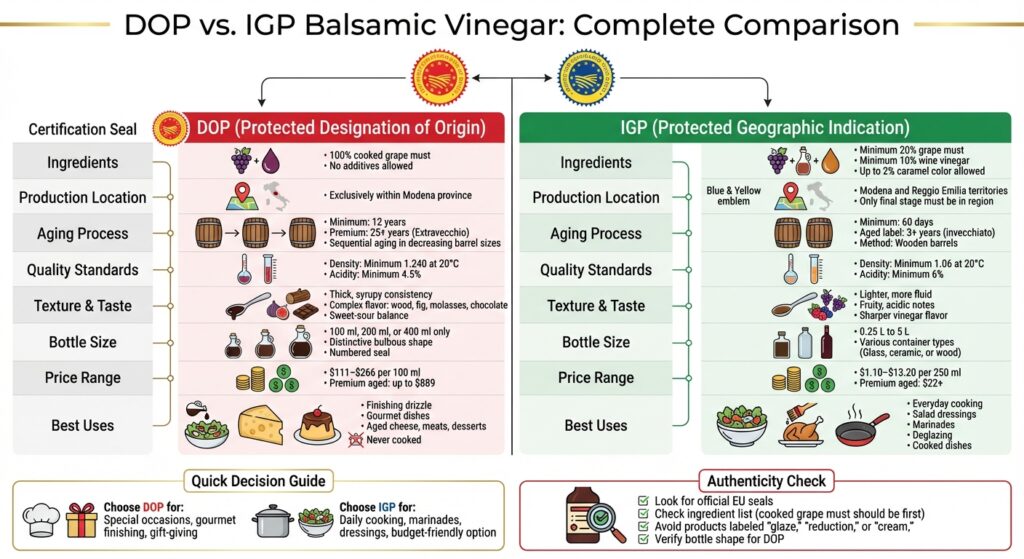
Aceto Balsamico Tradizionale di Modena DOP (Protected Designation of Origin) and its counterpart Aceto Balsamico Tradizionale di Reggio Emilia DOP represent the highest tier. These products must be made entirely from cooked grape must, aged for a minimum of 12 years, and approved by an official tasting panel before bottling. The affinato (refined) designation means at least 12 years of aging. The extravecchio (extra old) designation means a minimum of 25 years.
These products are sold exclusively in the officially approved bottle — designed by Giorgetto Giugiaro for Modena, and a distinctive amphora shape for Reggio Emilia. You cannot legally sell aceto balsamico tradizionale DOP in any other container.
The Middle Ground: IGP
Aceto Balsamico di Modena IGP (Protected Geographical Indication) is a different product entirely — though it uses similar language on the label. It can include a blend of cooked must and wine vinegar, with a much shorter aging period (as little as 60 days). It’s still a regulated product with geographic protection, and a well-made IGP balsamic is genuinely good for everyday cooking. But calling it the same thing as DOP tradizionale is like calling a student sketch the same as a Caravaggio because both use paint.
The Fake: Commercial Balsamic
Everything else — the $4 bottle, the “balsamic glaze” in the squeeze bottle, the stuff that’s 90% red wine vinegar with caramel coloring and glucose syrup — is neither DOP nor IGP. It may say “balsamic vinegar of Modena” in small print somewhere, or it may say nothing at all. At the Sacramento Italian market, I’ve compared several brands side by side, and the difference in flavor, texture, and complexity is not subtle. It’s shocking. The commercial products taste sharp, flat, and sweet in a cloying way that has nothing to do with the layered acidity and fruit of a real tradizionale.
How Aceto Balsamico Tradizionale Is Made
Starting with the Must
Production begins in autumn with the harvest of specific grape varieties — primarily Lambrusco and Trebbiano in Modena, Spergola and Berzemino in Reggio Emilia. The freshly pressed grape juice, complete with skins and seeds, is cooked slowly in open copper pots until it reduces by roughly 30 to 50 percent. This cooking concentrates sugars, deepens color, and begins the transformation of raw juice into something with real character.
The Batteria — A Set of Barrels That Becomes a Family Heirloom
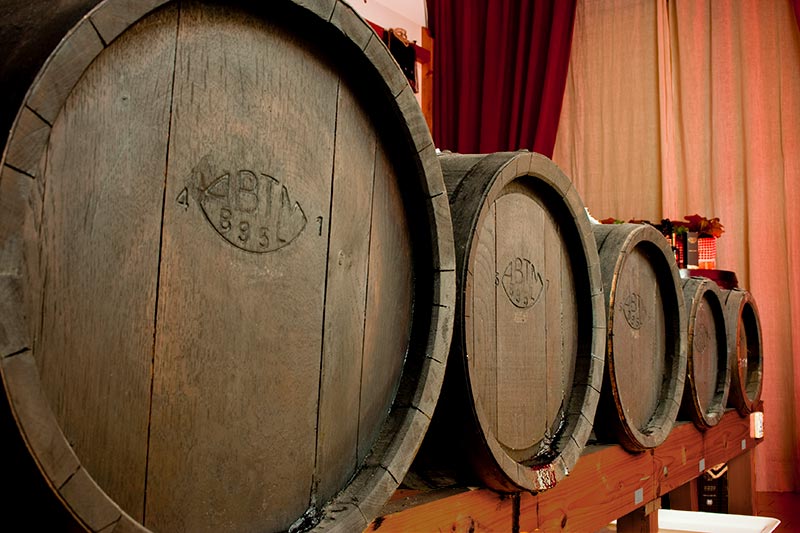
The cooked must is then transferred into the largest barrel of a batteria — a set of five to seven barrels of decreasing size, each made from a different wood. Typical woods include oak, chestnut, cherry, mulberry, and juniper, each contributing different aromatic compounds to the aging liquid over time.
Each year, the producer draws off a small amount of the most-aged vinegar from the smallest barrel — this is what eventually gets bottled. Then the smallest barrel is topped up from the next, that barrel from the next, and so on, with fresh cooked must added to the largest barrel. It’s a perpetual cycle, which is why truly old batteries may contain liquid that has been in continuous production for generations.
The Tasting Panel
Before a tradizionale DOP can be bottled, it must pass evaluation by an official consortium tasting panel. They assess appearance, density, color, aroma, and flavor. The product must meet strict minimum scores across all categories. If it doesn’t pass, it doesn’t get the DOP designation — no exceptions.
How to Buy the Real Thing
What to Look For
Buying genuine aceto balsamico tradizionale requires knowing what you’re looking at. Here’s what to check:
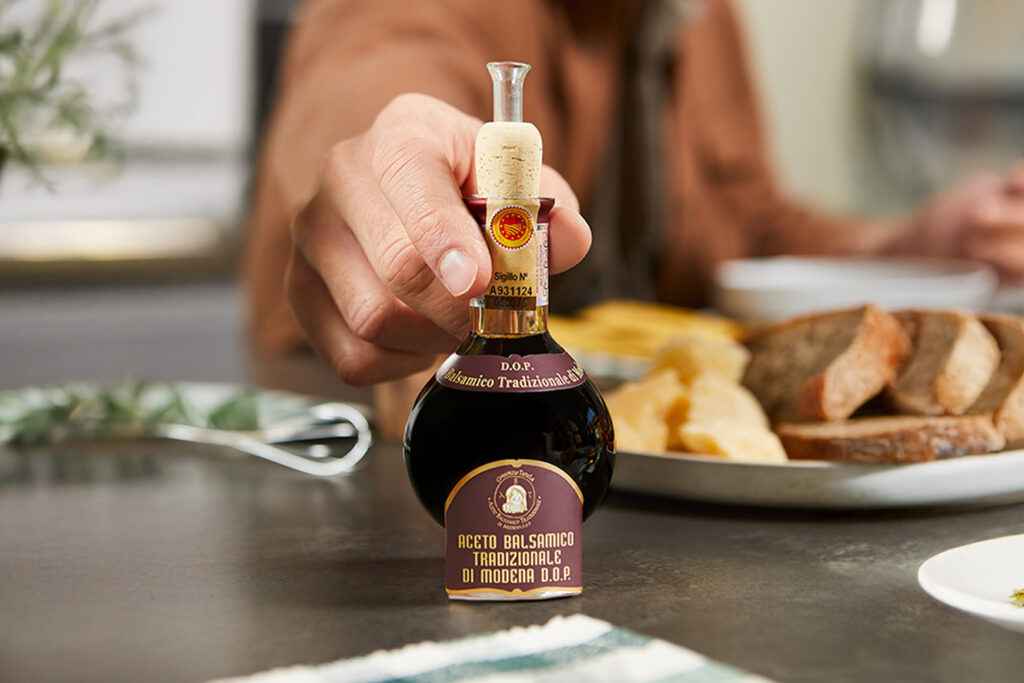
- The bottle shape: Tradizionale di Modena DOP comes in the official 100ml tulip-shaped bottle. Tradizionale di Reggio Emilia DOP comes in its own official amphora bottle. If the bottle looks like a regular vinegar bottle, it’s not tradizionale DOP.
- The DOP seal: Look for the official DOP certification on the label or cap.
- The consortium label: Modena products carry a label from the Consorzio Produttori Aceto Balsamico Tradizionale di Modena. Reggio Emilia products carry theirs from the Consorzio Tutela Aceto Balsamico Tradizionale di Reggio Emilia.
- The price: Genuine affinato (12 years) tradizionale will typically cost $50 to $100 USD for 100ml. Extravecchio (25+ years) can run well over $150. If the price seems too good, it isn’t tradizionale.
Where to Buy It
Specialty Italian food shops, reputable online Italian importers, and serious cheese shops are your best bets. At the Sacramento Italian market, I’ve compared several brands and found at least two reliable tradizionale options that are the genuine article. Chain grocery stores almost never carry it. When they claim to, read the label with skepticism.
After testing multiple brands side by side — ranging from a young affinato from a small Modenese producer to an extravecchio from a consortium-certified family operation — the differences within the DOP category itself are fascinating. Older product is noticeably more complex, woodier, and deeply sweet without being cloying. The one I keep in my kitchen is a 12-year affinato from Modena that I reorder every year. It lasts me about six months because I use it sparingly, which is exactly how it should be used.
How to Use Aceto Balsamico Tradizionale
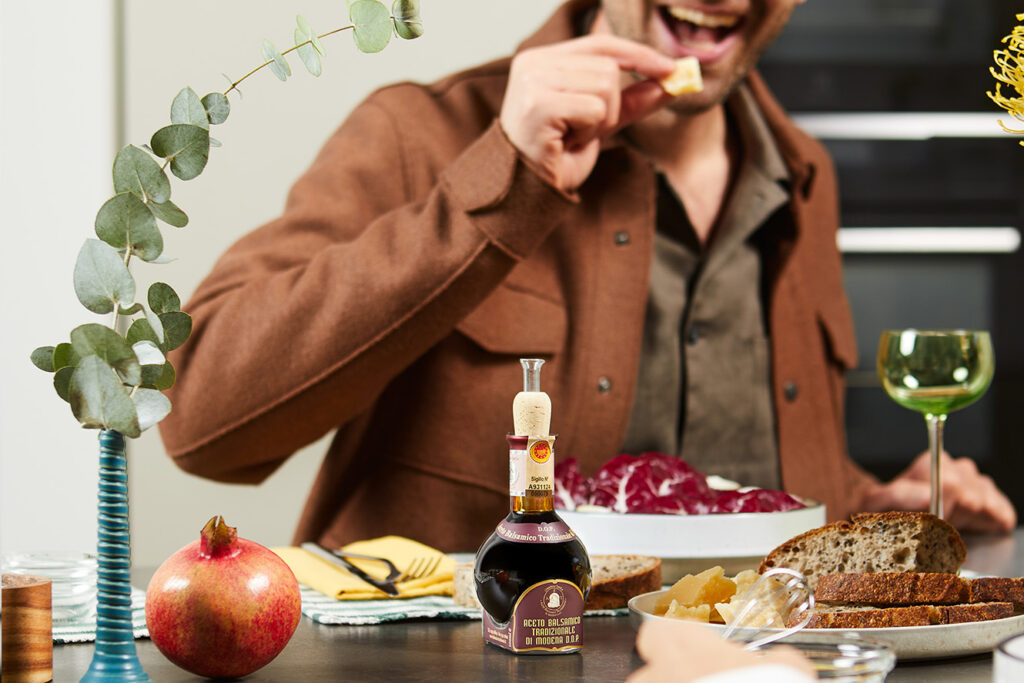
Here is the most important thing I can tell you: tradizionale is a finishing condiment, not a cooking ingredient. You do not reduce it. You do not use it in marinades. You do not drizzle it over a pizza that’s going back in the oven. Heat destroys the volatile aromatics that make it extraordinary.
Classic Uses
- A few drops on Parmigiano-Reggiano: This is the traditional pairing, and it exists for good reason. The salt and fat of the cheese and the sweet-sour depth of the vinegar are one of the great combinations in all of food.
- Over grilled or roasted meats: A few drops on a bistecca, a pork loin, or a lamb chop at the moment of serving.
- On fresh strawberries: With or without a little black pepper. My grandmother Julia made something similar with a local vinegar in Valparaíso — when I finally tasted the real thing, I understood what she’d been reaching for.
- On risotto: Finished at the table, not stirred in during cooking.
- Over vanilla gelato: Controversial to some, revelatory to everyone who tries it.
How Much to Use
Less than you think. We’re talking about a few drops — sometimes as few as three or four — deployed with a small spoon or the dropper that some bottles include. This is not a condiment you pour. It is a condiment you place.
How to Store It
Aceto balsamico tradizionale is remarkably stable. Store it at room temperature, away from direct light and heat. The traditional bottle’s stopper is usually a cork or a small cap — keep it sealed between uses. It does not need refrigeration, and refrigerating it can actually affect the texture and aroma.
A properly stored bottle will keep essentially indefinitely. It may continue to develop complexity over years in your home, which is a beautiful thought — something in your pantry still quietly aging.
Common Mistakes to Avoid
- Using it in salad dressing: That’s what IGP or commercial balsamic is for. Tradizionale belongs on finished dishes, not emulsified into a vinaigrette.
- Buying it based on price alone: Some expensive balsamics are still not tradizionale DOP. Price is necessary but not sufficient. Check the bottle and the label.
- Confusing “aged” with “tradizionale”: Commercial producers use the word “aged” freely. Aged in a tank for six months is not the same as 12 years in a batteria of hardwood barrels.
- Storing it in the refrigerator: Unnecessary, and potentially counterproductive.
- Using it in large quantities: This signals either a misunderstanding of the product or an extremely generous budget.
- Buying it as a gift without the context: If you give someone tradizionale, tell them what it is. Otherwise there’s a real chance it ends up in a pasta sauce and disappears without a trace of its 25 years of existence being appreciated.
- Using it in salad dressing: That’s what IGP or commercial balsamic is for. Tradizionale belongs on finished dishes, not emulsified into a vinaigrette.
- Confusing “aged” with “tradizionale”: Commercial producers use the word “aged” freely. Aged in a tank for six months is not the same as 12 years in a batteria of hardwood barrels.
- Storing it in the refrigerator: Unnecessary, and potentially counterproductive.
- Using it in large quantities: This signals either a misunderstanding of the product or an extremely generous budget.
- Buying it as a gift without the context: If you give someone tradizionale, tell them what it is. Otherwise there’s a real chance it ends up in a pasta sauce and disappears without a trace of its 25 years of existence being appreciated.
The Bottom Line
Aceto balsamico tradizionale is one of the most extraordinary condiments on earth — a product that requires specific geography, specific grapes, specific wooden barrels, and a minimum of 12 years of patient attention before a drop of it leaves Emilia-Romagna. When I visited Liguria and tasted local producers talking about their connections to Modenese families with acetaie going back generations, I understood that this isn’t just food — it’s a living document of Italian agricultural culture.
The fake stuff isn’t inherently evil. A good IGP balsamic has its place in a vinaigrette or a quick pan sauce. But calling it the same thing as tradizionale DOP is a disservice to everyone who has spent decades tending those barrels. My grandmother Julia didn’t have access to the real thing in Valparaíso, but she understood the principle: real food takes time, and time cannot be faked. José Villalobos — that’s a lesson she passed down that I carry into every pantry conversation I write.
Buy the real thing once. Use it properly. You’ll understand immediately.
Back to the full Italian pantry guide
Frequently Asked Questions
Why does real balsamic need to age for exactly 12 years?
The 12-year minimum allows the grape must to develop complex flavors that can’t be rushed. During this time, the liquid concentrates as it moves through wooden barrels, losing water while gaining depth. Before 12 years, it simply hasn’t had enough time to achieve the balance of sweetness and acidity that defines authentic tradizionale.
Can I make balsamic vinegar at home, or is it really exclusive to Italy?
You can make vinegar at home, but you cannot legally call it aceto balsamico tradizionale — that designation is protected by law and only applies to products from Modena and Reggio Emilia. The specific terroir, grape varieties, and aging traditions tied to those regions create something you genuinely can’t replicate elsewhere, even with the same methods.
What’s actually in the cheap “balsamic” sold at supermarkets?
Most commercial balsamic starts with wine vinegar, then gets thickened with cornstarch or guar gum and darkened with caramel coloring to look the part. Some producers add grape juice for sweetness. It’s fundamentally different from tradizionale, which contains only cooked grape must and nothing else.
How do I know which barrel size I’m buying, and does it matter?
The label should indicate whether it’s aged 12, 18, or 25+ years — longer aging means smaller barrels and more concentration. A 25-year bottle will be thicker and more intense than a 12-year. The color also darkens with time. Start with a 12-year if you’re new to it; the difference is noticeable but not as pricey.
Is there a real difference between Modena and Reggio Emilia balsamic?
Both must meet the same minimum aging requirements and quality standards, but they come from slightly different grape varieties and local production methods. Modena tends toward deeper complexity, while Reggio Emilia is sometimes described as slightly more delicate. The difference is subtle — choosing between them matters less than choosing tradizionale over commercial imposters.
Written by José Villalobos
José Villalobos is a food writer and the founder of Calitalia Food. He grew up in Valparaíso, Chile, where his grandmother Julia cooked Italian food daily from memory and instinct. Based in Sacramento, California, he visits local Italian markets weekly and writes about ingredients, sauces, and regional food culture with the kind of detail that comes from years of sourcing, testing, and eating. Every product he recommends, he has personally bought and tested.