
It’s green, it’s garlicky, it’s unmistakably Italian. But Pesto alla Genovese is more than a beloved pasta companion—it’s a cultural emblem. Rooted in the rugged terrain of Liguria, this sauce represents not just the flavor of a region, but the ingenuity of its people.
To understand, we will dive into the history of Pesto alla Genovese, geography, agriculture, and tradition blended, literally and figuratively—to create one of the most iconic condiments in the world. In this post, we’re diving into the story behind the sauce: its evolution, the people who shaped it, and how it came to represent the very soul of Ligurian cuisine.

The History of Pesto alla Genovese – Liguria: Where It All Began
Tucked between the Alps and the Mediterranean Sea, Liguria is a narrow crescent-shaped region in northwestern Italy. Its capital, Genoa, was once one of the most powerful maritime republics in Europe. The land is steep and difficult to farm, but incredibly fertile, blessed with:

Liguria’s geography shaped its cuisine: resourceful, seasonal, and rich in flavor. The scarcity of arable land meant people had to make the most of what they had. Pesto, made from local herbs, nuts, and cheeses, was the perfect expression of this philosophy.
In my kitchen, I have tested both the mortar-and-pestle method and the food processor side by side.
Ancient Roman Roots – The Predecessor: Moretum
Long before anyone in Genoa mashed basil with a mortar and pestle, Romans were making a sauce called moretum. This paste-like condiment was made from:
• Garlic
• Olive oil
• Cheese
• Various herbs (but no basil)
• Sometimes vinegar or nuts
Moretum was typically spread on bread or used to season vegetables and meats. It was portable, non-perishable, and high in fat—ideal for soldiers and farmers alike.

A famous Latin poem—once attributed to Virgil—describes a farmer making moretum in great detail, emphasizing the pounding and mixing motions that still define pesto today.
The Introduction of Basil
Basil didn’t appear in Europe until the Middle Ages, when it traveled from India and North Africa via the spice trade. It was cultivated in monastery gardens and prized for its aromatic and medicinal properties.
By the 15th century, basil had become a fixture in Ligurian gardens. Thanks to the region’s warm, humid microclimate, Ligurian basil developed:
• Smaller leaves
• Sweeter, more delicate aroma
• Bright green color
• Minimal bitterness

This Genovese basil (now a DOP-protected variety) became the signature herb of the region—and pesto’s defining ingredient.
First Recorded Recipe – 19th Century Genoa

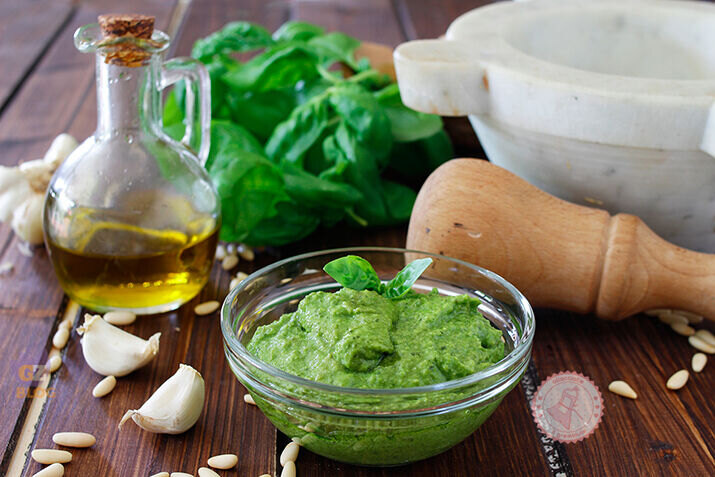
Although pesto was likely made in Ligurian homes for centuries, the first written recipe appeared in 1863 in La Cuciniera Genovese by Giovanni Battista Ratto. His version included:
• Garlic
• Basil
• Dutch cheese and Parmigiano
• Pine nuts
• Butter (yes, butter!)
• Olive oil
Notably, this version was less standardized than today’s Pesto alla Genovese. Cheeses were used based on availability, and butter was added as a luxury item. But the method—crushing ingredients into a paste—remained the same.
Later editions of the recipe gradually dropped butter and specified Pecorino Fiore Sardo and Parmigiano-Reggiano, solidifying the “modern” formula.
Why Genoese Pesto Took Hold
So why did pesto alla Genovese rise to fame, while other regional sauces faded?
Because it was:
• Simple – made with ingredients every Ligurian family had
• Shelf-stable – preserved under olive oil for months
• Nutrient-dense – with fats, protein, and salt
• Delicious – unmatched aroma and flavor
As Genoa remained a maritime hub, pesto traveled across the Mediterranean, and eventually across the Atlantic with Italian immigrants. Unlike many regional dishes, pesto adapted easily to foreign kitchens.

It didn’t need fire. It didn’t need meat. It just needed a mortar, good basil, and time.
The Role of the Mortar and Pestle
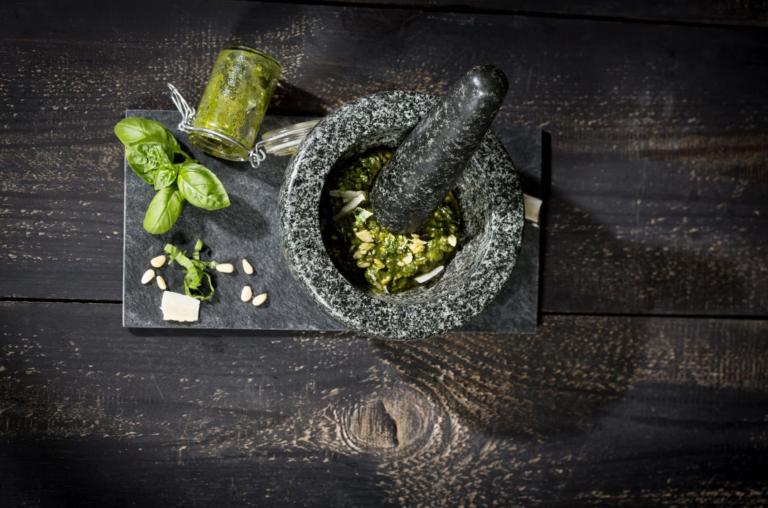
The traditional tool for making pesto is the mortar (mortaio) and pestle (pestello), ideally:
• A marble mortar for stability and cooling
• A wooden pestle to avoid metallic flavors
Ligurians still swear by this method. Crushing ingredients rather than cutting them creates:
• A coarse but creamy texture
• Layered flavor release
• Reduced oxidation
Modern chefs using food processors risk heat damage, over-blending, and a loss of flavor complexity.

Every two years, Genoa holds the World Pesto Championship, where competitors from around the globe use only mortars and pestles—proving that tradition still rules.
The UNESCO Bid and Culinary Legacy
In 2018, Genoa formally submitted Pesto alla Genovese to UNESCO for consideration as intangible cultural heritage. The bid highlighted:
• The ritual of hand-making pesto
• The use of local ingredients
• Its role in community identity
• The oral transmission of recipes through generations
While the application is still under review, the move reflected what Ligurians already knew: pesto isn’t just food—it’s a cultural treasure.
Today, pesto is served:
• With trofie pasta (a Ligurian staple)
• On focaccia
• In minestrone (as a finishing swirl)
• On fish, potatoes, and beans (a classic combo)

It’s deeply woven into the daily life of Genoa and beyond.
More Than a Sauce
The history of Pesto alla Genovese is a story of survival, adaptation, and celebration. It’s the ultimate example of peasant ingenuity turned gourmet masterpiece. From ancient garlic pastes to DOP-certified basil, from marble mortars to TikTok tutorials—pesto has evolved without ever losing its soul.
Every time you make it, eat it, or share it, you’re continuing a tradition that started long before you—and will continue long after. That’s the true power of pesto: not just its flavor, but its legacy.
Disclosure: Our blog contains affiliate links to products. We may receive a commission for purchases made through these links. However, this does not impact our reviews and comparisons. We try our best to keep things fair and balanced, in order to help you make the best choice for you.
Written by José Villalobos — Food writer and founder of Calitalia Food. Based in Sacramento, CA. Read more →