
How to Read an Italian Ingredient List, and What Should Not Be In It
The additives, bulking agents and cheaper swaps that separate a real Italian product from an imitation, in the order they appear on a label, and how to judge a list before you buy.
The ingredient list is the most reliable part of an Italian food label, because unlike the phrases on the front it is regulated, ordered by weight and difficult to write misleadingly. Learning to read it in order is the single most useful buying skill on this site. It is the most direct way of telling the authentic article from the imitation.
The traditional versions of almost every product covered here have very short lists. That is the pattern the whole method rests on.
Why the list beats the front of the pack
Ingredient lists are ordered by weight, descending, and that ordering is enforced. The claims on the front are not ordered, not weighted and mostly not enforced.
This means a producer can put a beautiful phrase and a tricolour on the front while the back reveals that the second ingredient is sunflower oil. Both are legal, and only one of them is telling you what is in the jar.
Short lists are the signal. The traditional versions of Italian pantry products are short by construction: pesto is seven ingredients, colatura is two, prosciutto is two. A long list on a product whose traditional form is short is the most reliable warning available.
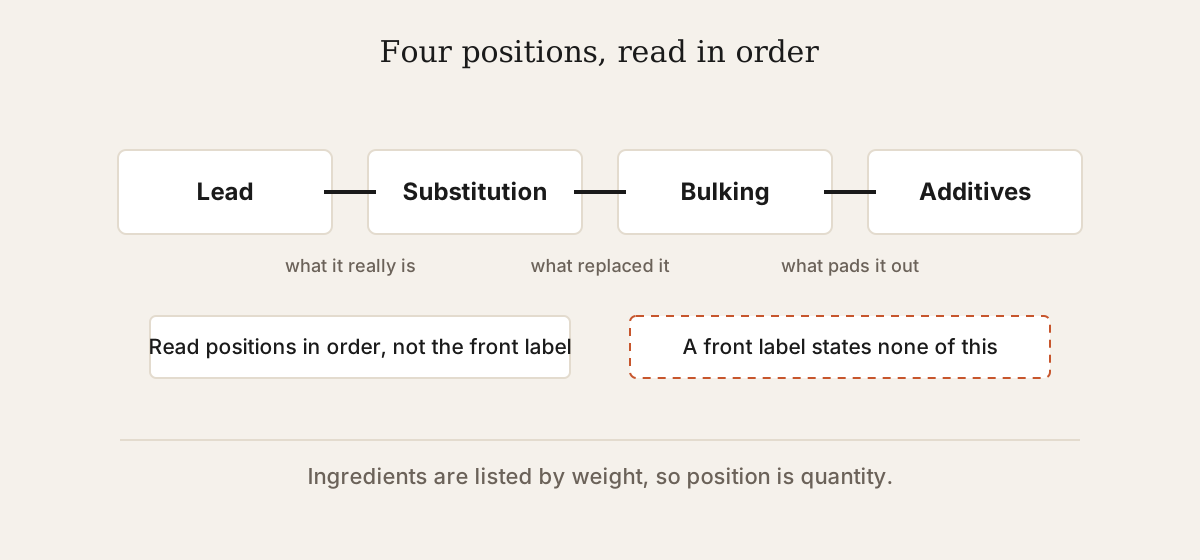
The four positions to read
Read the list in four passes rather than straight through, because different problems live at different depths.
Position one, the lead ingredient. It should be the thing you are buying. Tomatoes in a tin of tomatoes, basil in a pesto, pork in a salume. Where the lead is water, oil or salt, the product is built around something other than its name.
Position two, the substitution zone, roughly items two to four. This is where cheaper versions of named ingredients appear: cashews for pine nuts, sunflower oil after a small quantity of olive oil, generic hard cheese instead of a named DOP.
Position three, the bulking zone, usually the middle of the list. Potato flake, breadcrumb, starch, maltodextrin, fibre. These add body without cost and appear in no traditional preparation on this site.
Position four, the additive block at the end. Acidifiers, antioxidants, preservatives, colourings and stabilisers.
Which additives are fair and which are not
Not every additive is a fault, and treating them all as one category is the most common overcorrection.
Fair, in a shelf-stable product. Citric acid or ascorbic acid to prevent browning. Salt as a preservative. Nitrite in cured meats where the tradition uses it, though not in Prosciutto di Parma, whose discipline forbids it.
Fair with a shrug. Anti-caking agents in ground blends. Firming agents in tinned vegetables. These are process aids rather than flavour claims.
Not fair. Colouring standing in for an ingredient that would have supplied the colour. Flavouring standing in for an ingredient that would have supplied the flavour. Bulking agents replacing fat or solids. Each of these substitutes for something you believe you are paying for.
The distinction is whether the additive replaces an ingredient or enables the format. An acidifier that lets a jar sit on a shelf enables the format. A colour that replaces annatto or tomato replaces an ingredient.
Named against unnamed ingredients
An ingredient list that names its components is making checkable claims; one that uses category words is avoiding them.
“Parmigiano Reggiano DOP” is a claim. “Hard cheese” is a category. The first can be verified, the second cannot, and a producer using the good ingredient almost always names it because naming it is worth money.
The same applies across the board. Extra virgin olive oil against vegetable oil. Pine nuts against nuts. Durum wheat semolina against wheat flour. Sea salt against salt.
The rule of thumb: where a producer could have named something better and did not, assume they used something worse. It is not a certainty, and it is the correct default.
Percentages, and when they appear
Where an ingredient is named in the product name or highlighted on the front, its percentage often has to be declared, and that number is one of the most useful things on the pack.
A pesto naming basil, a nduja naming Calabrian chilli, a tinned tomato product naming San Marzano: in each case a percentage tells you how much of the defining ingredient is actually present. Producers proud of the number print it prominently. Producers who are not print it in the list.
Compare percentages across brands rather than judging one in isolation, since what counts as high varies by product.
What a good list looks like
Short, named, and containing nothing you would not have put in yourself.
Colatura: anchovies, salt. Prosciutto di Parma: pork, salt. Parmigiano Reggiano: milk, salt, rennet. Pesto genovese: basil, olive oil, Parmigiano, Pecorino, pine nuts, garlic, salt.
Checked on 13 August 2026, the first page of United States results for authentic italian ingredients returned specialist importers and cooking publishers rather than any labelling authority, which describes that search on that date. The practical reading is that there is no consumer-facing standard for the word authentic, which is exactly why the list matters more than the adjective.
Frequently asked questions
Does a long ingredient list always mean a worse product?
Not always, and it is the most reliable single signal on products whose traditional form is short. Some legitimate products are genuinely complex. But where a preparation is traditionally four or five ingredients and a jar lists fifteen, the additional items are almost always doing the work of ingredients that were left out.
Are preservatives in Italian food a bad sign?
Whether a preservative is a bad sign depends on whether it enables the format or replaces an ingredient. An acidifier that makes a jar shelf-stable is a fair trade for shelf stability. A colouring that stands in for the ingredient which would have provided the colour is a substitution you are paying for and not receiving.
Why do some labels say cheese rather than naming it?
Because the cheese used is not one worth naming. Producers using Parmigiano Reggiano say so, since the name carries value that justifies the cost. A generic category word in place of a name is a reliable indication that a cheaper equivalent was used, and the same logic applies to oils, nuts and flours.
What does the percentage next to an ingredient mean?
It is the proportion by weight of that ingredient in the finished product, and it is usually declared where the ingredient is named in the product name or emphasised on the front. It is among the most useful figures on a pack, particularly for comparing two jars of the same product where one prints a much higher number than the other.
Is the ingredient list regulated more strictly than the front of the pack?
Yes, in the sense that matters. The list must be complete and ordered by weight, which is checkable, while front-of-pack phrasing is largely descriptive and only lightly constrained. That asymmetry is why the back of the pack is a better guide than the front, regardless of how the front is designed.
CalItalia Food covers Italian ingredients: what they are, how to tell a good one from an ordinary one, and where to buy them in the United States.