DOP and IGP: What They Guarantee, and What They Do Not
The two Italian protected marks are not interchangeable. What each one controls, where the guarantee stops, how to use them to judge a label, and which foods carry no mark at all.
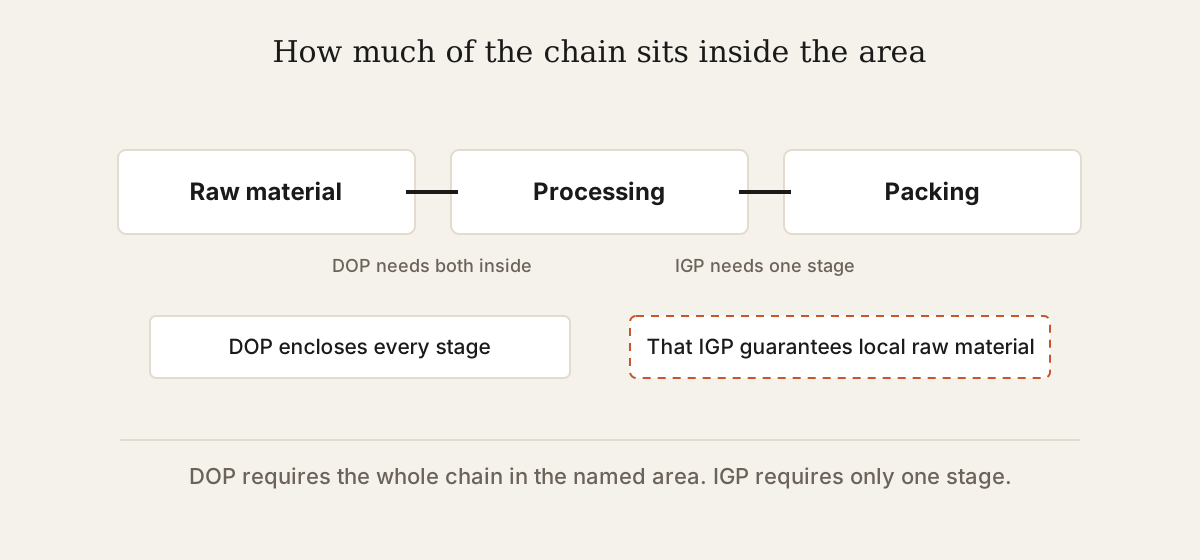
DOP requires the entire production chain to happen inside a defined area, and IGP requires only that at least one stage does, which is why the two marks look similar on a label and guarantee different things. Both are real, and neither guarantees that a product tastes good. Reading them correctly is where judging an Italian ingredient starts.
Most English-language writing treats them as a single tier of Italian quality. Separating them is the most useful thing you can learn about reading an Italian label, because it tells you exactly how far the guarantee reaches.
What DOP actually controls
DOP, Denominazione di Origine Protetta, requires that every stage of production happens within the named geographic area, from the raw material to the finished product. It is the stricter of the two marks.
For Parmigiano Reggiano that means the milk comes from cows in the defined provinces, the cheese is made there and it is aged there. For Prosciutto di Parma it means the pigs are born and raised in specified Italian regions and the ham is cured in the hills around Parma.
The mark also carries a production discipline, which is usually the more informative half. The Parma discipline forbids nitrates and permits only pork and salt. The Parmigiano discipline sets the feed, the milk handling and the minimum ageing. Those rules are public and specific.
What IGP actually controls
IGP, Indicazione Geografica Protetta, requires that at least one stage of production happens in the named area and that the product follows its registered discipline. The rest of the chain may sit elsewhere.
That is a genuine guarantee about method and a much weaker one about geography. Mortadella Bologna IGP guarantees the recipe, the permitted cuts, the fat and the slow cook, and does not guarantee that the pork was raised near Bologna.
IGP is not a lesser DOP. It is a different instrument, often used where a traditional recipe travelled while the raw material never was local to begin with. Treating it as a downgrade misreads what it is doing.
Where the guarantee stops
Neither DOP nor IGP guarantees that you will like the product, and neither grades quality within the category. A DOP cheese at the minimum ageing and a DOP cheese aged three times as long carry the same mark.
Neither mark is a freshness guarantee. A crowned Prosciutto di Parma sliced from a leg that has been open for a week is still crowned.
Neither mark tells you about the handling after it left Italy. Storage, slicing and shipping happen outside the discipline, and they are where a great deal of imported product is spoiled.
And a mark cannot tell you about a product that has none. Guanciale, most pancetta and nduja carry no general protected designation, and their quality rests entirely on the producer and on what you can see.
A caution about searching for the term
Checked on 13 August 2026, United States search results for dop meaning were dominated by unrelated senses of the letters rather than by the Italian food designation. That describes that search on that date. DOP is an abbreviation in several unrelated fields, so searching the term alone is an unreliable route to the food designation. Searching the full phrase, denominazione di origine protetta, or the name of a specific product, resolves it.
The marks you will also see
STG, Specialità Tradizionale Garantita, protects a recipe and a method with no geographic requirement at all. It is rare and it guarantees the least about origin of the three.
DOC and DOCG appear on wine rather than food and belong to a separate Italian system, though DOC has been broadly absorbed into the DOP framework at European level. Seeing DOC on a bottle and DOP on a cheese does not mean the two were assessed the same way.
Consortium marks are not the same as the protected designation. Many consortia use their own logo alongside the official mark, and a consortium logo on its own is a trade body’s badge rather than a legal designation.
How to read a label in practice
Look for the official mark rather than the words, because place names are not protected on their own and the words are where the ambiguity lives.
The official DOP and IGP marks are specific graphic symbols, and a product carrying the designation reproduces them. A label that spells out a place name without a mark is telling you where something is from as a marketing claim rather than a certified one.
“Prodotto in Italia”, made in Italy, is not a designation. It says the last substantial transformation happened in Italy, which can be true of a product whose raw material came from anywhere.
Check what the mark attaches to. On a pack of sliced cheese the mark may cover the cheese and not the slicing, and on a prepared food it may cover one named ingredient rather than the dish.
When the absence of a mark means nothing
Plenty of excellent Italian food carries no designation at all, either because the category is too broad to protect or because no consortium has pursued it.
This is where the marks stop helping and the rest of the judgement starts: the ingredient list, the producer, the price and what the product looks like. Nduja is a good example, since the ingredient list does all the work that a mark would otherwise do.
The practical rule. Where a mark exists for the category, its absence on a specific product is informative. Where no mark exists for the category, its absence tells you nothing.
Frequently asked questions
Is DOP better than IGP?
Neither is better; they guarantee different scopes. DOP ties the whole production chain to the named area, IGP ties at least one stage to it while still enforcing the recipe discipline. For a product where the traditional method matters more than the local raw material, IGP is the appropriate instrument rather than a compromise.
Does a DOP mark mean the product tastes good?
No, a DOP mark certifies origin, method and adherence to a discipline, not palatability or grade. Two products with the same mark can differ substantially in ageing, in handling after export and in how they were stored before you bought them. The mark narrows the field; it does not pick the winner.
What does “made in Italy” mean on food?
It indicates that the last substantial transformation took place in Italy, which is a much weaker statement than a protected designation. Raw material can come from elsewhere. It is a country-of-origin claim rather than a certification, and it is not policed the way DOP and IGP names are.
Why do some famous Italian foods have no DOP?
Usually because the category is too broad or too widely made to define a single discipline, or because no producer group has pursued protection. Guanciale, most pancetta and nduja fall into this group. Their absence of a mark is a fact about the category rather than a judgement on any particular producer.
Is a consortium logo the same as DOP?
No. A consortium is a trade body representing producers, and its logo is its own badge. Many consortia manage a protected designation and print both marks, but the consortium logo on its own carries no legal guarantee of origin or method. Look for the official designation mark alongside it.
CalItalia Food covers Italian ingredients: what they are, how to tell a good one from an ordinary one, and where to buy them in the United States.