
The Italian Ingredient, and the Gap Worth Paying For
What separates the authentic version of an Italian ingredient from what is sold in the United States, how to judge it, where to buy it, and where to start.
The subject of this site is the Italian ingredient that carries a real quality gap between the authentic article and what is available in the United States, and the gap is the point rather than the Italian-ness. An ingredient with no gap does not need explaining however Italian it is, and an ingredient with a large one is worth a page even where nobody has written a good one.
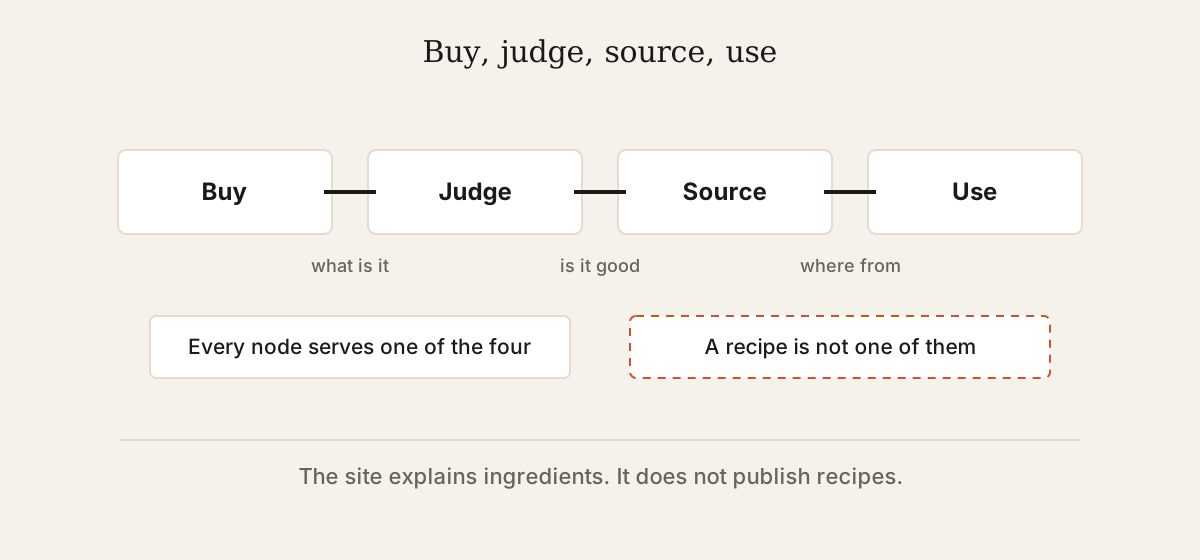
Everything here answers some part of four questions: what an ingredient is, how to tell a good one from an ordinary one, where to get it, and what to do with it once you have.
Why the gap is the subject
An American buyer standing at a counter usually cannot tell the good version from the ordinary one, and that is a narrower and more useful problem than Italian food in general.
For some ingredients the gap is enormous. Alba white truffle, colatura di alici and long-aged Parmigiano Reggiano are all substantially different from what is sold nearby under similar names or with similar words on the label. For others it barely exists, which is why this site has nothing to say about them.
The gap is what makes a page worth writing. Where the difference between the authentic article and the supermarket version is small, the honest thing is to say so and move on. Castelvetrano olives are the clearest example on the site: widely available, inexpensive, and very close to what you would eat in Sicily.
How the marks work, and where they stop
Protected designations are the strongest claim on any Italian label and they cover less than most people assume.
DOP and IGP guarantee different scopes. DOP ties the whole production chain to a named area; IGP ties at least one stage to it while still enforcing a recipe discipline. Neither grades quality within the category, and neither says anything about how a product was handled after it left Italy.
The label phrases are not designations at all. Made in Italy, Product of Italy and Italian Style sit in the same visual position as a protected mark and guarantee far less, and the third of them explicitly says the product is not Italian.
The ingredient list beats the front of the pack, because it is ordered by weight and enforced while front-of-pack phrasing is largely descriptive.
Several categories have no designation at all. Guanciale, most pancetta and nduja carry none, so for those the producer and the ingredient list do all the work a mark would otherwise do.
Judging what is in front of you
Most of this site is judgement, because it is the part a buyer can actually act on at a counter.
Cheese. Parmigiano Reggiano by its pin-dot rind and its age, where twelve months and thirty-six months are genuinely different cheeses. Caciocavallo by the evenness of its paste and how it breaks.
Cured meat. Prosciutto di Parma by the branded crown and how long the leg has been open. Guanciale by its dense jowl fat, which is why it is not pancetta. Soppressata by its coarse grind and firm white fat. Mortadella by the even distribution of its fat cubes. Nduja and lardo di Colonnata by their very short ingredient lists.
Pantry. Colatura di alici by colour and clarity. Castelvetrano olives by texture rather than by their surprising green. Pesto genovese by which of seven ingredients have been swapped for cheaper ones.
Price is a screening signal rather than a quality measure. It tells you reliably that a long cure or a low yield was involved, and it tells you nothing about ageing beyond the minimum or about handling after import.
Sourcing, and what you cannot get
Availability in the United States is shaped by two things, and only one of them is commercial.
Four routes actually work, and each is good at different things: a specialist importer for shelf-stable low-turnover items, a local Italian grocer or counter for anything cut to order, and a general supermarket for a short list it stocks properly.
Some things are not available at all, for regulatory reasons. A federal rule requires raw-milk cheese to be aged at least sixty days before import or sale, which excludes an entire category of young raw-milk cheeses. Cured meat faces a separate establishment-approval regime, which is why one producer’s prosciutto is on the shelf and a neighbour’s identical product is not.
Alba white truffle is the sharpest case of a seasonal constraint, since it cannot be cultivated, has a season of roughly three months and loses its aroma within days of harvest.
After you have bought it
The last of the four intents is the one most sites skip, and it is where a good ingredient is most often wasted.
Cured meat keeps far longer whole than sliced, and the single most common mistake is wrapping it in plastic film, which traps moisture against a product that needs to breathe.
Pesto is the most instructive case on the site, because its behaviour is measurable rather than a matter of taste. It tolerates warming and not cooking, it freezes better than it jars, and the tool used to make it changes its colour stability and texture.
Not every pesto is the Genovese one. Pesto alla trapanese is built on almonds and raw tomato, and sun-dried tomato pesto leads on tomato rather than basil. In both, ingredients that would be a cost substitution in a genovese are simply the recipe.
What this site does not cover
The border is narrow deliberately, and stating it plainly saves you time when something you expected to find is not here.
No recipes and no dish content. The subject is the ingredient, not the meal built on it. A page here explains what something is, how to judge it, where to get it and how it behaves.
No restaurant or dining coverage, no regional cuisine surveys, no wine pairing, and no health or nutrition. Health in particular is not one of the four declared intents: a reader asking whether an ingredient is good for them is not choosing between a good and a poor version of it, which is the only question this site is equipped to answer.
Butter is treated as a sauce component rather than a central ingredient, which removes a large amount of otherwise plausible material.
The regional attention is Southern Italian and Sardinian, and that is a priority rather than a boundary. Alba truffle is in Piedmont and is covered anyway, because a regional preference that excluded the clearest instance of the subject would be working against itself.
Where to start
If you are buying something specific, go to its page. If you are trying to get better at this generally, three pages carry most of the transferable skill.
Start with the ingredient list, because it applies to everything and takes ten seconds at a shelf.
Then DOP and IGP, so you know what a mark is promising and where it stops.
Then where to buy, because sourcing is the constraint that decides what is even possible.
The standing here is travel, sourcing and cooking. A page may say how an ingredient is used and how it behaves in a pan. No page claims a conducted test: no comparison has been run, no panel tasted, no set ranked. Where a page would need experience the site does not have, it says so rather than inventing it.
Frequently asked questions
What makes an ingredient worth covering here?
A real quality gap between the authentic version and what is available in the United States. That gap is the subject rather than Italian origin on its own, so an ingredient that is widely available in good condition gets little attention while one that is commonly imitated or hard to source gets a full page. Castelvetrano olives are covered partly to say the gap is small.
Do protected designations guarantee quality?
They guarantee origin, method and adherence to a published discipline, not palatability or grade. Two products carrying the same mark can differ substantially in ageing, in handling after export and in how long they sat at a counter. The mark narrows the field considerably and does not pick the winner within it.
Why are recipes not covered?
Because the entity here is the ingredient and a recipe delivers a dish, at which point the ingredient becomes interchangeable. The test used throughout is whether swapping the ingredient for a different one would break the page. If it would not, the page is a recipe wearing an ingredient’s name and it belongs somewhere else.
Is domestic American product worth buying?
Frequently, and in the categories most constrained by import rules it is often the best available option. Guanciale, nduja and soppressata are all made domestically to a serious standard because import restrictions created the demand. Judge them on the cut, the cure and the producer rather than on where the plant is.
Where should a complete beginner start?
With the ingredient list page, because reading a label transfers to every product and costs nothing. After that, the DOP and IGP page tells you what the marks on the shelf actually promise, and the sourcing page tells you which of the four buying routes suits what you are after. Those three cover most of what is generalisable.
CalItalia Food covers Italian ingredients: what they are, how to tell a good one from an ordinary one, and where to buy them in the United States. Who writes it, and on what standing.