Alba White Truffle: What You Are Actually Buying
The Piedmontese white truffle, its short season, how it is priced and graded, how to tell a real one from the products that borrow its name, and how to buy and use it.
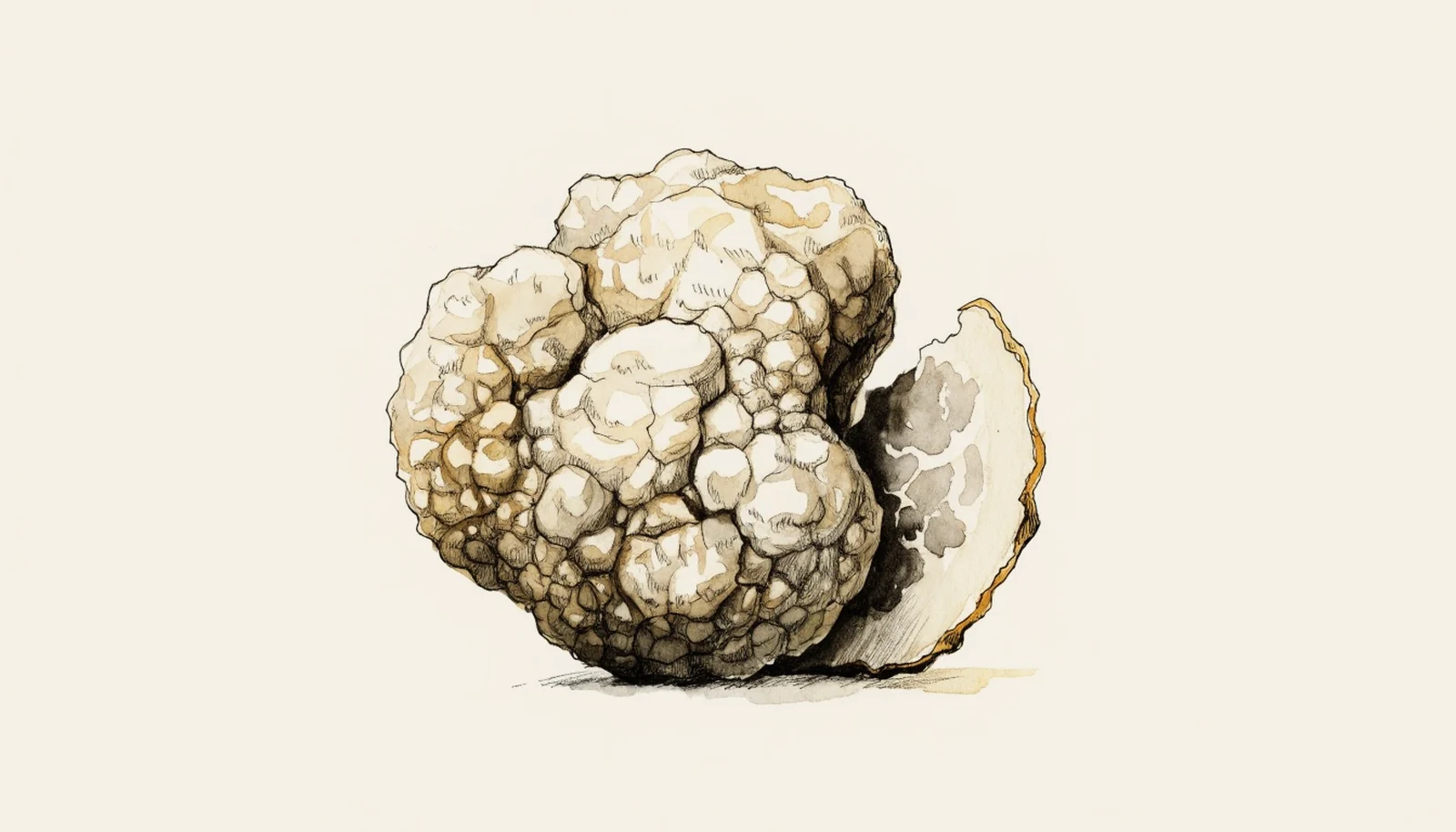
The Alba white truffle is Tuber magnatum, a wild subterranean fungus from Piedmont and a few other areas, harvested from roughly October to January and sold fresh by weight at prices that move week to week. It cannot be cultivated, which is the fact that explains everything else about it. It sits at the far end of the gap between the real ingredient and what borrows its name.
It is the clearest example on this site of the gap the property exists to describe: the difference between the authentic article and what is sold under its name in the United States is enormous, and most of what carries the word truffle contains none. Other ingredients here carry smaller versions of the same gap, among them colatura di alici and San Marzano tomatoes.
What the Alba white truffle actually is
Tuber magnatum is a wild fungus that grows in symbiosis with the roots of specific trees, mostly oak, poplar, willow and lime, in particular soils, and it is found by trained dogs rather than farmed. It has never been reliably cultivated.
That is the whole economic story. Supply depends on weather, soil and luck across a short season, so the price is genuinely volatile rather than artificially maintained, and a bad year moves it sharply.
Alba is a place and a marketing shorthand rather than a protected designation for the truffle itself. White truffles of the same species come from elsewhere in Piedmont, from other Italian regions, and from outside Italy. A truffle sold as Alba may be from the wider area.
Why the southern bias does not exclude it
This site’s regional attention is Southern Italian and Sardinian, and Alba is in Piedmont, in the north. It is covered anyway because the entity here is the quality gap rather than the region, and no ingredient on this property has a larger one. A regional preference that excluded the clearest instance of the subject would be working against itself.
The season, and why it matters to buying
The white truffle season runs roughly from October to January, peaking around November, and outside it no fresh Alba white truffle exists.
Anything sold as fresh white truffle in June is not Tuber magnatum. It may be a different species entirely, such as a summer truffle, which is a legitimate but far less aromatic fungus, or it may be preserved product.
Freshness within the season is measured in days, not weeks. A white truffle loses aroma rapidly from the moment it is lifted, and much of what a buyer is paying for is how recently it came out of the ground. A truffle that has been in transit for a week has lost a large part of what makes it worth the price.
How they are priced and graded
Price is by weight and moves with the season and the harvest, and larger, rounder, unblemished truffles command a substantial premium per gram over small or irregular ones.
Size is priced disproportionately. A single large truffle costs considerably more per gram than several small ones of the same total weight, because large specimens are rarer and shave more cleanly.
Shape and integrity matter commercially more than they do gastronomically. A knobbly truffle with soil in its crevices tastes the same and costs less.
Aroma is the real quality variable and it cannot be judged from a photograph. Buying fresh truffle unseen is a genuine risk, which is why reputable sellers describe harvest dates and offer overnight shipping.
The products that borrow the name
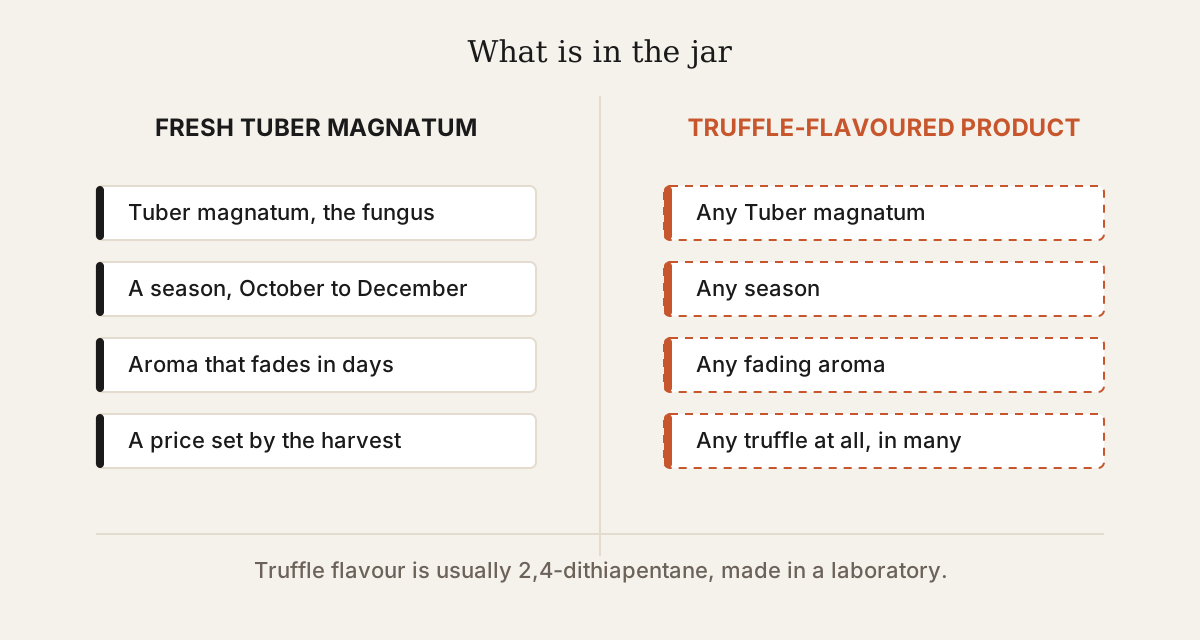
Most things labelled truffle in the United States contain no truffle, and the distinction is worth making precisely because the labelling rarely does.
Truffle oil is usually olive oil with a synthetic aroma compound, most often 2,4-dithiapentane, and typically contains no truffle at all. It smells intensely of one note of truffle and nothing else. It is not a fake in the fraudulent sense, since the label often says flavoured, but it is not a truffle product.
Truffle-flavoured products including butters, salts, sauces and crisps mostly use the same synthetic aroma, sometimes with a small quantity of a cheaper truffle species for legitimacy.
Preserved truffle products including truffle paste, minced truffle and truffle carpaccio may contain real truffle, frequently a less aromatic species, and the aroma is much reduced by processing. Read the species on the label.
None of these is a route to understanding fresh white truffle. Someone whose only experience is truffle oil has tasted a single synthetic compound rather than the thing.
Where to buy it
Specialist importers with air freight from Italy during the season, and a small number of high-end retailers, are the practical routes in the United States.
Checked on 13 August 2026, the first page of United States results for white truffle returned reference material alongside specialist importers and gourmet retailers, including Alma Gourmet, Eataly, TrufflesUSA and D’Artagnan. That describes that search on that date rather than recommending any seller.
Buy from a seller who states the harvest date and ships overnight. In this category the shipping speed is part of the product rather than a service detail.
How to use it
Shave it raw over a hot dish at the table and add nothing else that competes. Heat destroys the aroma, and so does almost any assertive ingredient.
The classic vehicles are deliberately plain: tagliolini with butter, a risotto finished simply, a fried or scrambled egg, a fonduta. The dish should be warm enough to release the aroma and bland enough not to argue with it.
Shave it at the last possible moment, directly onto the plate, using a truffle slicer for thin, even shavings.
Do not cook it into anything. Truffle stirred into a sauce and simmered contributes almost nothing.
Store it with eggs or rice for a day and the aroma migrates into them, which is a genuinely useful way to extend a small purchase.
Storage
Wrap it in paper, not plastic, keep it in a sealed container in the refrigerator, and change the paper daily. Expect a few days rather than a week.
Paper absorbs the moisture that the truffle releases, which is what causes it to rot. Plastic traps it and accelerates spoilage. Rice is sometimes used instead and works, though it draws out moisture and slightly dries the truffle.
Freezing is a last resort. It preserves some aroma and destroys the texture, so a frozen truffle is for grating into a hot dish rather than shaving over one.
Buy what you will eat within a few days. This is not an ingredient to stock.
Frequently asked questions
Why are Alba white truffles so expensive?
Because they cannot be cultivated, grow only in specific soils in symbiosis with particular trees, must be found by trained dogs, have a season of roughly three months, and lose aroma within days of harvest. The price is a genuine reflection of scarcity and perishability rather than positioning, which is why it moves substantially from year to year with the weather.
Does truffle oil contain truffle?
Usually not. Most truffle oil is olive oil carrying a synthetic aroma compound, commonly 2,4-dithiapentane, which reproduces one prominent note of truffle aroma and none of the rest. Some products add a small quantity of a cheaper truffle species. Read the ingredient list, and treat truffle oil as a flavouring rather than as a truffle product.
When is white truffle season?
Roughly October to January, peaking around November, varying with the year’s weather. Outside that window there is no fresh Alba white truffle on the market. Fresh truffle offered in spring or summer is a different species, most often a summer truffle, which is considerably less aromatic and much cheaper.
How much do I need per person?
Between five and ten grams per person is a normal serving shaved over a plain dish, which is enough for the aroma to carry without waste. Because the aroma is the point and it dissipates quickly, a smaller quantity shaved fresh at the table is better than a larger quantity added earlier.
Is a black truffle a substitute?
No, they are different species with different aromas and different handling. Black truffles, particularly Tuber melanosporum, tolerate gentle heat and are often cooked into dishes, while white truffle must be raw. A black truffle is a legitimate ingredient in its own right rather than a cheaper version of a white one.
CalItalia Food covers Italian ingredients: what they are, how to tell a good one from an ordinary one, and where to buy them in the United States.