
Caper Berries: The Fruit, Not a Big Caper, and What That Changes
Cucunci are what a caper bud becomes if you let it flower. Why they are milder rather than stronger, how to judge and use them, and when they are the wrong choice.
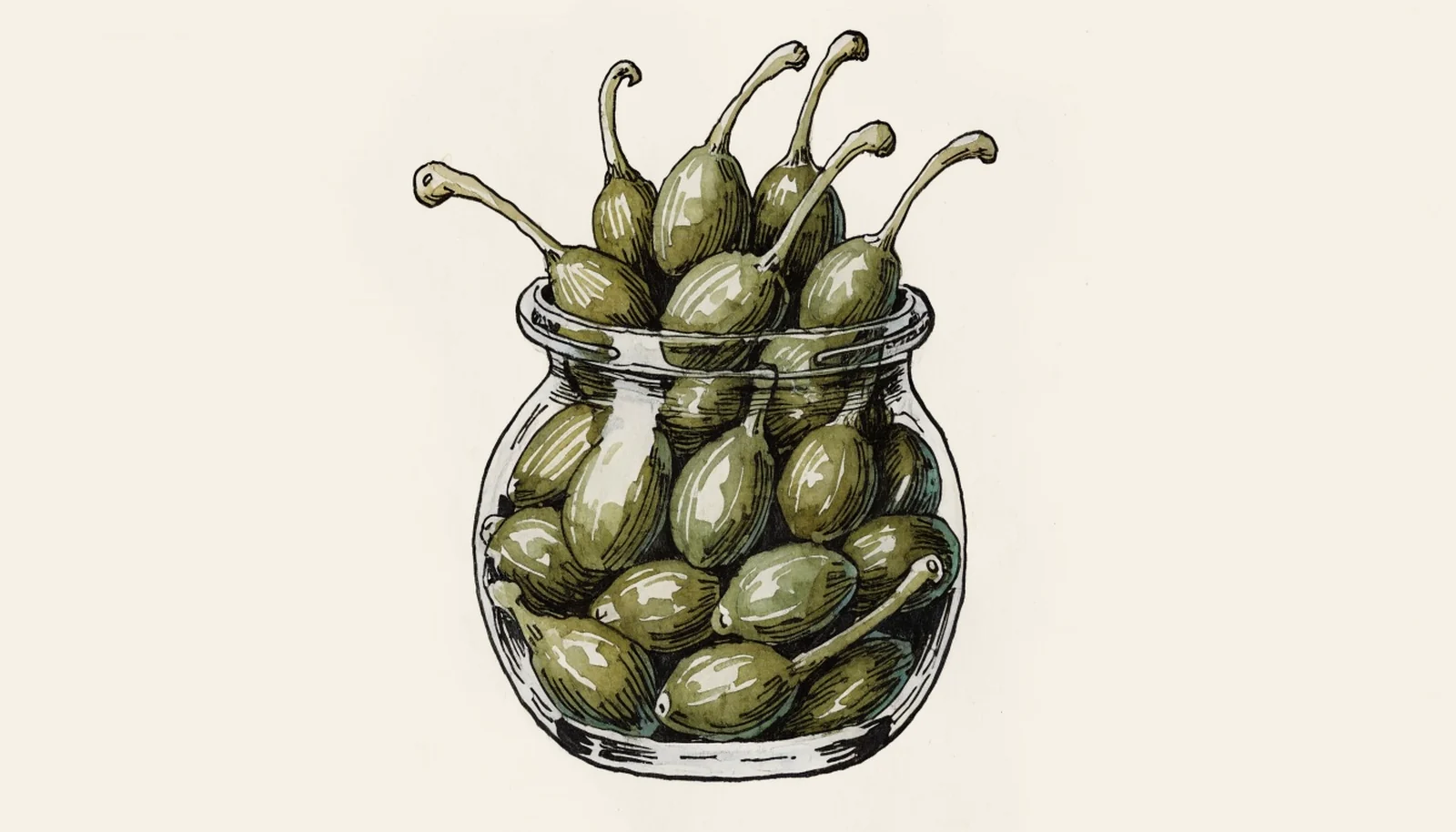
Caper berries, cucunci in Italian, are the fruit of the caper plant, formed when a flower bud is allowed to open and set rather than being picked. They are much larger than capers and, contrary to what the size suggests, considerably milder. Getting that right is part of how to judge an Italian pantry ingredient.
That inversion is the point of this page. Buying caper berries expecting a more powerful caper is the standard mistake, and it goes the wrong way round.
What caper berries actually are
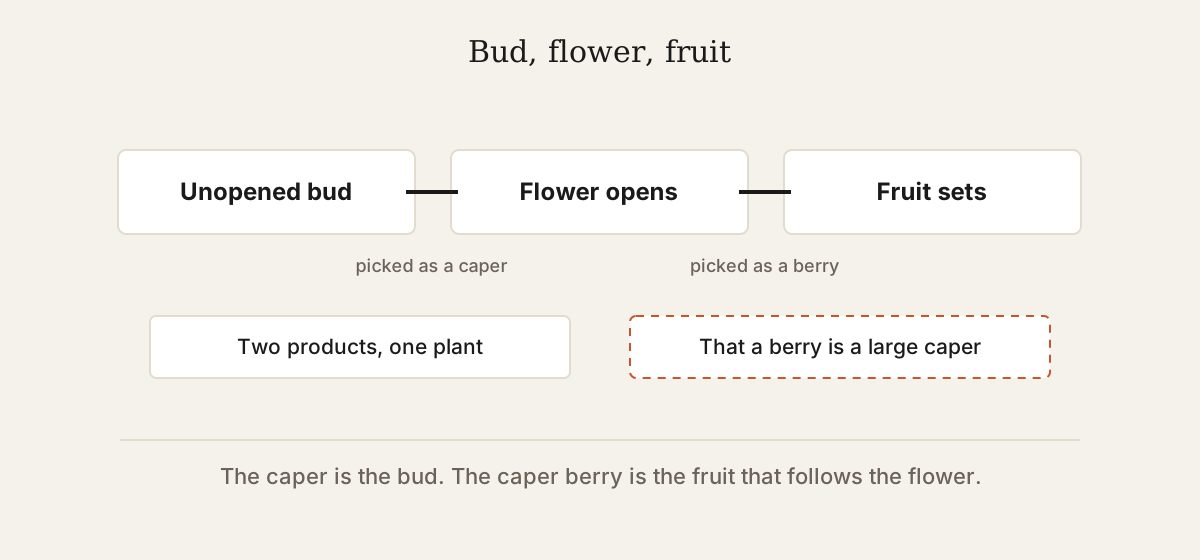
Caper berries are the seed pods of Capparis spinosa, formed after the flower has bloomed and been pollinated, harvested with a length of stalk attached.
They are the same plant as capers at a later stage. A caper is the unopened bud; a caper berry is what the bud becomes if left alone.
They are picked with the stalk on, which is how they are served and is part of their identity.
The size is about that of a small olive, oval, olive-green, with visible seeds inside.
The texture is firm with a slight crunch from the seeds, quite unlike a caper’s soft burst.
They are usually brined rather than salt-packed, which is the reverse of the preference for capers.
Cucunci is the Italian name, and caper berry is the direct English translation.
Why they are milder, not stronger
The flavour compounds that make a caper intense are concentrated in the bud and dilute as the fruit develops.
A caper bud is a dense package of flower tissue. Its mustard-oil compounds are concentrated in a small mass.
The berry is mostly seed and pod. The same compounds are spread through a much larger volume of less flavourful tissue.
So flavour per bite falls even as size rises. A caper berry tastes recognisably of caper and at perhaps a third the intensity.
The brine contributes proportionally more. Since the fruit itself is mild, a brined caper berry tastes substantially of its pickling liquid.
They are also less salty, being brined rather than salt-packed, which reinforces the impression of mildness.
This is why they are a garnish rather than a seasoning, which capers emphatically are.
How to use them
Serve them whole, by the stalk, cold or at room temperature. They are an eating item rather than a cooking one.
Their mildness and their stalk make them a natural cocktail garnish and antipasto element, in the register of an olive or a cornichon rather than a caper.
They are excellent in a martini or a bloody mary, where the stalk gives something to hold and the mild brine suits the drink.
Put them on an antipasto board alongside olives, cured meat and cheese, where they are eaten whole.
Eat the whole thing including the seeds, which give the characteristic crunch. The stalk is left.
Do not chop them into a sauce expecting capers. They are too mild and too seedy, and the dish will taste of nothing where a caper would have seasoned it.
Do not cook them. The texture goes and there is not enough flavour to justify the heat.
When they are the wrong choice
Caper berries and capers are not substitutes in either direction, and the mismatch is common.
Any recipe wanting caper flavour wants capers. Puttanesca, salsa verde, a butter sauce for fish, a vitello tonnato. Caper berries will not season these.
Any recipe wanting a whole garnish with a stalk wants berries. A caper is too small and has nothing to hold.
Quantity does not fix it. Using more caper berries adds seeds and brine faster than it adds caper flavour.
The reverse substitution fails on presentation. Capers scattered where berries were intended look like a mistake rather than a garnish.
Where a recipe simply says capers, it means the buds. Caper berries are always named specifically because they are the less usual item.
How to judge a jar
Judge them on firmness, then the stalk, then the brine.
They should be firm and plump, not shrivelled or collapsed.
The stalk should be intact on most of them, which is what they are sold for.
The skin should be unbroken and the fruit should not be split.
Colour should be an even olive-green, dull rather than bright. Vivid green suggests colouring.
The brine should be clear to faintly cloudy and smell clean and vinegary. Murky brine or a sour off-smell means a fermentation problem.
Checked on 13 August 2026, the first page of United States results for caper berries returned specialist Italian importers and general grocery retailers, which describes that search on that date rather than recommending any seller. Availability here is reasonable.
What they should cost
Expect roughly 8 to 16 dollars for a jar in the United States, which is less per unit weight than good salt-packed capers.
They are cheaper because they are easier. A berry represents a bud that was not picked, so it costs the grower a caper harvest and then grows itself, and it requires no daily picking window.
Salt-packed caper berries exist and are rare, and are worth buying if found, for the same reason salt beats brine for capers.
Very cheap jars are usually heavily vinegared, which matters more here than for capers since the fruit is mild enough for the brine to dominate.
They are not a luxury item and are priced accordingly.
Storage
In their brine, refrigerated after opening, three to four weeks.
Keep them submerged, since any fruit above the brine line will discolour and soften.
Use a clean utensil each time.
Unopened jars keep a year or more in a cool dark cupboard.
Do not freeze them. The flesh collapses and the crunch that is much of their appeal is lost.
The brine is worth keeping for a dressing or a drink, since it carries a good deal of the flavour.
Frequently asked questions
Are caper berries just large capers?
Caper berries are the fruit of the caper plant and capers are its unopened flower buds, so they are two harvest stages of the same plant rather than two sizes of one product. A caper berry forms when a bud is allowed to flower and set. Despite being much larger, it is considerably milder, since the flavour compounds concentrated in the bud are spread through a bigger, seedier fruit.
Can I substitute caper berries for capers?
Caper berries do not substitute for capers in any recipe wanting caper flavour, because they are perhaps a third as intense and add seeds and brine faster than they add flavour. Puttanesca, salsa verde and vitello tonnato all need the buds. The substitution fails in the other direction too, since capers are far too small to serve as a whole garnish.
Do you eat the stalk on a caper berry?
The stalk is not eaten. It is left on during harvesting and packing so the berry can be picked up and held, which is why they work as a cocktail garnish, and it is discarded like an olive stone. The fruit itself is eaten whole, seeds included, and the seeds give the characteristic slight crunch.
What do caper berries taste like?
Caper berries taste recognisably of caper at much reduced intensity, with a firm slightly crunchy texture from the seeds and a pronounced note of the vinegar brine they are usually packed in. They are milder and less salty than salt-packed capers. Because the fruit itself is gentle, the quality of the brine has a larger effect on the finished taste than it does with capers.
What are cucunci?
Cucunci is the Italian name for caper berries, the fruit of the caper plant harvested with a length of stalk attached. They appear under that name on Italian and specialist labels, and under caper berries in English. They are the same product, and jars labelled cucunci are frequently the ones packed by producers who also sell salt-packed capers.
CalItalia Food covers Italian ingredients: what they are, how to tell a good one from an ordinary one, and where to buy them in the United States.