
Mortadella: How to Tell a Real Bologna IGP From the Rest
Mortadella Bologna carries an IGP, and most mortadella sold in the United States does not. What the mark controls, how to judge a slice, what the pistachios tell you, and where to buy it.
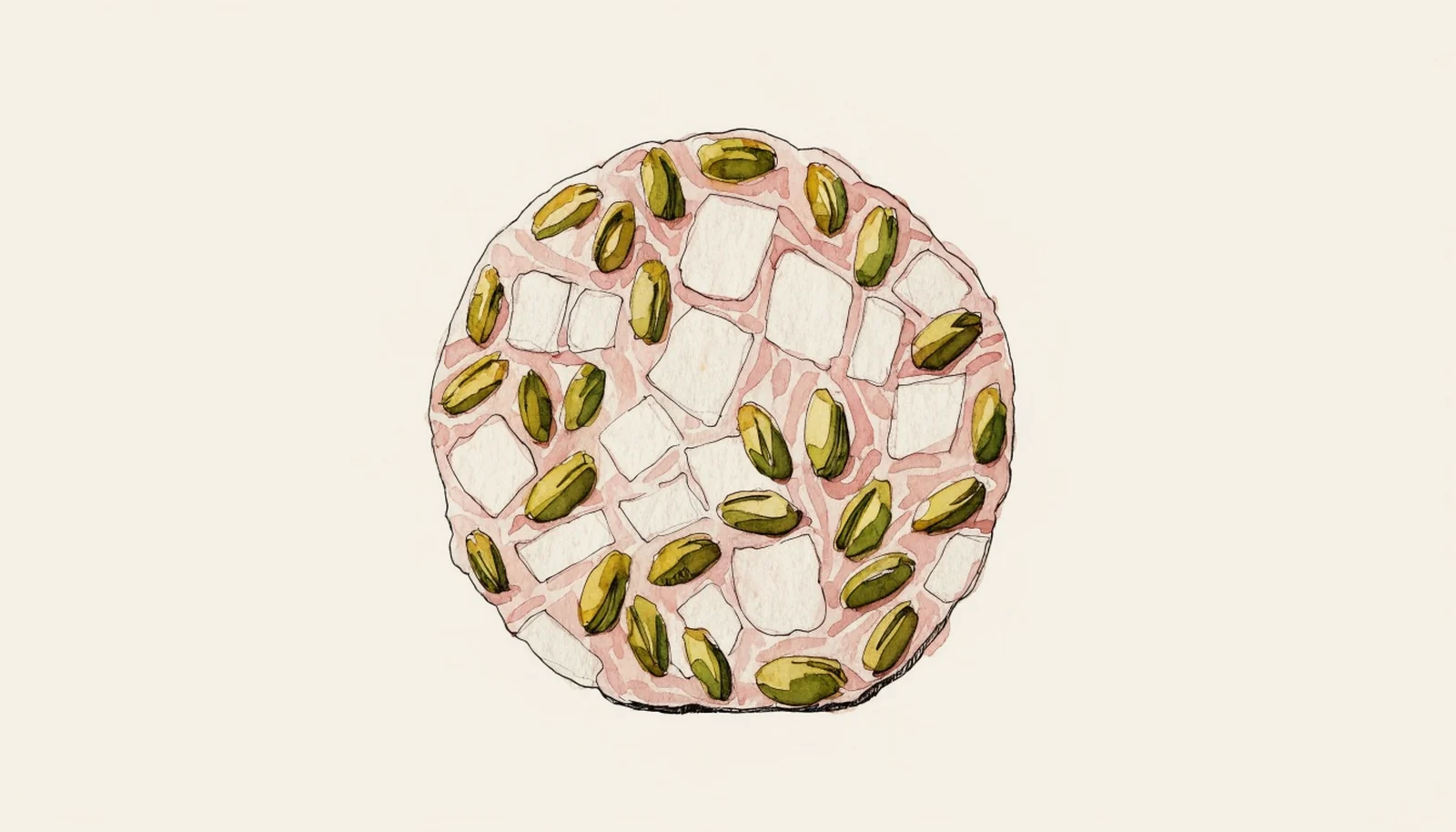
Mortadella is a large, finely emulsified cooked pork sausage from Emilia-Romagna, studded with cubes of neck fat and often with pistachios, and the version worth buying carries the Mortadella Bologna IGP. Everything else sold under the name is a related product rather than the same one. It is a clear case of the gap between the authentic article and its American namesake.
This is a rare case in Italian salumi where the protected mark does most of the work for you, so the buying decision is unusually simple once you know what to look at.
What mortadella actually is
Mortadella is pork ground to a paste, blended with cubes of hard back fat, seasoned, packed into a large casing and cooked slowly in dry air ovens until set. The emulsion and the slow cooking are what separate it from every other sausage in the case.
The scale matters to the product. Mortadella is made in very large formats, and the long, gentle cook that a large diameter requires is part of why the texture is silky rather than springy. A small mortadella is a different eating experience even when the recipe matches.
It is fully cooked, not cured in the dry-aged sense. That places it in a different part of the salumi shelf from prosciutto or soppressata and explains why it is soft, mild and short-lived once opened.
Where it comes from
The product belongs to Bologna and the surrounding region, and the name Bologna in English sausage is a distant descendant of it. The Italian original and the American supermarket product diverged a long time ago.
What the IGP actually controls
Mortadella Bologna IGP sets the production area, the permitted cuts and the fat content, controls the additives, and requires the characteristic slow cook. It does not restrict production to a single province the way a DOP would.
That distinction is worth holding on to. IGP, Indicazione Geografica Protetta, requires that at least one stage of production happens in the named area and that the recipe follows the discipline. DOP requires the whole chain to sit inside the area. So an IGP mark is a real guarantee about method and a weaker guarantee about geography than DOP is.
What it rules out is more useful than what it rules in. Under the discipline, the fat cubes must come from throat fat, the mixture cannot carry the fillers common in industrial cooked sausage, and the product cannot be smoked. A mortadella that is smoky, rubbery or speckled with irregular fat is outside it.
The three visible tells
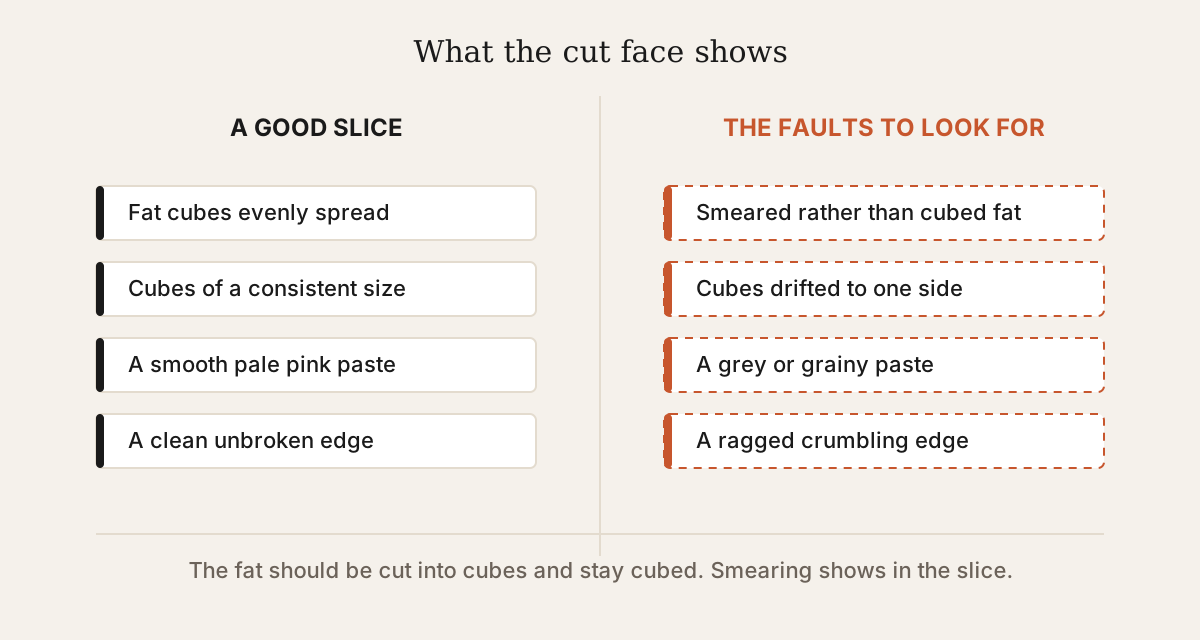
Look at the cut face before anything else, because the structure of a mortadella is legible in a way that most cured meats are not.
The fat cubes should be evenly distributed and roughly even in size. They come from a specific fat with a high melting point, which is why they hold their shape in the emulsion instead of smearing. Irregular, smeared or greyish fat points to a cheaper fat or a rushed emulsion.
The paste around them should be uniformly pale pink and smooth, with no visible graininess. Graininess means the emulsion broke or was never properly formed.
The slice should be silky rather than bouncy. Industrial cooked sausage is springy because of added starch and water. Mortadella Bologna IGP should feel soft and yield rather than push back.
About the pistachios
Pistachios are traditional and optional, and their presence tells you nothing about quality on its own. Some of the best producers make it without. What is worth noticing is whether they look like whole nuts rather than fragments, since fragments are cheaper and sometimes stand in for a smaller quantity of better nuts.
What it should cost
Expect roughly 14 to 25 dollars a pound at a counter for imported IGP mortadella in the United States, and considerably less for domestic products sold under the same name.
The price gap here is doing honest work. Imported mortadella carries the cost of the discipline, the slow cook and the shipping of a cooked product with a limited life. A product at supermarket deli prices is not a bargain version of the same thing; it is a different sausage.
Domestic American producers making mortadella to a serious standard do exist, and they should be judged on the three visible tells rather than on the mark, since they cannot carry an IGP.
Where to buy it
Italian delis, specialist importers and cheese counters with real salumi turnover carry it; ordinary supermarket deli counters mostly carry the American descendant instead.
Checked on 13 August 2026, the first page of United States results for mortadella returned a mix of reference material and specialist sellers, including Volpi and a national deli brand. That is a description of that search on that date and not a recommendation of any seller.
Buy it sliced to order where you can. Mortadella has a large cut face relative to its life once opened, and pre-packaged slices lose the texture quickly.
Storage, and why it is short
Once cut, mortadella keeps only a few days refrigerated and wrapped closely, which is much shorter than dry-cured salumi. It is a cooked, high-moisture product and it behaves like one. The guide to how long Italian cured meat keeps treats cooked products separately for that reason.
Wrap it in paper rather than sealing it airtight, which lets it breathe without drying the cut face. It does not freeze well: the emulsion separates on thawing and the texture that made it worth buying is the first thing lost.
Buy what you will eat within about three days. This is the salume where buying a large piece to save money reliably costs you more.
Frequently asked questions
Is mortadella the same as bologna?
No, though American bologna descends from it. Mortadella Bologna IGP is made to a controlled discipline with visible cubes of throat fat and no fillers or smoke. Most American bologna is a finer, softer emulsion with added starch and water and no visible fat cubes. They are relatives separated by a long distance.
Does mortadella have to contain pistachios?
No. Pistachios are traditional and common but optional, and the IGP discipline does not require them. Their presence is not a quality signal in itself, though whole nuts rather than fragments suggest a producer spending money where it shows.
Can I eat mortadella without cooking it?
Yes. It is fully cooked during production and is eaten as it comes, usually sliced very thin. Warming it briefly changes it pleasantly, and it is also used cubed in stuffings and fillings, but no cooking is required for safety.
Why is my mortadella rubbery?
Almost always because it is an industrial cooked sausage rather than a mortadella made to the IGP discipline. Springiness comes from added starch and water. A secondary cause is slicing it too thick, since the texture only reads as silky when the slice is thin enough to drape.
Is IGP as good a guarantee as DOP?
It is a real guarantee of a different scope. DOP requires the entire production chain inside the named area; IGP requires at least one stage there plus adherence to the recipe discipline. For mortadella that means the mark tells you a great deal about method and less about the precise geography than a DOP name would.
CalItalia Food covers Italian ingredients: what they are, how to tell a good one from an ordinary one, and where to buy them in the United States.