
Prosciutto di San Daniele: One Town, Two Ingredients, and the Trotter Left On
The Friulian DOP ham pressed flat with the foot still attached. Why the zone is a single town, what the two-ingredient rule excludes, how it differs from Parma, and how to judge and use it.
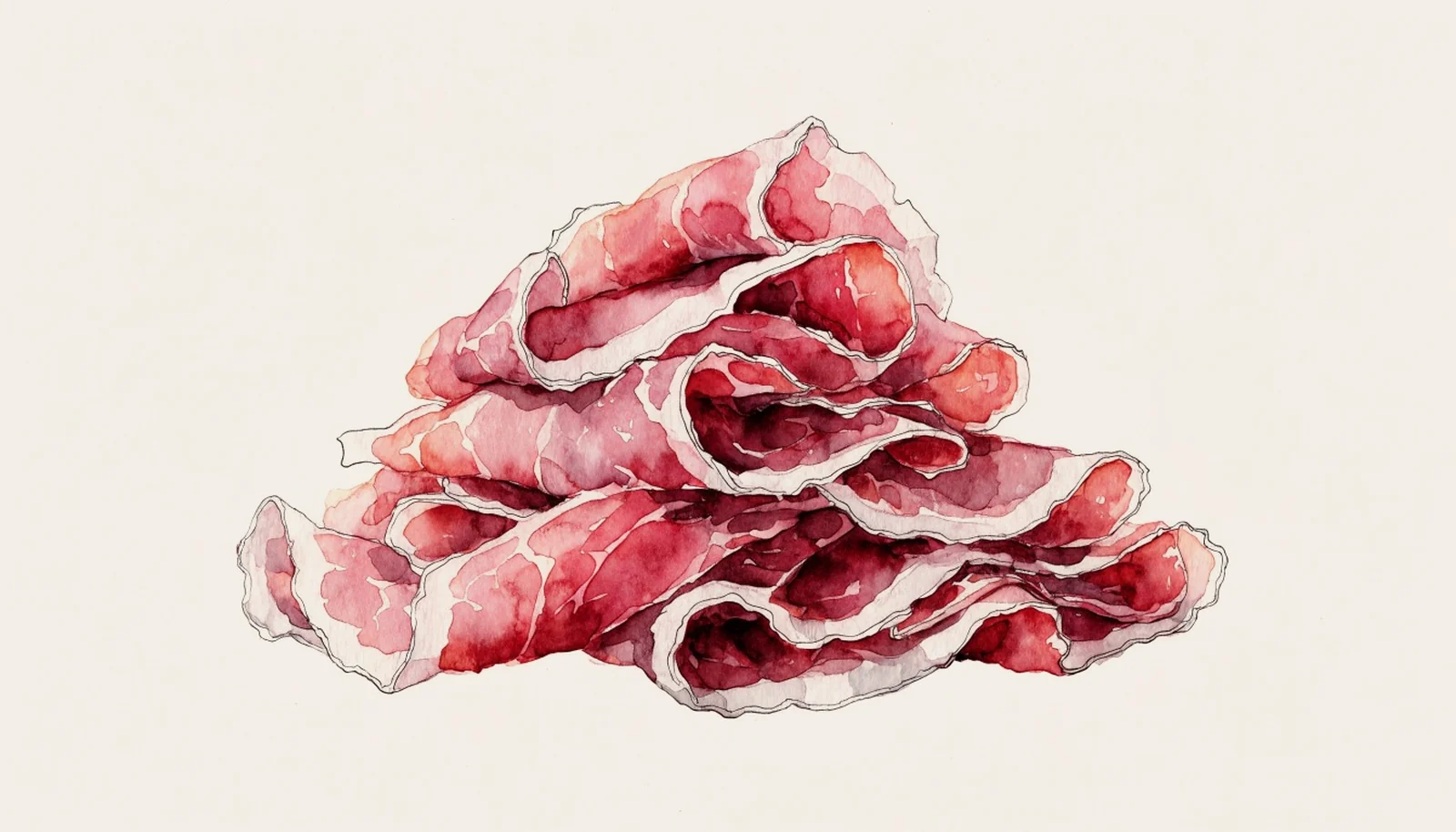
Prosciutto di San Daniele is a DOP dry-cured ham made from Italian pork and sea salt alone, aged a minimum of thirteen months, pressed during curing and sold with the trotter still attached. It is one of the Italian ingredients whose protected name is worth checking for. Every producer is in the single town of San Daniele del Friuli.
That last point is the one most often glossed over, and it is the sharpest difference between this ham and every other famous Italian prosciutto.
What Prosciutto di San Daniele actually is
Prosciutto di San Daniele is a whole pork hind leg, salted, pressed, and hung to cure for at least thirteen months in the town of San Daniele del Friuli in the north-east of Italy.
There are two ingredients and no others. Italian pork and sea salt. The specification permits nothing else, which means no nitrates, no nitrites, no sugar and no preservatives of any kind.
The trotter is left on. The foot stays attached through curing and sale, which is the visual signature of the ham and is required by the specification.
It is pressed during curing. The leg is worked flat, which is why a whole San Daniele has its characteristic shape, often described as a guitar.
The minimum cure is thirteen months from salting, and many are held considerably longer.
The pigs come from a defined pool of central and northern Italian regions, the same heavy-pig tradition Parma draws on, and must be traceable.
Why the zone is a single town
The San Daniele DOP is unusual in being restricted to the territory of one municipality, which is far tighter than most protected designations.
All production and ageing happens within San Daniele del Friuli. No neighbouring commune qualifies, however similar its conditions.
The stated reason is the air. The town sits on moraine hills where cool Alpine air off the Carnic Alps meets humid air moving up from the Adriatic, and the moraine gravel drains the site. The producers hold that this specific combination is what the curing depends on.
The producer count is correspondingly small. A few dozen firms, all in one town, which is a different industrial structure from Parma’s much larger and more dispersed zone.
That tightness is the guarantee. A DOP requires the whole chain in the zone, and here the zone is small enough to walk across.
It also constrains supply, which is part of why San Daniele is consistently priced above generic prosciutto and roughly alongside Parma.
What the two-ingredient rule actually excludes
Pork and salt sounds like marketing until you compare it against what an unprotected ham is permitted to contain.
Nitrates and nitrites are excluded. Most cured meat worldwide uses one or both to fix colour and inhibit bacteria. San Daniele uses neither, relying on salt, time and the curing environment.
Sugar and dextrose are excluded, which are common in commodity hams to speed fermentation and round the flavour.
Water and phosphates are excluded. Injected brine and phosphates add weight and hold moisture in industrial hams, and are the main reason a cheap ham is wet.
So the colour is doing real work as evidence. A nitrate-cured ham holds a bright pink whatever its age; San Daniele’s colour comes from the cure itself, which is why it deepens toward red with time.
This is the same rule Parma follows, and the two DOPs are aligned on it. The distinction between them is not additives.
San Daniele against Parma
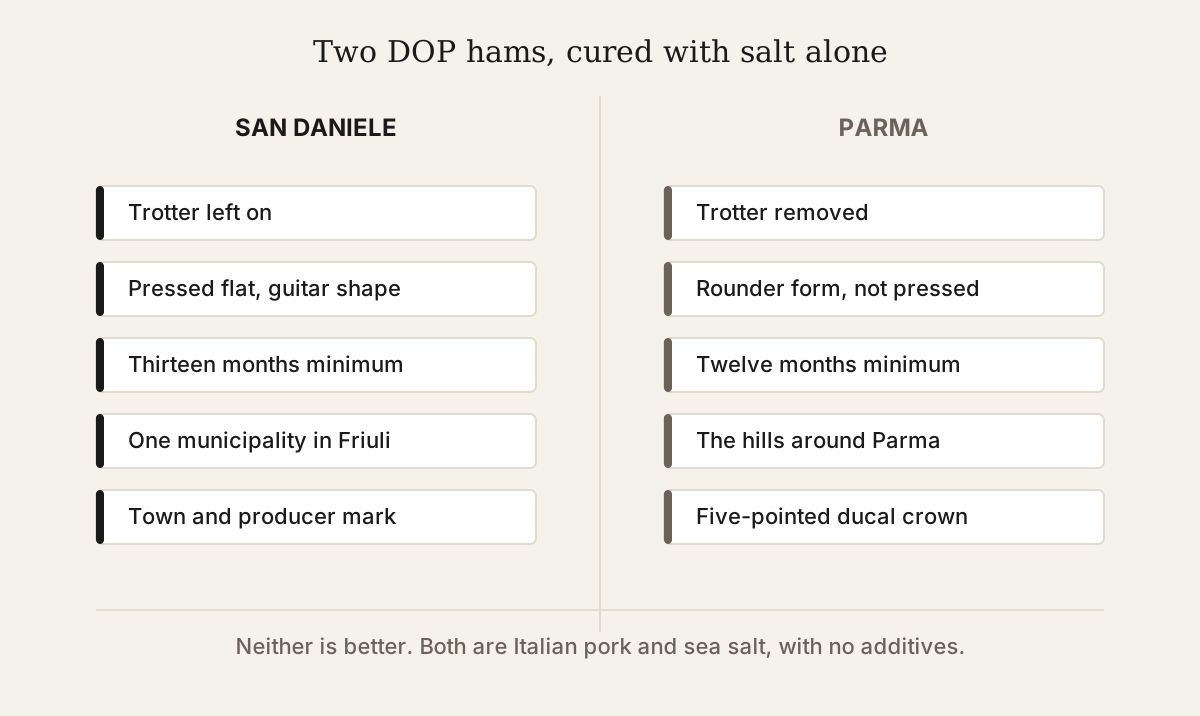
Prosciutto di San Daniele and Prosciutto di Parma are both DOP hams from the same heavy-pig tradition cured with salt alone, and the differences between them are real but narrower than the marketing on either side suggests.
The trotter distinguishes them on sight. San Daniele keeps it, Parma removes it.
Pressing distinguishes the shape. San Daniele is pressed flat, Parma keeps a rounder form.
The minimum ageing differs slightly, thirteen months against twelve, though in practice both are frequently aged well beyond their minimum.
The brand marks differ. Parma carries the five-pointed ducal crown fire-branded into the rind; San Daniele carries its own mark identifying the town and the producer. Look for the brand on the skin rather than for a paper label.
San Daniele is usually described as the sweeter and more delicate of the two. That is the conventional reading and it is a matter of degree between two hams that are far more alike than either is to an unprotected prosciutto.
Neither is better. They are different DOPs with different specifications, and preference between them is preference rather than ranking.
How to judge it
Judge it on the brand, then the colour, then the fat.
Find the fire-branded mark on the rind. A paper label or a printed sleeve is not the designation. On a pre-sliced pack, the DOP mark and the producer number should both be printed.
The lean should be a deep rose to red, deepening with age, translucent when sliced thin enough. A flat uniform pink suggests a nitrate-cured ham, which this is not.
The fat should be white and soft, clean-smelling, and should not be trimmed away. In a properly aged San Daniele the fat is part of the eating rather than waste.
White crystals in the lean are tyrosine, an amino acid that crystallises during long ageing. They are a sign of proper maturation rather than a fault.
It should be sliced to translucency. Thick-cut San Daniele is tough and wasteful, and a counter that cannot slice it thin is not the place to buy it.
Checked on 13 August 2026, the first page of United States results for prosciutto di san daniele returned the consortium alongside specialist and cheese retailers, which describes that search on that date rather than recommending any seller. Availability in the United States is genuinely good.
What it should cost
Expect roughly 35 to 60 dollars a pound in the United States for sliced San Daniele, which puts it alongside Parma and well above generic prosciutto.
The thirteen-month minimum is the cost. A leg loses a great deal of weight to evaporation over that time and occupies curing space throughout, and the price reflects the shrinkage as much as the labour.
Very cheap prosciutto is not this ham. Prosciutto sold at a fraction of the price is unprotected, usually much younger and frequently nitrate-cured, which is a legitimate product and a different one.
Pre-sliced packs cost more per pound and waste less. Buying a wedge and slicing it at home is generally a false economy without a proper slicer.
How to use it
Eat it as it comes, sliced translucently thin, at room temperature. Nothing needs to be done to it.
Its delicacy means it should not be buried. Melon and figs are traditional; a plain bread and butter is better still.
Take it out of the refrigerator twenty minutes before serving. Cold, the fat is waxy and the aroma is closed.
Do not cook it. Heat toughens the lean and drives off the aroma that thirteen months produced, and a cheaper cured pork does any cooking job better.
Wrapping it around something is fine. Grissini, asparagus, a piece of fruit. Wrapping it around something and then baking it is not.
Storage
Sliced and wrapped, two to three days refrigerated, and it is at its best the day it is cut. The wider rules are in the guide to how long Italian cured meat keeps.
Whole or in a piece it keeps far longer, several weeks refrigerated with the cut face covered, which is the argument for buying a wedge if you have a slicer.
Keep sliced ham flat and separated, not compressed into a ball, since the slices fuse and tear apart.
Cover the cut face of a piece with its own fat or with paper, and trim a thin layer before the next use if it has darkened.
Do not freeze it. The texture that thirteen months produced does not survive.
Frequently asked questions
Why does Prosciutto di San Daniele still have the foot attached?
Prosciutto di San Daniele keeps the trotter attached because the DOP specification requires it, and it functions as an identifying mark visible on any whole ham. It is also held to assist the cure by helping moisture leave the leg evenly during ageing. Prosciutto di Parma, by contrast, is sold with the foot removed, so the trotter is the quickest way to tell the two apart on sight.
What is the difference between San Daniele and Parma?
Prosciutto di San Daniele is pressed flat, keeps its trotter, is aged a minimum of thirteen months and is produced only within the single town of San Daniele del Friuli. Prosciutto di Parma is rounder, has the foot removed, has a twelve-month minimum and comes from a much larger zone around Parma. Both use pork and sea salt alone, and neither is better than the other.
Does Prosciutto di San Daniele contain nitrates?
Prosciutto di San Daniele contains no nitrates or nitrites, because the DOP specification permits only Italian pork and sea salt. Sugar, water and phosphates are excluded on the same basis. This is why its colour deepens toward red with age rather than holding the flat bright pink of a nitrate-cured ham.
What are the white specks in my San Daniele?
The white specks in Prosciutto di San Daniele are tyrosine crystals, an amino acid that comes out of solution during long ageing, and they indicate a properly matured ham rather than a fault. They are pleasant to eat and slightly crunchy. The same crystals appear in Prosciutto di Parma and in long-aged Parmigiano Reggiano for the same reason.
How can I tell genuine Prosciutto di San Daniele?
Genuine Prosciutto di San Daniele carries a mark fire-branded into the rind identifying the designation and the producer, and that brand rather than any paper label is the proof. On pre-sliced packaging, look for the DOP mark together with a producer number. The trotter left attached on a whole ham is a further confirmation, since no other major Italian prosciutto keeps it.
CalItalia Food covers Italian ingredients: what they are, how to tell a good one from an ordinary one, and where to buy them in the United States.