
Salame Genovese: The Ligurian Original, and the American Salami That Took the Name
Sant Olcese salami contains beef and is lightly smoked. Genoa salami on a US deli counter is a different product. What separates them, how to judge a slice, and how to buy either.
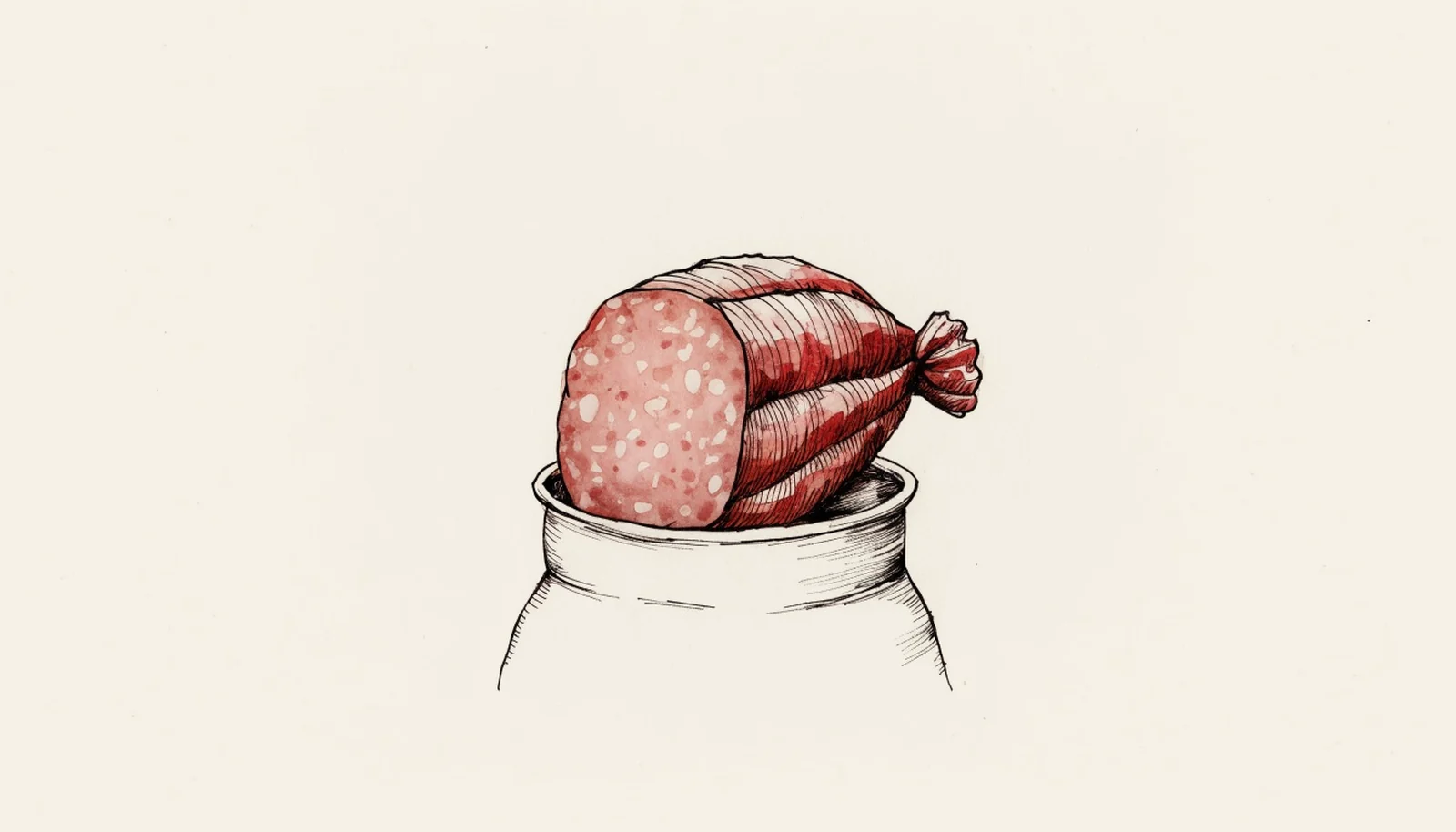
Salame genovese in Liguria means the salami of Sant’Olcese, a village above Genoa: a mixture of pork and beef, seasoned and lightly smoked over wood. Genoa salami on an American deli counter is a different product with a different composition and no smoke. Knowing which of the two you want is the first question in sourcing an Italian ingredient in the United States.
The two share a name and a distant ancestry. Almost everything else about them diverges, and the divergence is not a story about authenticity.
What the Ligurian original actually is
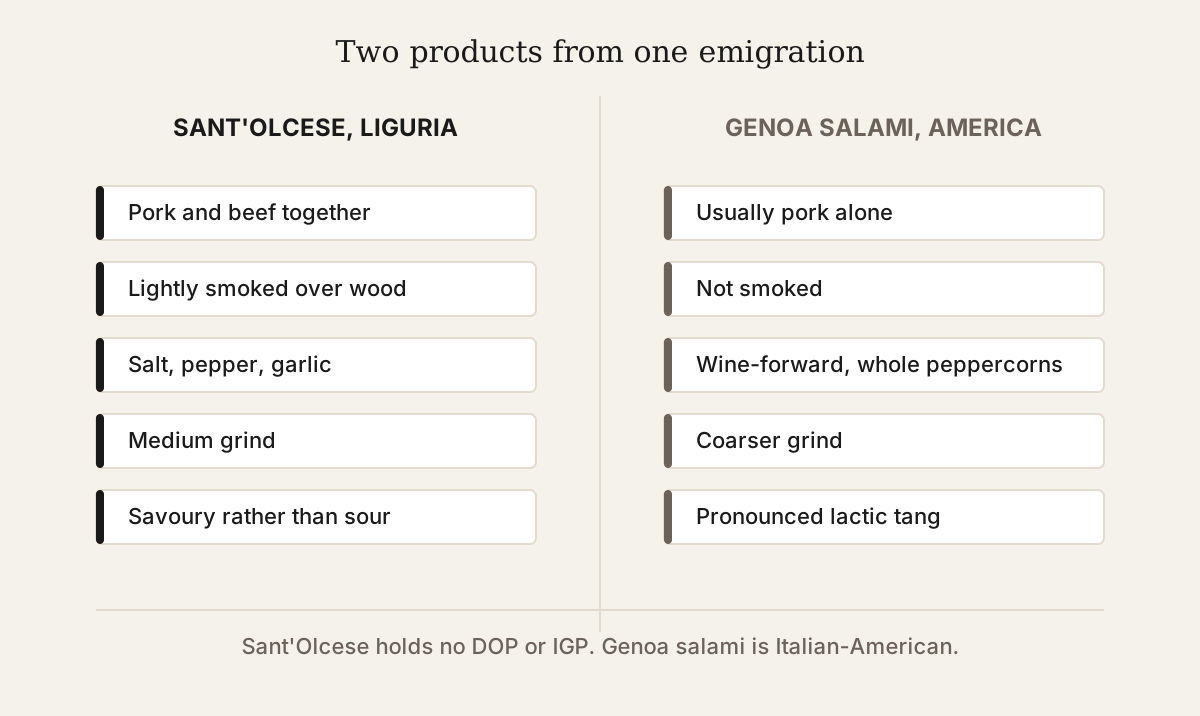
Salame di Sant’Olcese is made from pork and beef together, ground medium, seasoned with salt, pepper and garlic, cased and then lightly smoked before ageing.
The beef is the composition that marks it. Most Italian salami is pork alone. A meaningful proportion of beef is unusual and it gives the Sant’Olcese a firmer bite and a darker lean.
The smoking is light and is genuine. Ligurian practice ran to a brief smoke over local wood, which is uncommon in Italian salumi generally and is not a modern shortcut here.
The grind is medium rather than the coarse cut of the southern sausages or the fine mill of a Milano.
Nostrano genovese is the same tradition under a broader local label, nostrano meaning simply local, of this place.
It has no DOP or IGP. Sant’Olcese salami is a local speciality recognised regionally and unprotected at European level, so the name is not legally reserved.
Genoa salami in America, and where it came from
Genoa salami is a large and settled American deli category, and it is not an imitation of Sant’Olcese so much as a separate development from the same emigration.
It is usually pork alone, sometimes with a little beef, and is not smoked.
It is tangier than most Italian salami. A more pronounced lactic fermentation gives the sourness that Americans recognise as the Genoa character, and that tang is the category’s defining trait here.
It is coarser than Milano and wine-forward, frequently with visible whole peppercorns.
It is an Italian-American product with its own century of history. Ligurian emigrants brought a salami tradition to American cities and it evolved under different conditions, ingredients and tastes.
Calling it fake misdescribes it. The useful question is not whether it is authentic but which of the two products you are trying to buy.
Which one you are buying
The label rarely distinguishes them, so the evidence is composition, smoke and price.
Read the meat list. Beef alongside pork points to the Ligurian tradition. Pork alone points to the American category.
Smell for smoke. A faint smoke note is Sant’Olcese; its absence is the American product. Nothing else in the two traditions smells smoky.
Judge the tang. A pronounced sourness is the American Genoa signature. The Ligurian salami is savoury rather than sour.
Checked on 13 August 2026, the first page of United States results for salame genovese returned reference entries for Sant’Olcese and nostrano genovese alongside an American producer, which describes that search on that date rather than recommending any seller. The Italian sense dominates that particular phrasing, while searching for Genoa salami returns the American category, and that is a useful practical distinction between two search terms.
Neither is hard to find in its own market. American Genoa is in every supermarket; Sant’Olcese requires a specialist importer and is genuinely scarce here.
How to judge a slice
Judge it on the grain, then the colour, then the aroma.
The grain should be evenly defined, with fat in distinct particles against the lean. Smearing is the usual production fault.
A darker lean than you expect is normal in the Ligurian version because of the beef, and is not a sign of over-ageing. In an all-pork Genoa a dark lean does suggest age.
Fat should be white and firm. Yellow fat means age in either product.
No grey ring at the rim. A grey ring means the exterior dried faster than the interior.
In the American product, sourness should be pleasant rather than sharp. An acetic or vinegary edge is over-fermentation rather than style.
In the Ligurian product, smoke should be faint. A strong smoke note means a heavy hand or a liquid smoke shortcut.
What it should cost
Expect roughly 10 to 18 dollars a pound for American Genoa salami and 25 to 40 dollars a pound for imported Sant’Olcese where you can find it.
The gap is a distribution gap rather than a quality gap. Genoa salami is produced at industrial scale in the United States; Sant’Olcese is a village product crossing an ocean in small quantities.
Cheap Genoa salami is not suspicious. It is a high-volume everyday product and the price reflects scale.
Very cheap salami sold as Genoa with a long ingredient list is a different matter, and milk proteins and polyphosphates are the things to look for.
How to use it
Eat either sliced thin at room temperature. Both are sandwich and board salami rather than cooking ones.
American Genoa’s tang makes it the one that stands up to strong company: sharp provolone, hot peppers, vinegary dressing, which is precisely the Italian-American sub it built its career in.
Sant’Olcese suits plainer treatment. Bread, a mild cheese, a Ligurian white. Its smoke and beef are subtle and strong accompaniments bury them.
Serve both at room temperature. Cold, the fat is waxy and the tang in the American product turns harsh.
Cooking is a waste of either, though Genoa’s robustness survives it better.
Storage
Whole and wrapped in paper, several weeks refrigerated. Sliced, four to five days.
Paper rather than plastic for both, so the casing continues to breathe.
Trim the cut face if it has darkened before slicing again.
The white bloom on a natural casing is the intended mould. Coloured fuzzy growth is not.
The smoked Ligurian version keeps marginally better, since light smoking adds a small preservative effect on the surface.
Frequently asked questions
Is Genoa salami actually from Genoa?
Genoa salami as sold in the United States is an Italian-American product rather than an import from Genoa, developed by Ligurian emigrants and their descendants over more than a century. The salami actually made near Genoa is Sant’Olcese, which contains beef and is lightly smoked, neither of which is typical of the American category. Both are legitimate products with a shared ancestry.
Does salame genovese contain beef?
Salame di Sant’Olcese, the Ligurian original, contains a meaningful proportion of beef alongside pork, which is unusual in Italian salami and gives it a firmer bite and darker lean. American Genoa salami is usually pork alone or pork with a small amount of beef. The meat list on the label is the most reliable way to tell which tradition a product belongs to.
Is salame genovese smoked?
Salame di Sant’Olcese is lightly smoked over wood, which is a genuine part of the Ligurian tradition and rare among Italian salami generally. American Genoa salami is not smoked. A faint smoke note is therefore a reliable indicator that you have the Ligurian product rather than the deli-counter category.
Why is Genoa salami sour?
Genoa salami as made in America is sour because of a more pronounced lactic fermentation, which developed into the defining character of the category rather than being a fault. The sourness should read as a pleasant tang. A sharp acetic or vinegary edge indicates over-fermentation and is a genuine fault rather than an intensified style.
Does salame genovese have a DOP or IGP?
Salame genovese holds no DOP and no IGP in either sense of the name. Sant’Olcese salami is recognised as a local Ligurian speciality without European protection, and Genoa salami is an unprotected American style name. In both cases the producer and the ingredient list carry the whole judgement, since no mark is doing any work.
CalItalia Food covers Italian ingredients: what they are, how to tell a good one from an ordinary one, and where to buy them in the United States.