Spianata: The Salami That Is Pressed Flat, and Why
A flattened Calabrian or Roman salami with a wide oval slice. What the pressing does to the cure, how piccante differs from romana, and how to judge and use one.
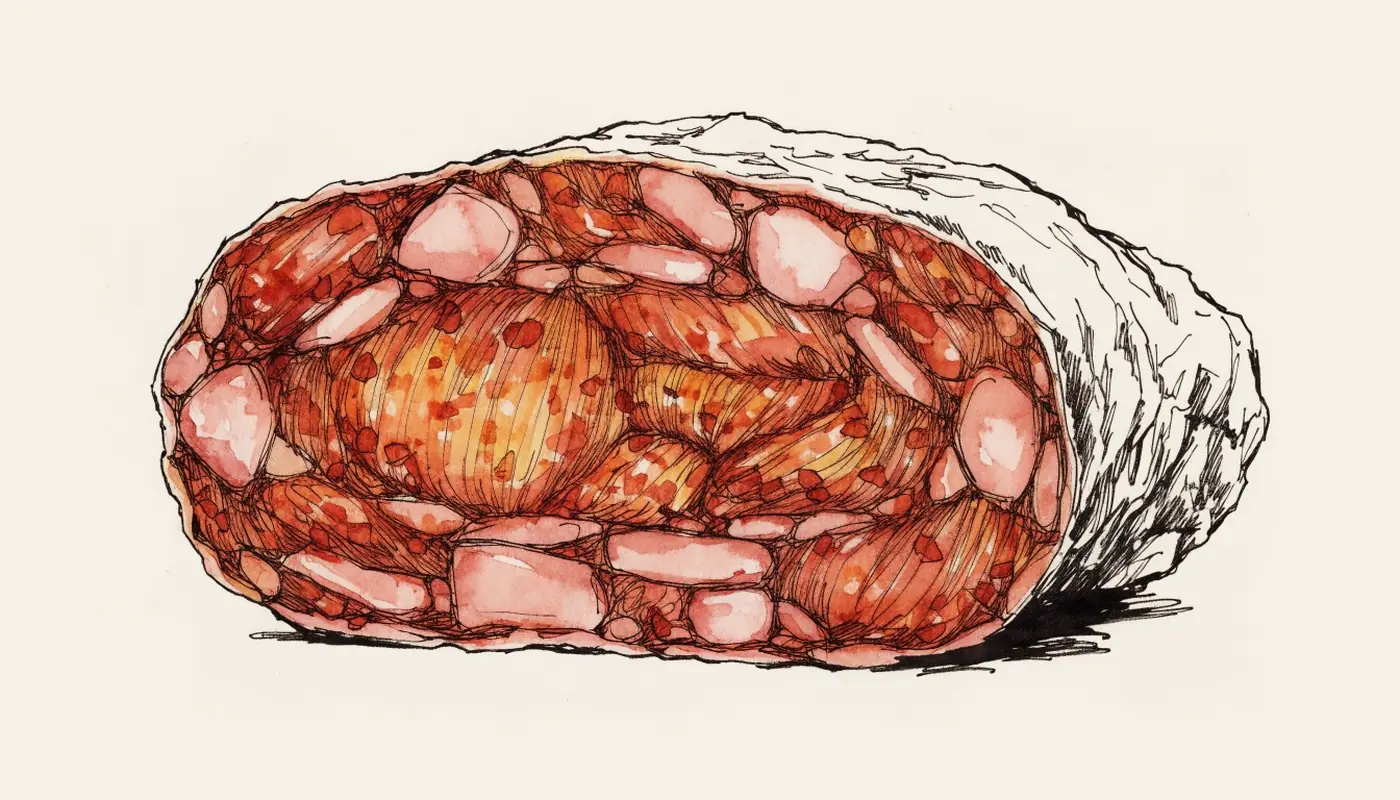
Spianata is a salami pressed flat during curing so that the finished salume is a flattened oval rather than a cylinder, giving a wide slice. The name means flattened, and the pressing is a production decision rather than a shape it happens to have. Like the other unmarked Italian ingredients on this site, it is judged on the producer and the ingredient list.
Two spianate are commonly sold, a hot Calabrian one and a milder Roman one, and they are related by technique rather than by recipe.
What spianata actually is
Spianata is ground seasoned pork stuffed into a wide casing and then pressed between boards or plates during the early part of its cure, so it dries in a flattened form.
The pressing happens while the salami is still soft. Once the mixture has set, the shape is fixed and the salami finishes drying flat.
The Calabrian version is a chilli product. Spianata piccante is seasoned with Calabrian chilli and sweet paprika, which gives it a deep red colour throughout as well as its heat.
The Roman version is milder. Spianata romana is larger, seasoned with pepper and garlic rather than chilli, and is not a hot salami.
The grind is medium to coarse in both, with visible fat.
The casing is wide to begin with, since a narrow salami pressed flat would give a thin strip rather than a broad oval.
What the pressing actually does
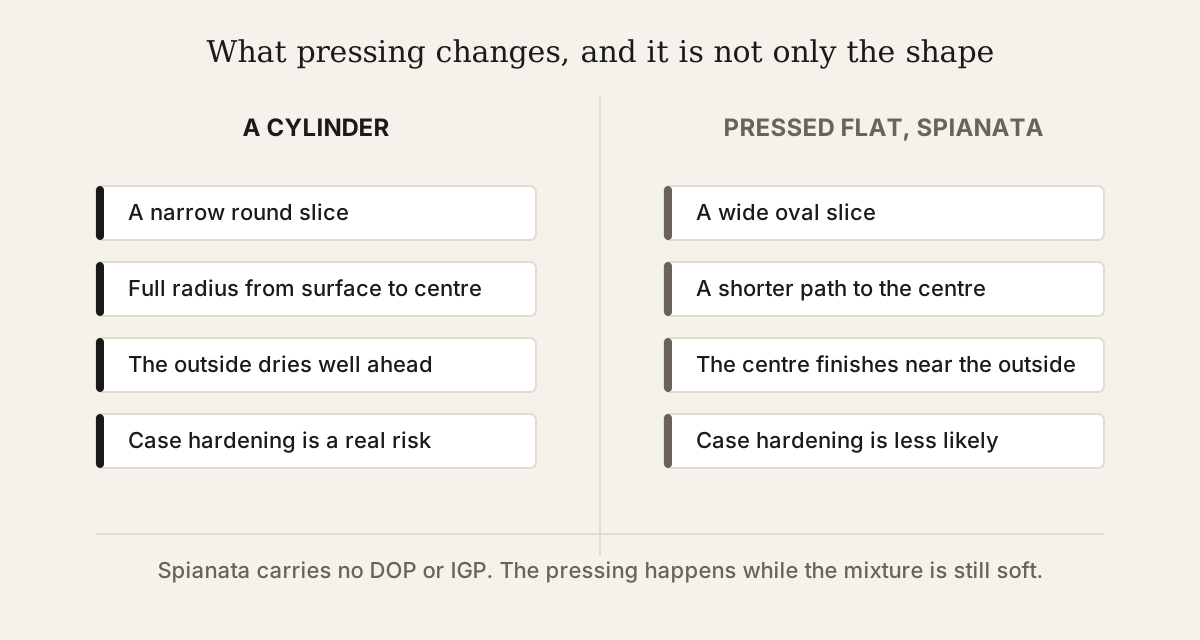
Flattening a salami changes two things that matter, and only one of them is about appearance.
It widens the slice face. A flattened oval gives a much broader slice than a cylinder of the same weight, which is the visible reason and the one usually given.
It also shortens the distance from surface to centre. A pressed salami has less depth for moisture to travel through, so it dries more evenly and the centre finishes closer to when the exterior does.
That reduces the risk of case hardening, the fault where the outside dries into a barrier that traps moisture inside. Wide cylindrical salami are prone to it and a pressed one is less so.
It is therefore a technique with a technical payoff, not merely a regional habit, which is why the same idea appears independently in Calabria and Lazio.
The broad slice suits the way it is eaten. A wide flat piece covers bread in one layer, which is exactly what a sandwich salami wants to do.
Piccante against romana
The two spianate share a shape and differ in almost everything else.
Spianata piccante is Calabrian and hot. Chilli and paprika throughout, deep red, assertive, and part of the same Calabrian tradition as nduja and soppressata.
Spianata romana is from Lazio and mild. Larger, paler, seasoned with pepper and garlic, and considerably more restrained.
Neither is a variant of the other. They are two regional products that arrived at the same forming technique.
Piccante is far more common in the United States, and a salume sold simply as spianata on an American counter is usually the Calabrian one.
Checked on 13 August 2026, the first page of United States results for spianata returned specialist salumi retailers and cheese sellers, with the Calabrian piccante sense dominant, which describes that search on that date rather than recommending any seller.
Designations, and the absence of one
Spianata carries no DOP and no IGP under that name, in either its Calabrian or its Roman form.
Calabria’s protected pork products are named individually. Soppressata di Calabria, Capocollo di Calabria, Pancetta di Calabria and Salsiccia di Calabria hold DOPs. Spianata is not among them.
So the name describes a form rather than an origin, in the same way salame Milano and salame Toscano do.
A spianata made outside Calabria may legitimately be called spianata piccante, and a good deal of what is sold in the United States is made domestically.
The judgement therefore rests on the producer, the colour and the ingredient list. With no specification behind the name, that is all there is.
How to judge a slice
Judge it on colour and grain, then on the edges, then on the smell.
In a piccante, the red should run all the way through and look like ground chilli and paprika rather than dye. A bright uniform scarlet with no visible flecks suggests colouring rather than seasoning.
The grain should be defined, with fat particles distinct against the lean. Smearing is the usual industrial fault.
Look at the pressed edges. A properly pressed spianata has slightly compacted, denser edges. A salami that is merely oval because it was hung against something is not the same product.
No grey ring at the rim, and no hard translucent band, which would indicate case hardening despite the pressing.
It should smell of chilli and cured pork, or of pepper and garlic in the romana. A dusty, flat smell means old spice.
Fat should be white and firm. Yellowing means age.
What it should cost
Expect roughly 16 to 30 dollars a pound in the United States.
The wide format uses more casing and more handling than a simple hanging salami, and the pressing adds a labour step, which puts it slightly above an everyday salami and below the protected whole-muscle products.
Domestic American versions are common and often very good, particularly from producers already making Calabrian styles.
Very cheap spianata piccante is worth reading the label on, since paprika and colouring can produce the appearance of a chilli salami at low cost.
How to use it
Eat it sliced thin at room temperature. The wide slice makes it the natural sandwich salami of the group.
Spianata piccante’s heat means it wants plain company rather than competition: bread, a mild cheese, a bland vegetable. Putting it next to nduja doubles the chilli and hides both.
It is very good on pizza. The wide slice cut into pieces distributes chilli and rendering fat across the surface in a way a narrow salami cannot.
Cooking is legitimate here. The seasoning is robust enough to survive heat, which is not true of the northern salami.
Serve at room temperature on a board. Cold, the fat is waxy and the chilli reads harsh rather than warm.
Storage
Whole and wrapped in paper, several weeks refrigerated. Sliced, four to five days.
The flat form means more surface relative to volume, so it continues drying faster than a cylinder would and hardens rather than spoils if left too long.
Keep it in paper rather than plastic.
Trim the cut face if it has darkened or hardened.
A hardened piece is still useful chopped into a cooked dish, where the concentrated chilli is an advantage.
Frequently asked questions
Why is spianata flat?
Spianata is flat because it is pressed between boards or plates during the early part of its cure, while the mixture is still soft enough to take a shape. The pressing widens the slice face and, less obviously, shortens the distance moisture has to travel from centre to surface, so the salami dries more evenly and is less prone to case hardening than a wide cylinder.
Is spianata the same as soppressata?
Spianata and soppressata are different products, although both are sometimes pressed and both come out of southern Italian tradition. Soppressata di Calabria holds a DOP and is defined by its cut and composition, while spianata is a form description with no protected designation. Spianata is typically ground finer and pressed flatter, giving a much broader slice.
How hot is spianata piccante?
Spianata piccante is genuinely hot, seasoned with Calabrian chilli alongside sweet paprika, and the heat runs through the whole salami rather than sitting in flecks. It is comparable to other Calabrian chilli salumi and milder than nduja, which carries a far higher proportion of chilli. The Roman spianata, by contrast, carries no chilli at all.
What is the difference between spianata piccante and spianata romana?
Spianata piccante is Calabrian, red, and seasoned with chilli and paprika, while spianata romana is from Lazio, paler, larger and seasoned with pepper and garlic without heat. They share only the flattened form, having arrived at the same technique independently. On an American counter an unqualified spianata is usually the Calabrian one.
Does spianata have a DOP?
Spianata carries no DOP and no IGP, despite Calabria holding protected designations for soppressata, capocollo, pancetta and salsiccia. The name refers to the pressed form rather than to an origin, so it may be used by producers anywhere including in the United States. Judge it on the visible chilli, the definition of the grain and the ingredient list.
CalItalia Food covers Italian ingredients: what they are, how to tell a good one from an ordinary one, and where to buy them in the United States.