
Testa in Cassetta: Italian Head Cheese, and the Sweet Spices In It
Boiled head meat set in its own gelatin with pine nuts, pistachios and warm spice. The Ligurian and Piedmontese tradition, why the English name puts people off, and how to judge and use it.
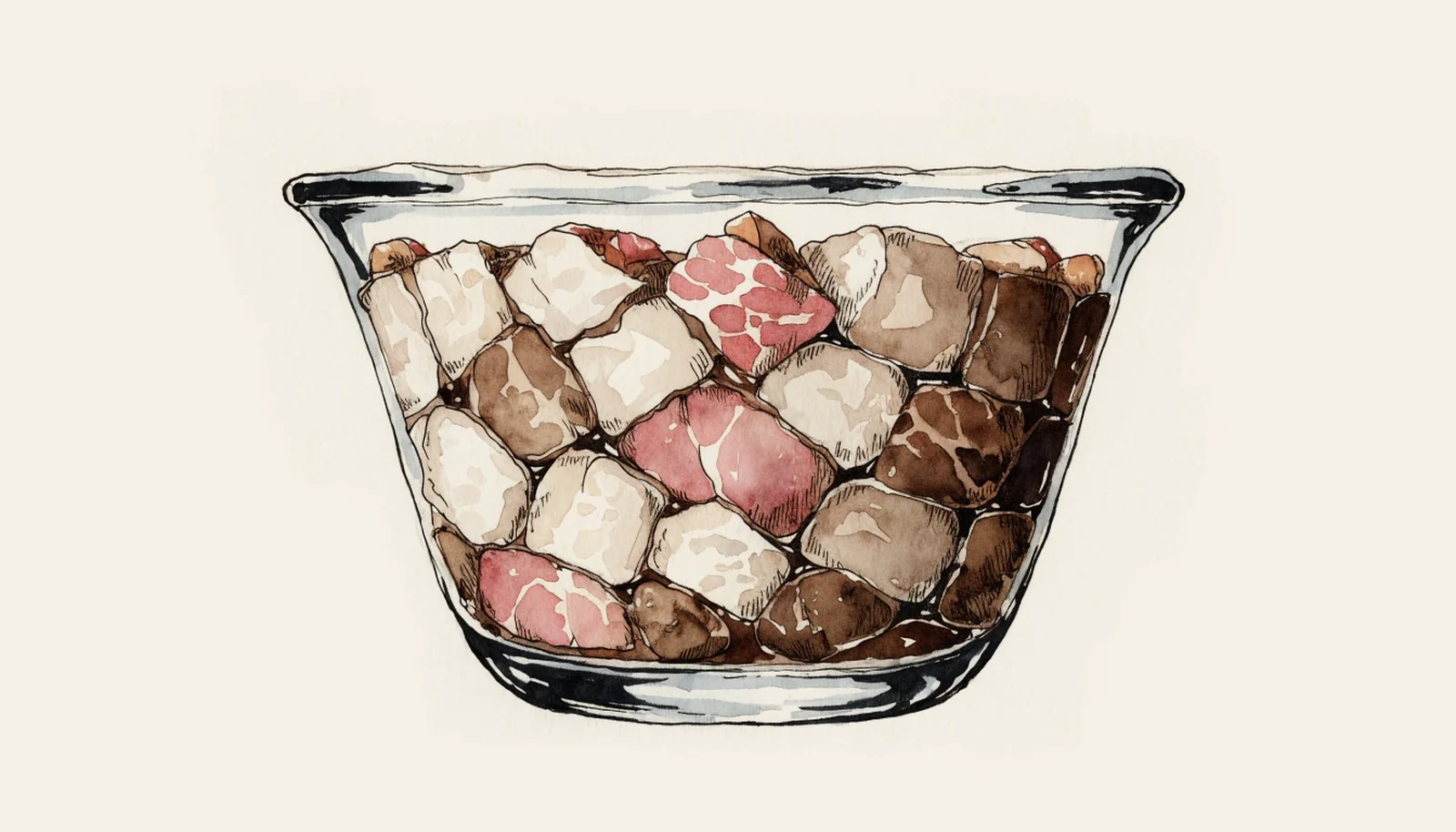
Testa in cassetta is Italian head cheese: meat from a boiled pig’s head, with the tongue, set in its own natural gelatin in a rectangular mould and sliced cold. The Ligurian and Piedmontese versions carry pine nuts, pistachios and warm spices such as cinnamon, cloves and nutmeg. It is one of the Italian ingredients better found locally than imported.
The name translates as head in a box, which is accurate and does the product no favours in English. That framing problem is worth clearing before anything else, because it is the only real obstacle between an American buyer and a genuinely good salume.
What testa in cassetta actually is
Testa in cassetta is made by simmering a pig’s head until the meat falls away, chopping that meat with the tongue and sometimes the rind, seasoning it, and pressing it into a rectangular mould where the cooking liquid sets into gelatin around it.
The gelatin is natural. Nothing is added to set it. A pig’s head is rich in collagen, and the stock made from boiling it gels on cooling by itself.
The cut is coarse and visible. Pieces of meat and tongue stay identifiable in the slice, which distinguishes a good one from an emulsified industrial pâté.
Pine nuts and pistachios appear in the Ligurian tradition, distributed through the mixture, which is unusual for a head cheese anywhere.
The spicing is warm and sweet. Cinnamon, cloves, nutmeg and sometimes mace alongside pepper, in the same register as the northern cured meats.
The mould gives the shape. Cassetta means small box, and the rectangular slice is a consequence of the form rather than a stylistic choice.
It is a cooked product, not a cured one. No salt cure, no drying, no ageing. This governs how it keeps.
Why the English name is the problem
Head cheese is an accurate translation of a category and an unhelpful description of this product.
It contains no cheese. The word describes the set, sliceable form rather than any dairy content, which is true of the German Sülze and the French fromage de tête as well.
Naming the raw material is unusual in English food labelling. Very few products are named for the part of the animal in a way that forces the buyer to picture it, and the ones that are tend to be niche.
The same product is unremarkable across Europe. Brawn in Britain, fromage de tête in France, Sülze in Germany, and testa in cassetta or coppa di testa in Italy.
Coppa di testa is the more common Italian name. It appears across central and southern Italy, and it is not related to the cured neck sold as coppa despite the shared word.
The Gavi version holds Slow Food recognition, which is a mark of a product judged worth preserving rather than a legal designation.
Judge it as an assembled cold cut, which is what it is, and the name stops mattering.
How it differs from Tuscan soppressata
Italy has more than one head-based cold cut and they are not the same thing.
Tuscan soppressata is also a head product, made from the parts of the pig that do not go into salami, and is covered on this site’s soppressata page.
Testa in cassetta is set in a rectangular mould and carries the Ligurian and Piedmontese sweet spicing with nuts.
The Tuscan version is typically seasoned differently, and neither carries a protected designation.
Coppa di testa in the south frequently carries citrus peel and chilli instead of pine nuts and cinnamon.
So the category is regional throughout. There is no national Italian head cheese, and asking which region a piece comes from tells you more than the name does.
How to judge a slice
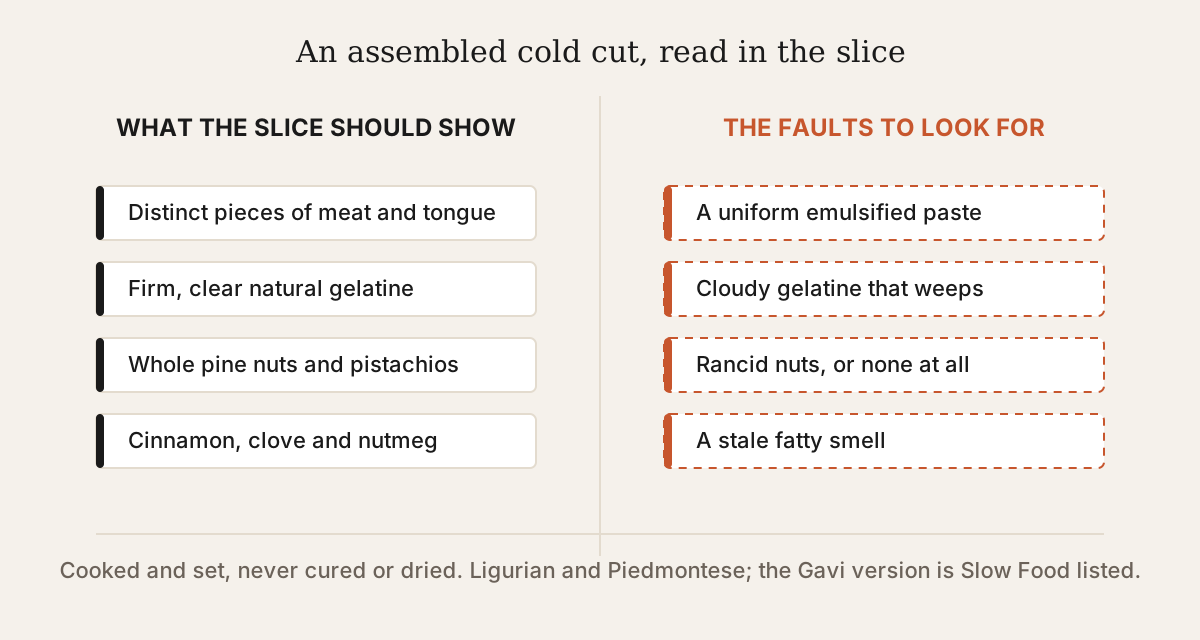
Judge it on the definition of the pieces, then the gelatin, then the smell.
Meat pieces should be clearly visible and distinct. A uniform pink paste means an emulsified industrial product rather than this.
The gelatin should be firm and clear, holding the slice together without weeping. Cloudy, soft or watery gelatin means it was poorly made or is past its point.
The slice should hold its shape when lifted, and should not collapse.
Nuts should be intact where the version includes them, and should not be soft or rancid. Pine nuts in particular go rancid readily.
It should smell clean and faintly spiced. Any sourness, or a stale fatty note, means it is old.
Checked on 13 August 2026, the first page of United States results for testa in cassetta returned Slow Food and Italian regional reference material rather than United States sellers, which describes that search on that date rather than recommending any seller. Counting rule: a result counts as a seller when it offers the product for purchase into the United States. On that rule the first page carried none.
What it should cost and where to look
Expect roughly 12 to 22 dollars a pound where it is available, which makes it one of the cheapest things on a salumi counter.
The price reflects the raw material rather than the labour. A pig’s head is an inexpensive cut and the work involved is considerable, so the product is undervalued relative to the effort in it.
A whole-animal butcher is the realistic route in the United States, along with Italian-American salumerie that still make their own.
American head cheese is widely sold and is a different tradition, usually vinegary rather than sweet-spiced and without nuts. It is not a substitute for the Ligurian product so much as a relative.
Import presence is negligible. As a cooked, moist product with a short life, it is a poor candidate for shipping.
How to use it
Eat it cold, sliced thin, with something sharp alongside. It is not a cooking ingredient.
Its richness needs cutting: a mustard, a pickle, a sharp salad leaf, a piece of crusty bread. In Liguria and Piedmont it is antipasto rather than a sandwich meat.
Slice it thin with a sharp knife. The gelatin tears under a blunt blade and the slice falls apart.
Serve it cool but not cold. Straight from the refrigerator the gelatin is rubbery and the spicing is closed; ten minutes out is enough.
A sharp dressing suits it. A little vinegar or a mustard is traditional and does the same job in every European version of the product.
Do not heat it. The gelatin melts and the whole structure is lost.
Storage
Refrigerated and wrapped, three to five days. This is a cooked product and keeps like one.
It is not a cured salume and the comparison misleads. The salami around it on a counter keep for weeks because salt and drying preserve them. Nothing preserves this.
Keep it covered so the cut face does not dry and the gelatin does not weep.
Discard it if the gelatin has gone cloudy or watery, or if the fat smells stale, both of which appear before anything looks obviously wrong.
It does not freeze. The gelatin breaks on thawing and releases water, and the slice will not hold together.
Frequently asked questions
Does head cheese contain cheese?
Head cheese contains no cheese and no dairy at all. The word describes the set, sliceable form of the product rather than any ingredient, and the same convention appears in the French fromage de tête. Testa in cassetta is meat from a boiled pig’s head, set in the natural gelatin that the head’s own collagen produces on cooling.
What is in testa in cassetta?
Testa in cassetta contains meat from a boiled pig’s head together with the tongue, set in gelatin rendered from the head itself, and seasoned with warm spices such as cinnamon, cloves and nutmeg. The Ligurian and Piedmontese versions also carry pine nuts and pistachios. Nothing is added to make it set, since a pig’s head supplies more than enough collagen.
Is testa in cassetta the same as coppa di testa?
Testa in cassetta and coppa di testa describe the same kind of product under different regional names, and the seasoning varies with the region. Testa in cassetta is the Ligurian and Piedmontese name and carries sweet spices with pine nuts. Coppa di testa further south frequently uses citrus peel and chilli instead. Neither is related to the cured neck sold as coppa.
How long does testa in cassetta keep?
Testa in cassetta keeps three to five days refrigerated, because it is a cooked product rather than a cured one and nothing preserves it beyond cooking. The salami beside it on a counter keep for weeks because salt and drying protect them, which is a comparison that misleads people regularly. It also does not freeze, since the gelatin breaks on thawing.
Is Italian head cheese the same as American head cheese?
Italian and American head cheese are related traditions with different seasoning. The Ligurian and Piedmontese versions are spiced with cinnamon, cloves and nutmeg and carry pine nuts and pistachios. American head cheese is typically vinegary and sharply seasoned, without nuts or sweet spice. Both set head meat in natural gelatin, so the method is shared and the result tastes quite different.
CalItalia Food covers Italian ingredients: what they are, how to tell a good one from an ordinary one, and where to buy them in the United States.