
Cacciatorini: The Pocket Salami With a DOP Nobody Reads
Small mild salami sized to be carried, protected as Salamini Italiani alla Cacciatora DOP. Why the size drives everything, why the DOP mark says something else, and how to judge and use them.
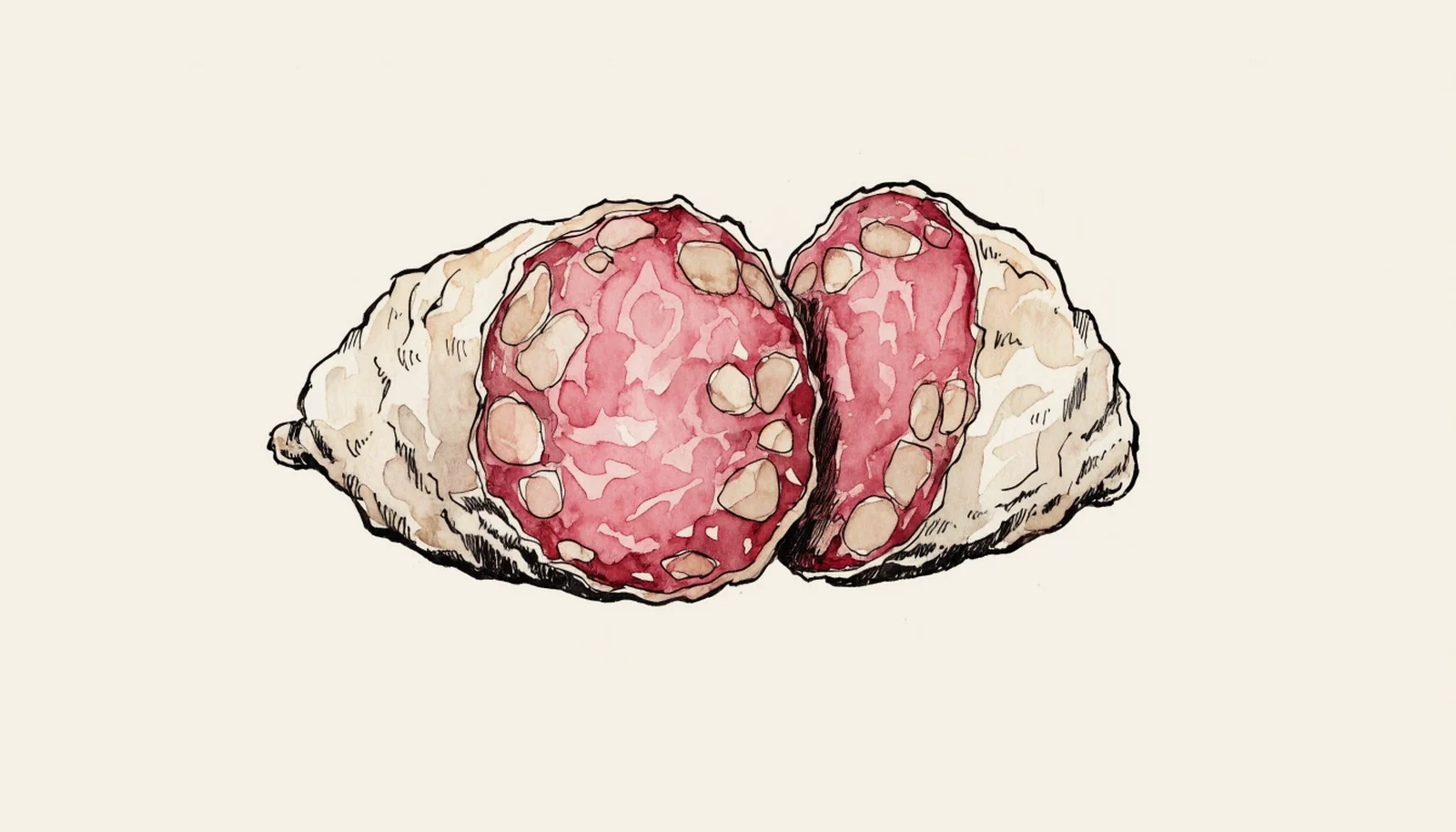
Cacciatorini are small, mild pork salami, roughly the length of a finger, cured quickly because of their size and eaten young. They are protected, under a name almost nobody uses: Salamini Italiani alla Cacciatora DOP. Reading that mark is part of judging an Italian ingredient at the counter.
The gap between the name on the mark and the name on the shelf is the practical problem with this product, and it is worth resolving before anything else.
What cacciatorini actually are
Cacciatorini are ground pork, seasoned simply, stuffed into a narrow casing in short lengths and cured for a matter of days to a few weeks.
The size is the product. A cacciatorino is small enough to be carried in a pocket, which is the origin of the name: cacciatore means hunter, and these were the salami taken out for the day.
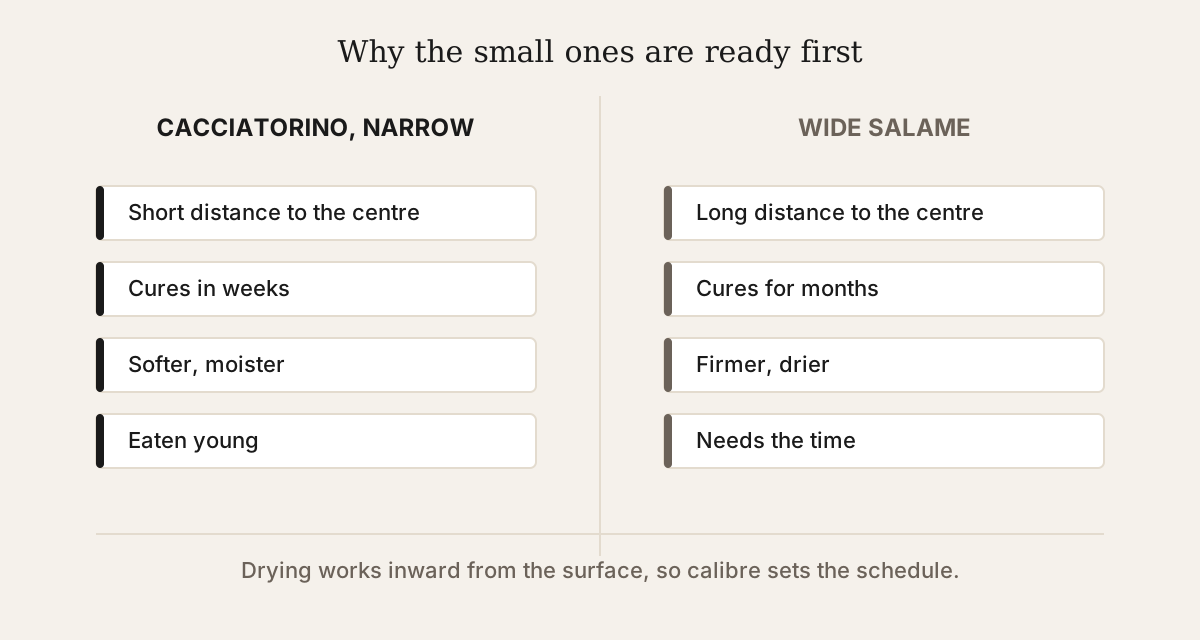
The cure is very short, because a narrow salami dries fast. Where a wide salame needs months for moisture to reach the surface from the centre, these need very little time. Salame di Varzi turns that difference into four named formats.
The seasoning is mild. Salt, pepper, garlic, sometimes a little wine. Nothing assertive, which suits a salami eaten in quantity as food rather than tasted as a delicacy.
The grind is medium, with fat visible but not in large pieces.
They are sold in pairs or in strings, tied together, which is how they are cured and how they are still packaged.
The name problem
The protected name and the common name are different words, and the shelf usually carries the common one.
The DOP is Salamini Italiani alla Cacciatora, which translates as small Italian salami in the hunter’s manner.
Nobody says that. Cacciatorini, cacciatorino in the singular, and cacciatore are what shops, producers and customers actually use.
So the DOP mark may be present while the word cacciatorini is what you see, or the reverse, and neither tells you about the other.
Look for the DOP mark itself rather than for any particular word. That is the only reliable signal.
Cacciatore is also a cooking term. Pollo alla cacciatora is a braised chicken dish and has nothing to do with this salami beyond the shared adverbial phrase, which clutters search.
Plenty of unprotected cacciatorini exist, in Italy and in the United States, made in the style and perfectly good.
What the DOP covers
Salamini Italiani alla Cacciatora is a DOP, which is the stronger European mark, and its scope is broader than most.
A DOP requires the whole chain in the zone. The pigs, the production and the ageing.
The zone is unusually large. It covers a substantial band of northern and central Italian regions rather than a single province or town, which is uncommon for a DOP and reflects that this was always a widespread everyday product rather than a local speciality.
It specifies heavy pigs from the traditional Italian pool, the same animals behind the great hams.
It sets a minimum ageing which is short in absolute terms, since the format cannot support a long one.
It restricts the composition, which is the part that matters most on a cheap everyday product where shortcuts are tempting.
How to judge them
Judge them on firmness, then the cut face, then the smell.
They should be firm and springy rather than hard. A rock-hard cacciatorino has dried past its point, which happens easily at this calibre.
The grain should be defined, with fat in distinct particles. Smearing means the mixture warmed during grinding.
The lean should be a rose to light red, without a grey ring. In a very thin salami a grey ring appears readily and means it dried too fast. The same is true of salsiccia secca.
Fat should be white and firm. A small salami has high surface area, so yellowing appears sooner than in a large one.
They should smell sweet and porky, mildly garlicky. Sourness is a fermentation fault with nowhere to hide in a product this lightly seasoned.
The floor for this page rests on a single extractable competitor. That is not a measurement, so treat any figure here as a guide rather than a surveyed range.
What they should cost
Expect roughly 15 to 28 dollars a pound in the United States, which makes them among the cheaper things on a salumi counter despite the DOP.
The short cure is why. Very little time, space or weight loss is involved, so even a protected version does not carry the cost structure of an aged product.
Checked on 13 August 2026, the first page of United States results for cacciatorini returned specialist food retailers and salumerie, which describes that search on that date rather than recommending any seller. Availability is reasonable, largely through Italian-American shops.
Domestic American versions are common and often good. They cannot carry the DOP and are judged on the grind, the fat and the producer.
A very low price is not a warning here in the way it would be for a long-cured product, since this was always an everyday salami.
How to use them
Eat them whole or sliced thick, at room temperature, as food rather than as a tasting item.
Their mildness and portability are the point. They are the salami to put in a bag, to eat with bread and cheese, to hand to somebody walking out of the door.
Slice them thick or bite them. A thin slice of something this narrow is a scrap, and the traditional way is to cut short lengths.
They suit plain company, bread, a mild cheese, a piece of fruit.
Cooking them is legitimate but pointless. They will render into a dish without complaint, and a cheaper cured pork does the same for less.
Serve at room temperature, though these are more forgiving of being eaten cold than a fatty salume is.
Storage
Whole and wrapped in paper, several weeks refrigerated. They do not need refrigeration for short periods, which is what made them a carrying food.
The high surface-to-volume ratio means they continue drying quickly, so they harden rather than spoil.
Paper rather than plastic, so the casing can breathe.
A hardened cacciatorino is still good chopped into a cooked dish, and is not a safety problem.
White bloom on the casing is the intended mould culture. Coloured fuzzy growth is not.
Buy the quantity you will eat, since the drying continues regardless of how carefully they are wrapped.
Frequently asked questions
Why are they called cacciatorini?
Cacciatorini means little hunter’s salami, from cacciatore, hunter. The salami are made small enough to be carried in a pocket or a bag and eaten during a day out, which is the origin of both the size and the name. The size in turn determines the short cure, so the whole product follows from that original purpose.
Do cacciatorini have a DOP?
Cacciatorini are protected under the DOP Salamini Italiani alla Cacciatora, which is a name almost nobody uses in speech or on a shelf label. Because the common name and the protected name are different words, the presence of one tells you nothing about the other. Look for the DOP mark itself rather than for any particular wording.
Why is the cacciatorini DOP zone so large?
The Salamini Italiani alla Cacciatora DOP covers a wide band of northern and central Italian regions rather than a single province, which is unusual for a DOP. The breadth reflects that this was always a widespread everyday salami made across much of Italy rather than a local speciality tied to one town’s conditions. The mark protects the method and the pig rather than a narrow terroir.
How long do cacciatorini need to cure?
Cacciatorini cure in days to a few weeks rather than the months a full-sized salami requires, because their narrow diameter means moisture has a very short distance to travel from the centre to the surface. That short cure is why they are mild and soft rather than concentrated. Left too long they harden, which is the usual way they go wrong.
Are cacciatorini the same as pepperoni sticks?
Cacciatorini and American snack sticks share a format and little else. Cacciatorini are mild, seasoned with salt, pepper and garlic, and the protected version specifies heavy pigs and a restricted composition. Snack sticks are typically spiced for heat or smoke, made from commodity meat and often include binders and flavourings that the DOP would exclude.
CalItalia Food covers Italian ingredients: what they are, how to tell a good one from an ordinary one, and where to buy them in the United States.