
Ciauscolo: The Spreadable Salami That Is Not Nduja
A soft, mild, spreadable salame from Le Marche, ground three times and aged barely a fortnight. What the IGP covers, how it differs from nduja, and how to judge and use one.
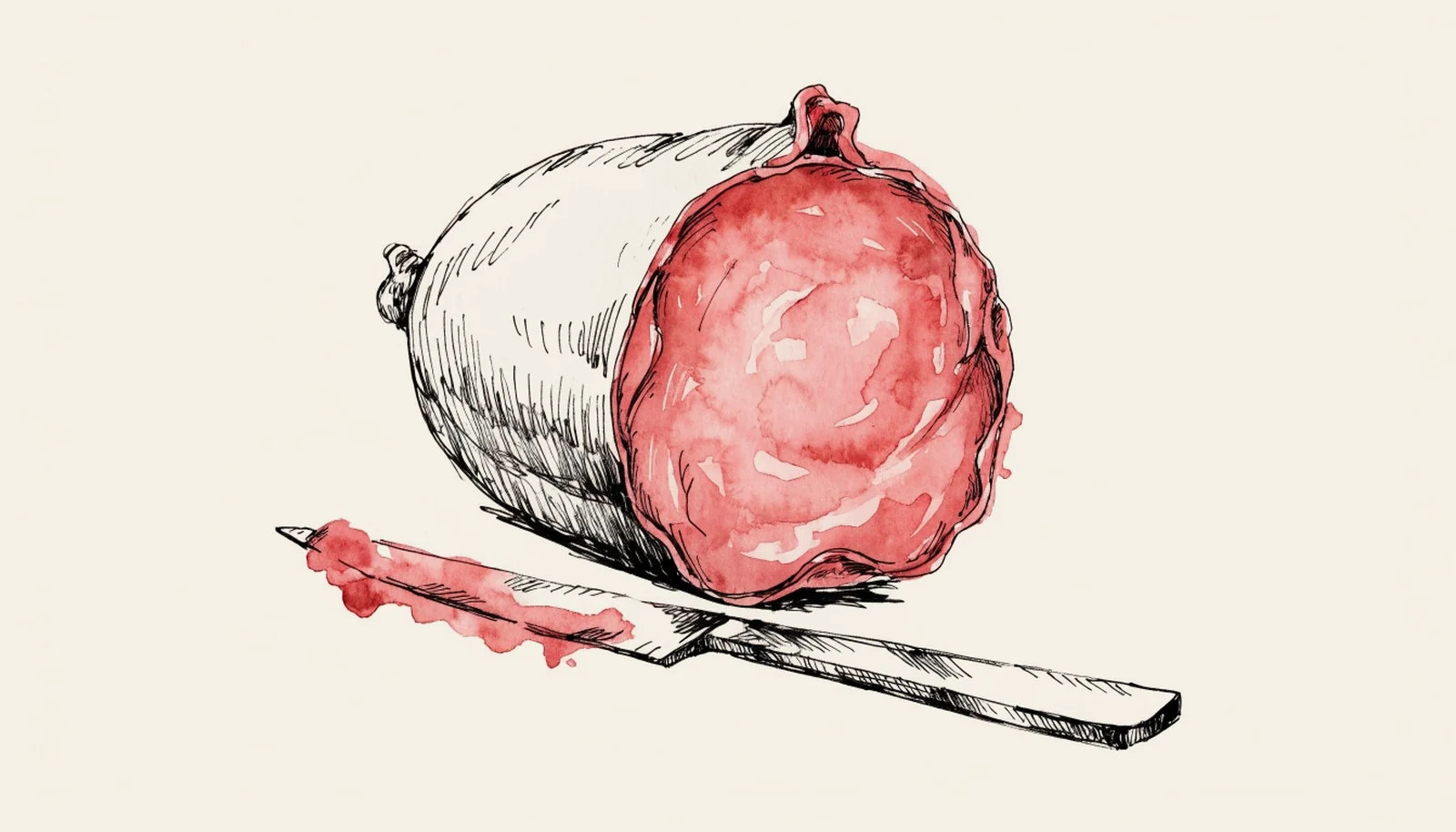
Ciauscolo is a soft, spreadable pork salami from Le Marche, ground repeatedly until the mixture becomes a paste, seasoned with salt, pepper, garlic and wine, and aged for as little as fifteen days. It carries an IGP and it is spread on bread with a knife rather than sliced. It is one of the Italian ingredients that are hard to source in the United States.
Italy has two well-known spreadable salumi and the other one is nduja. Almost everything written about ciauscolo in English compares the two, and the comparison is worth making properly, because they are alike in exactly one respect.
What ciauscolo actually is
Ciauscolo is a mixture of pork belly, shoulder and trimmings, passed through the grinder two or three times until it is smooth, seasoned, cased in natural gut and aged briefly.
The repeated grinding is the technique. A single pass gives a conventional salami grain; two or three passes break the fat and lean down into an emulsion soft enough to spread at room temperature.
The fat proportion is high, and it has to be. A lean mixture ground this fine turns into a dense paste rather than a spreadable one.
The seasoning is mild. Salt, black pepper, garlic and often a little wine. There is no chilli.
Some traditional versions are lightly smoked, over beech or juniper, which is a regional variation within the style rather than a different product.
The ageing is very short, from around fifteen days, which is why the texture stays soft and the flavour stays fresh and porky rather than concentrated.
How it differs from nduja
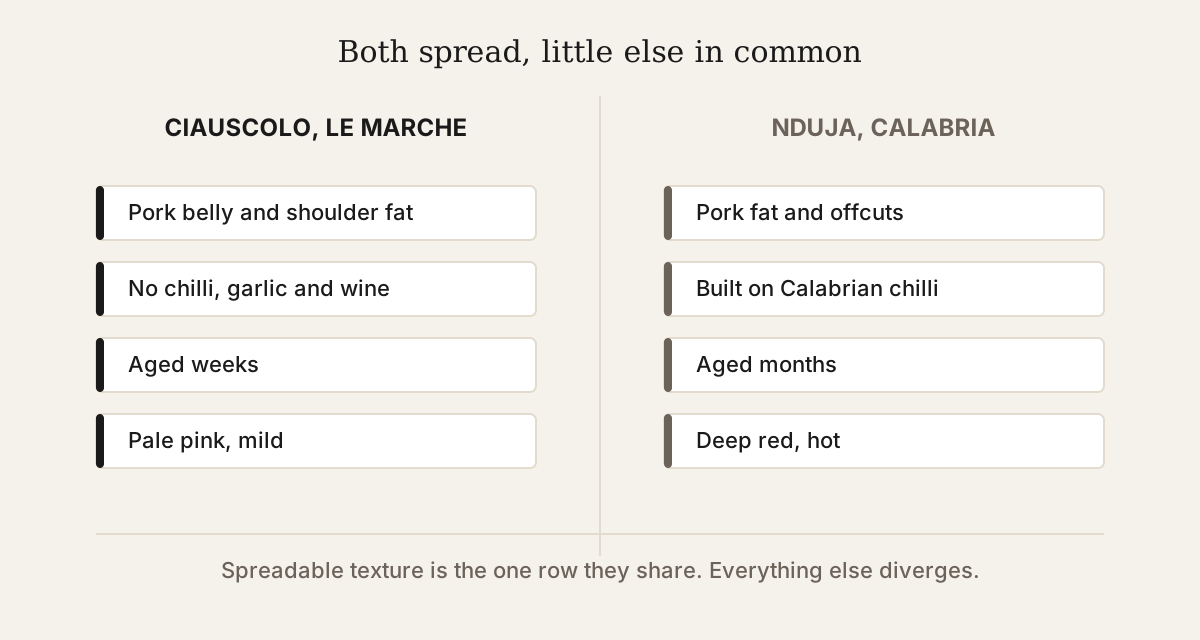
Ciauscolo and nduja share a spreadable texture and share nothing else of consequence.
Ciauscolo is from Le Marche on the Adriatic coast; nduja is Calabrian, from the far south. They are not regional variants of one preparation.
Ciauscolo is mild and nduja is very hot. Nduja’s identity rests on Calabrian chilli, which makes up a substantial share of the mixture. Ciauscolo contains none.
The softness comes from different places. Nduja is soft because of the chilli paste and the fat it is worked into; ciauscolo is soft because the meat is ground repeatedly into an emulsion.
Ciauscolo has an IGP and nduja has no protected designation at all, which reverses the usual expectation given how much better known nduja is in the United States.
They are used differently. Nduja is as much a cooking ingredient as a spread, melting into sauces and onto pizza. Ciauscolo is eaten cold on bread, and heating it wastes it.
What the IGP covers
Ciauscolo IGP ties the production to a defined zone in Le Marche and a small adjoining part of Umbria, and to a written method.
The zone is the Marche provinces of Macerata, Ancona, Ascoli Piceno and Fermo, plus part of the province of Perugia. A ciauscolo made outside that area cannot carry the mark.
IGP requires at least one production stage in the zone rather than the whole chain, so the pigs need not be born and raised there. That is the standing difference between IGP and DOP and it is not a weakness in the mark, only a narrower promise.
The specification sets the minimum ageing and the composition. This matters more than usual for a product whose whole character depends on fat proportion and grinding.
The spelling varies locally. Ciavuscolo and ciabuscolo appear in the same region for the same product, and the IGP recognises the variants.
How to judge one
Judge it by texture at room temperature first, then by colour, then by smell.
It should spread cleanly with a knife at room temperature without needing to be worked. If it crumbles it was over-aged or under-fatted; if it slumps and weeps oil it has been kept warm or is past its point.
The colour should be an even pink to dull rose. Grey through the body means oxidation, and a sharply darker rim means the outside dried much faster than the inside.
It should smell sweet, porky and faintly garlicky. Sourness or a cheesy note is a fermentation fault, and in a barely aged product that fault has had no time to be masked.
The casing should peel away cleanly from the paste beneath.
Check whether it is smoked before buying if that matters to you, since the unsmoked and lightly smoked versions taste quite different and the label does not always make it obvious.
What it should cost and where to find it
Expect roughly 25 to 40 dollars a pound in the United States where you can find it at all, and finding it is the real constraint.
Its short ageing and high moisture make it a harder product to ship and hold than a firm dry salami, which is the practical reason it is scarce here rather than any regulatory one.
Checked on 13 August 2026, the first page of United States results for ciauscolo returned reference material, a cooking publisher and a discussion thread rather than sellers, which describes that search on that date rather than recommending any seller. Counting rule: a result counts as a seller when it offers ciauscolo for purchase. On that rule the first page carried none, which is a fair signal of how thin its United States distribution is.
Italian specialist importers are the realistic route, and it is worth asking rather than searching, since this is the kind of product a good counter brings in occasionally rather than stocks.
How to use it
Spread it thickly on bread, ideally a plain unsalted Marche-style loaf, and eat it at room temperature. That is the whole intended use.
Its mildness means it takes an accompaniment well: a sharp pickle, a raw onion, a hard cheese, a glass of the region’s red.
Take it out of the refrigerator half an hour before eating. Cold ciauscolo is stiff and reads as bland, and the difference temperature makes here is larger than for any sliced salume.
Do not cook with it. This is the clearest practical line between ciauscolo and nduja. Heat splits the emulsion, the fat runs and the delicate seasoning disappears, and nduja is the product that does that job.
Storage
Refrigerated and wrapped in paper, one to two weeks once opened, which is short by salumi standards and follows directly from the short cure. The wider comparison is in the guide to how long Italian cured meat keeps.
It is a fresh product in a cured product’s clothing. The fifteen-day minimum ageing does not give it the keeping qualities of a three-month salami, so treat the dates on it seriously.
Keep it wrapped closely so the exposed face does not dry and darken, and trim that face if it does.
It does not freeze well. The emulsion breaks on thawing and the texture, which is the entire point of the product, does not come back.
Frequently asked questions
Is ciauscolo the same as nduja?
Ciauscolo and nduja are different products that share only a spreadable texture. Ciauscolo is a mild pork salame from Le Marche, made spreadable by grinding the meat repeatedly, and it holds an IGP. Nduja is a very hot Calabrian preparation built on chilli, carries no protected designation, and is used as a cooking ingredient as much as a spread.
Why is ciauscolo spreadable?
Ciauscolo is spreadable because the meat is passed through the grinder two or three times rather than once, which breaks the lean and the fat into an emulsion, and because the fat proportion is high enough to keep that emulsion soft. The short ageing period contributes as well, since the product never dries out enough to firm up.
Is ciauscolo spicy?
Ciauscolo is not spicy and contains no chilli. It is seasoned with salt, black pepper, garlic and usually wine, and its character is mild and sweet. Anyone expecting heat is thinking of nduja, which is the Calabrian spreadable salame and is genuinely hot.
Can I cook with ciauscolo?
Cooking ciauscolo is possible and wastes it. Heat splits the emulsion that makes it spreadable, renders out the fat and drives off the delicate garlic and pepper seasoning, leaving a greasy residue. Nduja is the spreadable salume built to be cooked, and it is the right choice for a sauce or a pizza.
How long does ciauscolo keep?
Ciauscolo keeps one to two weeks refrigerated once opened, which is short for a cured meat and follows from a minimum ageing of about fifteen days. It has far more moisture than a firm dry salami and never develops the same keeping qualities. It also does not freeze usefully, because the emulsion breaks on thawing.
CalItalia Food covers Italian ingredients: what they are, how to tell a good one from an ordinary one, and where to buy them in the United States.