
Salsiccia Secca: The Dried Sausage, and the Word That Confuses It
Southern Italian pork sausage hung to dry and eaten uncooked. Why salsiccia means two different things in America, what the Calabrian DOP covers, and how to judge and use one.
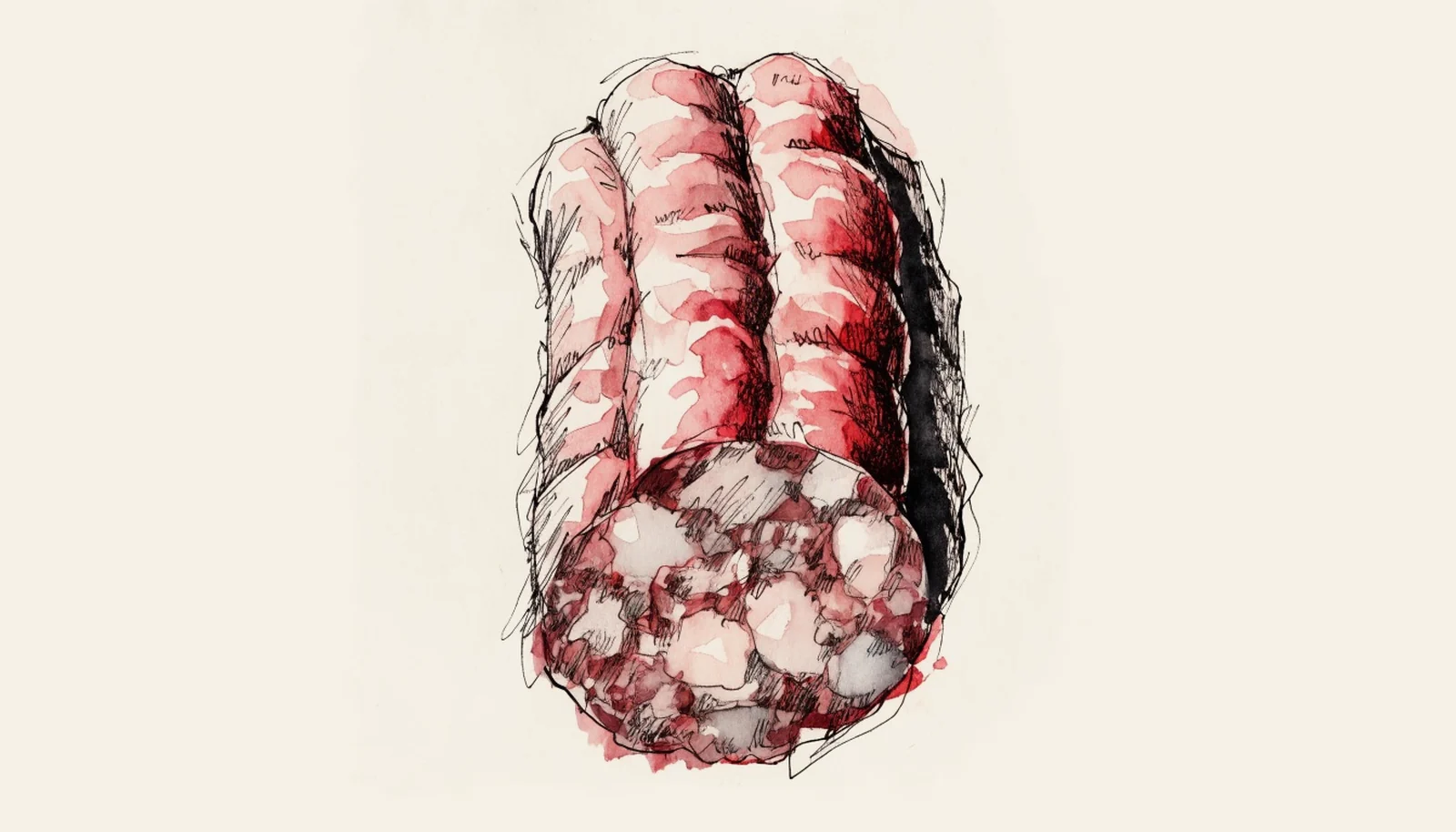
Salsiccia secca is southern Italian pork sausage, seasoned with salt, pepper and usually fennel or chilli, cased in narrow natural gut and hung to dry until it is a cured product eaten without cooking. It is one of the Italian ingredients that American shelf labels muddle. It is not a fresh sausage that has been dried out.
That distinction sounds pedantic until you try to buy it in the United States, where the word salsiccia almost always means the raw sausage in the butcher’s case.
What salsiccia secca actually is
Salsiccia secca is coarsely cut pork, seasoned, stuffed into narrow hog casing, tied into links or a horseshoe and dry-cured for a few weeks until firm.
The narrow diameter is the technical point. A thin sausage dries quickly and evenly, which is why salsiccia secca is ready in weeks where a wide salami takes months. Everything about the product follows from its calibre.
The meat is cut rather than finely ground in traditional practice, punta di coltello, at the point of the knife. That gives a coarse, uneven grain in which lean and fat stay clearly separate.
Fennel seed and chilli are the two seasoning axes. Southern versions run to chilli, and fennel appears in Campania and Puglia in particular. Both are traditional and neither is a variant of the other.
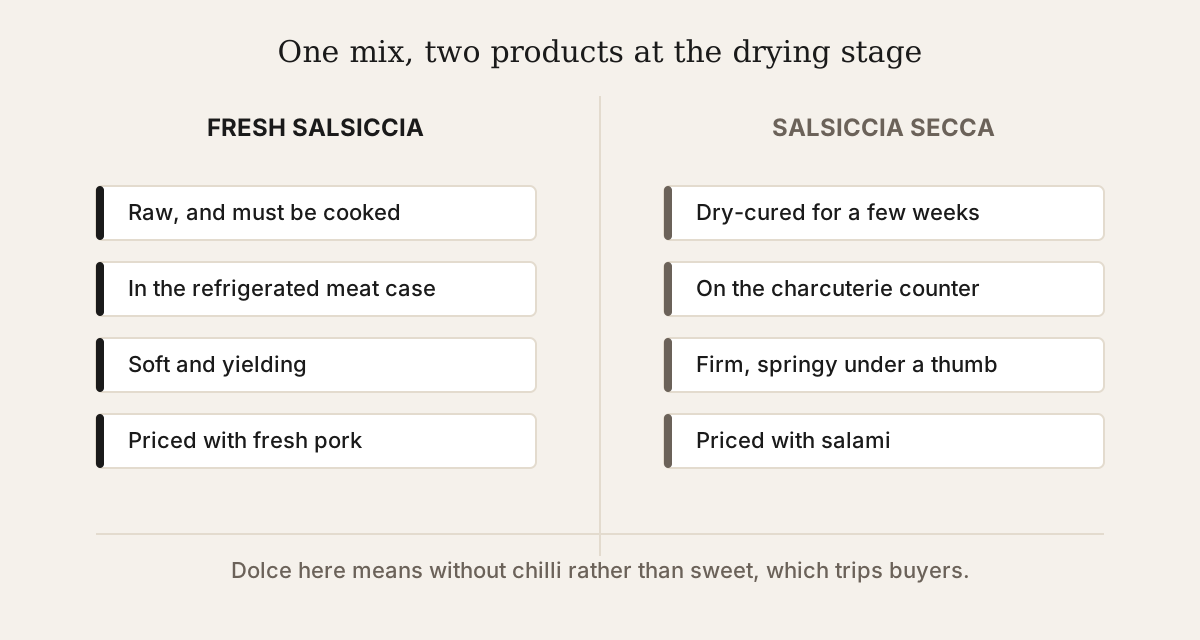
It is sold in dolce and piccante forms. Dolce here means without chilli rather than sweet, which is a routine source of confusion on an American label.
It is eaten as it comes, sliced on the diagonal or torn, at room temperature.
The word problem, and how to buy around it
Salsiccia in American usage overwhelmingly means fresh Italian sausage sold raw to be cooked, and salsiccia secca is a different product that happens to share the noun.
Fresh salsiccia is a raw sausage. It must be cooked, it lives in the refrigerated meat case, and it is priced with fresh pork.
Salsiccia secca is a cured salume. It is shelf-stable within reason, hangs or sits on a charcuterie counter, and is priced with salami.
The English shelf label rarely distinguishes them. Dry sausage, dried sausage and cured sausage all appear, and so does the bare word salsiccia on both products.
The reliable tells are texture and location. A cured one is firm, gives when squeezed rather than yielding softly, and sits with the salumi rather than with the raw meat.
Checked on 13 August 2026, the first page of United States results for salsiccia secca returned specialist charcuterie sellers and a food reference site, which describes that search on that date rather than recommending any seller. Adding the word secca to a search is what resolves the ambiguity, and it resolves it well.
The Calabrian DOP
Salsiccia di Calabria DOP is the protected version, registered alongside the other Calabrian pork products, and it is a narrower thing than the general category.
A DOP is the stronger mark. It requires the whole production chain in the named zone, pigs included, unlike an IGP which requires only one stage there.
Calabria holds a group of these marks together. Salsiccia di Calabria, Capocollo di Calabria, Pancetta di Calabria and Soppressata di Calabria were protected as a set, which is why Calabrian pork carries unusually consistent guarantees.
The specification fixes the cut and the seasoning. Calabrian salsiccia is a chilli product by definition rather than by preference.
Most salsiccia secca carries no mark at all. Puglian, Campanian, Lucanian and domestic American versions are unprotected and are judged on the producer, which is the ordinary situation for this category.
How to judge one
Judge it on firmness, then the cut face, then the casing.
It should be firm and springy rather than hard. A rock-hard sausage has dried too far and will be tough and salty; a soft one has not finished and should not be eaten uncooked.
The grain should be coarse and clearly defined, with fat in distinct pieces. A fine, uniform paste indicates a machine-ground industrial product, which is a different style rather than a fault, but it is not this one.
The lean should be deep red to brick, with no grey ring. In a thin sausage a grey ring is a sign of drying too fast, which happens easily at this calibre.
Fat should be white and firm. Yellow fat means age, and a thin sausage has a lot of surface area exposed to air.
A white bloom on the casing is the intended mould and is normal. Green or black fuzz is not.
Chilli-heavy versions should smell of chilli and pork, not of dust. A flat, papery smell means old chilli and a sausage past its best.
What it should cost
Expect roughly 15 to 28 dollars a pound in the United States, which makes it one of the more affordable ways into southern Italian salumi.
The short cure is the reason. A few weeks of drying ties up far less capital and far less space than a twelve-month ham, and the price reflects that rather than reflecting a lesser product.
DOP versions sit at the top of that range and carry a real guarantee about origin and chilli.
Domestic American producers make this style well, and a good Italian-American salumeria’s own dried sausage is often better value than an import that has spent weeks in transit.
How to use it
Eat it cold, sliced thick on the diagonal or simply broken into pieces. Its coarse grain is the texture and thin slicing wastes it.
Its assertiveness makes it the salume to serve with plain things: bread, a mild cheese, a raw fennel salad, an unremarkable red wine.
It cooks better than most cured salumi. The coarse fat renders cleanly and a piccante version seasons a pan of greens or a bean dish in the way a Calabrian kitchen actually uses it.
Chopped into a sauce it behaves like a seasoning rather than like meat, contributing chilli, fennel and cured pork depth in one move.
Do not confuse the cooking use with the fresh product. A recipe calling for salsiccia to be browned and crumbled wants the fresh sausage; using the dried one there is expensive and gives a chewier result.
Storage
Whole and hung or wrapped in paper, several weeks to a couple of months refrigerated. Cut, one to two weeks.
The narrow calibre that makes it dry quickly also makes it keep well, since there is little moist interior left to spoil.
Paper, not plastic. A cured casing needs to breathe, and plastic produces a slick surface within days.
It will keep drying as it sits, which is not spoilage. A sausage that has become too hard is still good chopped into a cooked dish.
Trim any cut face that has hardened or darkened before slicing again.
Frequently asked questions
Is salsiccia secca the same as fresh Italian sausage?
Salsiccia secca is a cured product eaten without cooking, while fresh Italian sausage is raw and must be cooked, and the two share a name rather than a category. Both start as seasoned pork in a casing, and the dried version is then hung for several weeks until it is firm and shelf-stable. In an American shop the cured one sits with the salumi and the fresh one sits in the refrigerated meat case.
Does salsiccia secca need to be cooked?
Salsiccia secca does not need cooking and is intended to be eaten as it comes, sliced at room temperature. It has been cured and dried rather than merely dehydrated, which is what makes it safe and pleasant to eat uncooked. A sausage that still feels soft and yielding has not finished curing and should not be treated this way.
What does dolce mean on a salsiccia label?
Dolce on an Italian sausage label means without chilli rather than sweet, and it is contrasted with piccante, which means with chilli. Neither term refers to sugar. This is a frequent misreading on American shelves, where dolce is taken to promise a sweet sausage and instead promises a mild one.
Is salsiccia secca the same as pepperoni?
Salsiccia secca and pepperoni are different products, though pepperoni descends from this family of southern Italian dried sausages. Pepperoni is an American creation, finely ground, uniformly red from paprika and mild in heat. Salsiccia secca is coarsely cut, seasoned with fennel or genuine chilli, and has a far more variable texture.
Does salsiccia secca have a DOP?
Salsiccia di Calabria holds a DOP, which covers the Calabrian chilli-seasoned version and requires the whole production chain including the pigs to be in Calabria. Salsiccia secca made elsewhere in southern Italy or in the United States carries no protected designation. Most of what reaches an American counter is unmarked, so the producer and the visible quality of the sausage are what to judge.
CalItalia Food covers Italian ingredients: what they are, how to tell a good one from an ordinary one, and where to buy them in the United States.