Violino di Capra: The Cured Goat Leg Named After How It Is Sliced
A whole goat leg cured in the Valchiavenna, held like a violin and cut with the knife as a bow. What the ritual is, why goat rather than pork, and how to judge and use one.
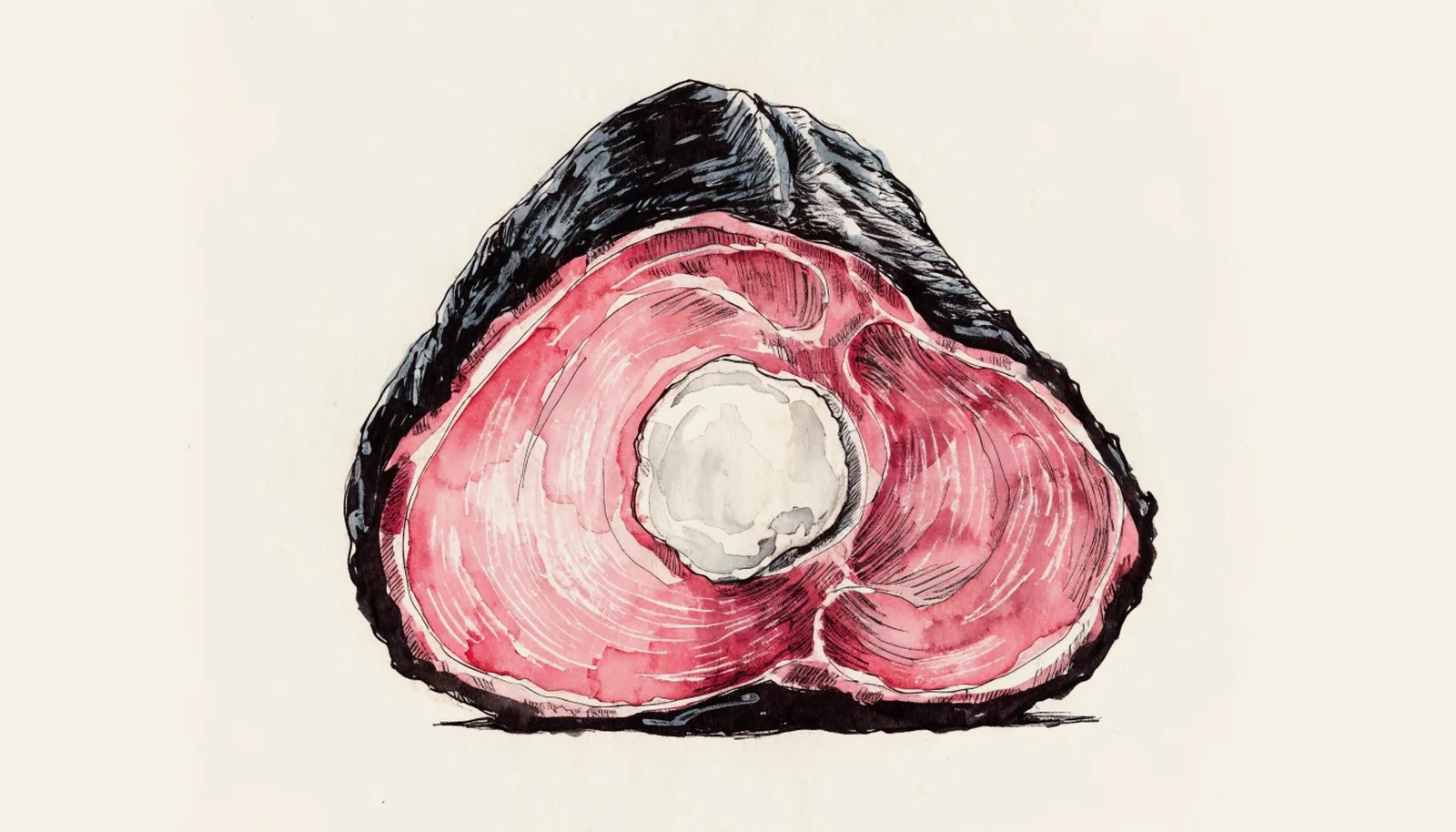
Violino di capra is a whole goat leg or shoulder, salted, rubbed with juniper, garlic, bay and pepper, and dry-cured in the Valchiavenna in northern Lombardy. Its name comes from how it is served: tucked under the chin and sliced with a long knife drawn across it like a bow. It sits at the scarce end of the Italian ingredients covered here.
Most cured meats are named for a place, an animal or a cut. This one is named for a gesture, and the gesture is a genuine part of the product rather than a story attached to it afterwards.
What violino di capra actually is
Violino di capra is a bone-in goat leg or shoulder, dry-salted, seasoned with an Alpine aromatic mixture and hung to cure for a few months in mountain air.
The bone stays in. The leg is cured whole, which is what gives it the shape the name depends on.
The seasoning is Alpine and aromatic. Juniper, garlic, bay, black pepper, sometimes rosemary and cloves, rubbed into the surface with the salt.
Some versions are lightly smoked, which is a valley tradition rather than a modern addition.
The cure runs to a few months, less than a pork ham of comparable size, because goat is leaner and takes salt more readily.
It comes from the Valchiavenna, the valley running north-west from Lake Como toward the Swiss border, and from the adjoining valleys.
The name, and the ritual behind it
The violin comparison describes a specific way of serving that is still practised and is the reason the product has the profile it does.
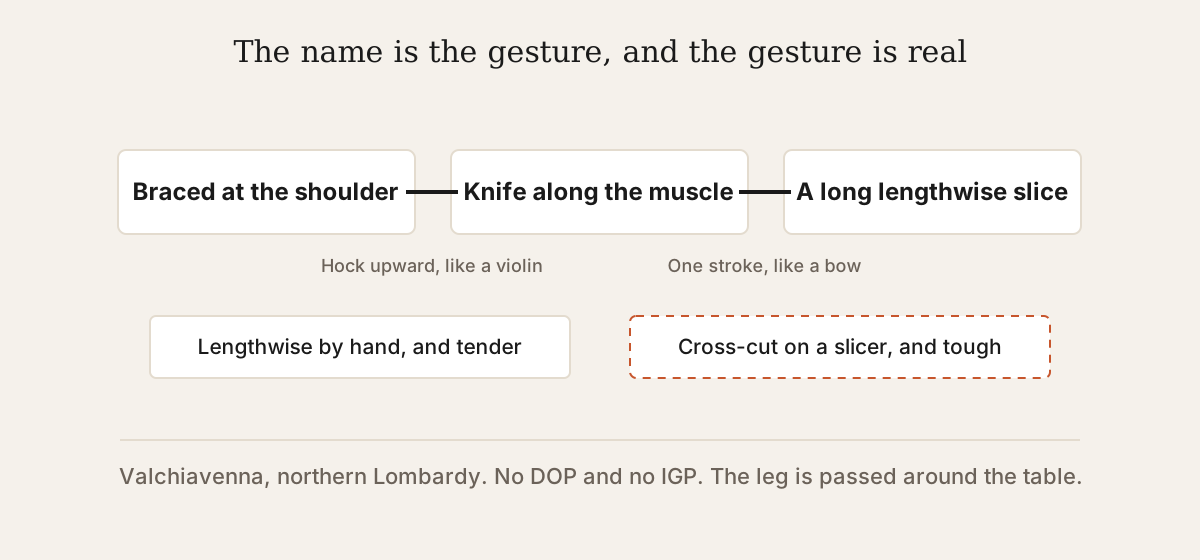
The leg is braced against the shoulder, hock upward, held the way a violin is held.
A long thin knife is drawn along the muscle, parallel to the bone, in a single stroke resembling a bow across strings.
That produces long thin slices running with the grain rather than across it, which is unusual and is what the technique is for. A lengthwise slice of a lean cured muscle is more tender than a cross-cut one.
It is a table performance. The leg is passed around and each person cuts their own, which is how it is eaten in the valley.
So the name is descriptive rather than poetic. The shape, the posture and the cutting motion are all real, and the slice they produce is genuinely different from what a slicer gives you.
Why goat
Goat is unusual for a cured whole leg, and the reason is the terrain rather than preference.
The Alpine valleys support goats where they do not support pigs at scale. Steep, thin pasture suits browsing animals, and goat was what the mountain economy had.
Goat is very lean, which shortens the cure and produces a dense, dark meat.
It carries a distinct flavour that is stronger than pork and milder than mutton, and the heavy juniper and garlic cure exists partly to frame it.
Chamois was used historically in the same valleys, as it was for mocetta, and protection of Alpine wildlife ended that for commercial production.
It is not a cheap substitution. Goat is a low-yield animal and a violino uses a whole leg, which is part of why the finished product is expensive.
Designation, and the absence of one
Violino di capra carries no DOP and no IGP.
It is recognised as a traditional Lombard product, which records its regional standing without reserving the name or publishing a specification.
Lombardy’s protected cured meats are named individually, Bresaola della Valtellina IGP among them, and violino is not on that list.
So the producer is the guarantee. With no specification, the valley of origin and the maker’s name are the available evidence.
Slow Food and similar bodies have supported it as a product at risk, which is a recognition of scarcity rather than a legal protection.
How to judge one
Judge it on colour, then the aroma, then how it cuts.
The lean should be a deep red to brown-red, darker than pork and even in tone. A pale violino is under-cured.
It should smell of juniper and garlic over the meat. The aromatics should be immediately obvious, since a heavy surface cure is central to the product.
There should be very little fat, and any that appears should be firm and white.
A hard dark rim means it dried too quickly, which lean goat is prone to.
It should cut lengthwise without tearing. Crumbling along the grain indicates over-drying.
Checked on 13 August 2026, the first page of United States results for violino di capra returned specialist references, a charcuterie blog and Swiss and Italian regional sites rather than United States sellers, which describes that search on that date rather than recommending any seller.
What it should cost and whether you can get it
Expect it to be expensive where it appears at all, and to be effectively unavailable in the United States.
A whole cured goat leg from a small Alpine valley is a low-volume artisan product with no designation supporting an export route, and imported goat charcuterie faces a much thinner distribution network than pork does.
The floor for this page rests on a thin competitor sample. Only two extractable competitors were found for the head, so treat any figure here as a guide rather than a measurement.
There is no close substitute. Mocetta is the nearest in seasoning and is also scarce; bresaola is the nearest in availability and is beef with a much plainer cure.
Seeing one is more likely than buying one. It appears at Alpine food festivals and in Valtellina restaurants far more often than in retail.
How to use it
Slice it lengthwise, thin, at room temperature, and eat it with bread. Nothing needs to be added.
Its natural companions are the valley’s own: rye bread, a mountain cheese, pickled vegetables, a Valtellina red.
Cut with the grain rather than across it. This is the whole point of the serving technique and a cross-cut slice of lean cured goat is noticeably tougher.
Do not dress it. The juniper and garlic cure is already the seasoning.
Serve at room temperature, since a very lean cured meat straight from the cold reads as hard and closed.
Do not cook it. There is no fat to render and the aromatics are lost.
Storage
Whole and hanging in a cool dry place, months. Once cut, keep it wrapped in paper and refrigerated, and expect the cut face to dry within days.
The bone and the surface cure protect it well while whole, which is how it was designed to be kept through a mountain winter.
Trim the cut face before each use once it has darkened.
Paper rather than plastic, so the surface stays dry rather than becoming slick.
Do not freeze it. A lean cured muscle loses its texture and does not recover it.
Frequently asked questions
Why is it called violino di capra?
Violino di capra is named for how it is served: the cured goat leg is braced against the shoulder like a violin and a long knife is drawn along it like a bow. The comparison is descriptive rather than decorative, since the posture produces long slices cut with the grain rather than across it. A lengthwise slice of lean cured goat is noticeably more tender than a cross-cut one.
What does violino di capra taste like?
Violino di capra tastes of goat, which is stronger than pork and milder than mutton, framed by a heavy surface cure of juniper, garlic, bay and pepper. The meat is very lean, dense and dark, closer to bresaola in texture than to a pork ham. Where the version is lightly smoked, the smoke sits behind the juniper rather than in front of it.
Does violino di capra have a DOP?
Violino di capra carries no DOP and no IGP. It is recognised as a traditional Lombard product, which records its regional standing without reserving the name or publishing a specification a buyer could rely on. Lombardy’s protected cured meats are designated individually, and Bresaola della Valtellina IGP is on that list while violino is not.
Can I buy violino di capra in the United States?
Violino di capra is effectively unavailable in the United States. It is a low-volume artisan product from a small Alpine valley with no protected designation supporting an export route, and imported goat charcuterie has a far thinner distribution network than pork. Mocetta is the closest in seasoning and is also scarce; bresaola is the closest in availability and is a much plainer beef product.
Is violino di capra the same as mocetta?
Violino di capra and mocetta are different products from neighbouring Alpine regions that share an approach. Violino is a bone-in goat leg from the Valchiavenna in Lombardy, cured whole and sliced lengthwise at the table. Mocetta is a boned lean muscle from the Valle d’Aosta, now usually beef, sliced very thin across the grain. Both use a juniper-led herb cure.
CalItalia Food covers Italian ingredients: what they are, how to tell a good one from an ordinary one, and where to buy them in the United States.