
Capocollo: The Neck Muscle, and the Word Coppa Cannot Carry
Cured pork neck, marbled and mild. Why the shorter name is unusable in English search, what the DOPs cover, how to judge a slice, and how to use it.
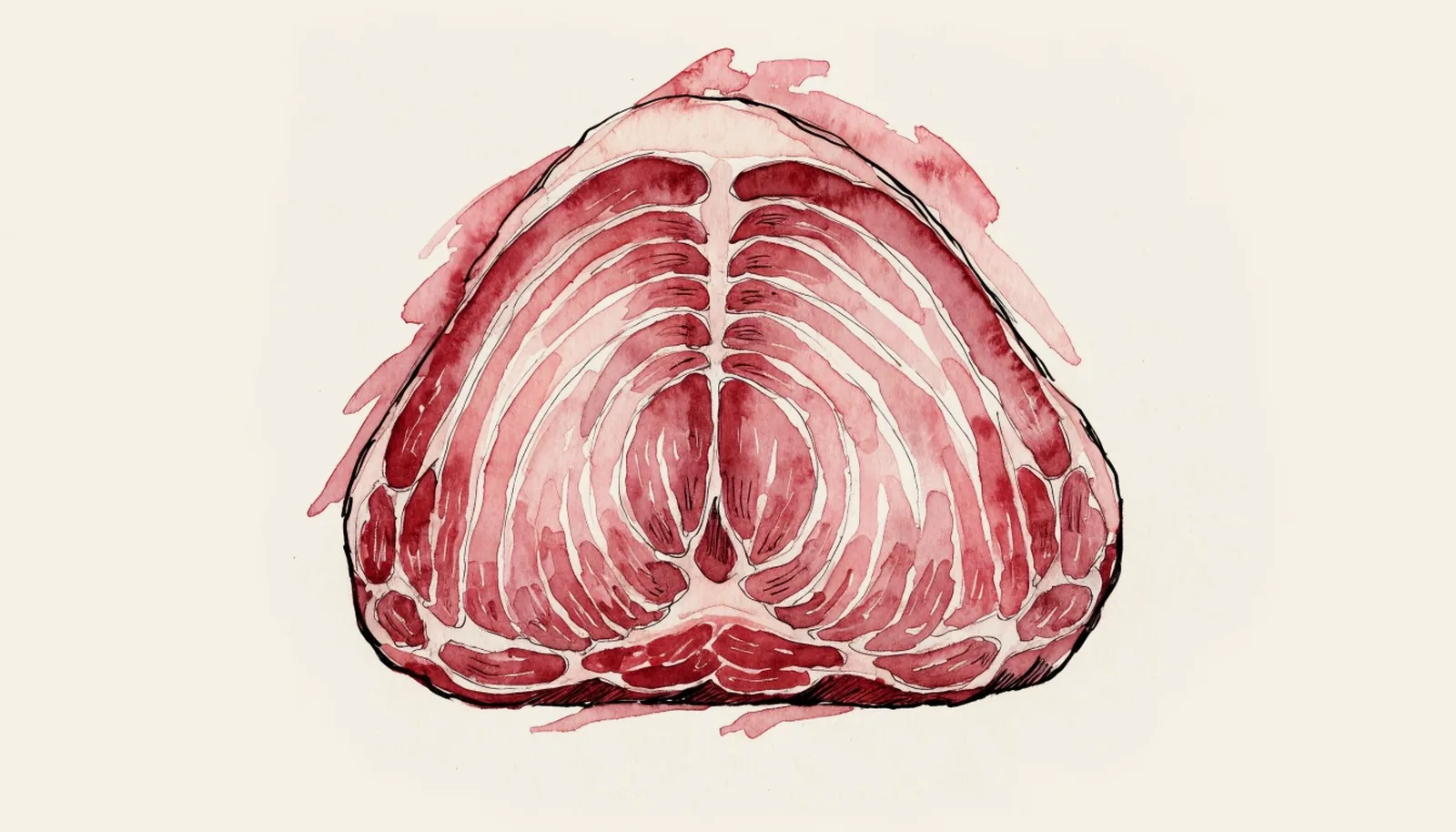
Capocollo is the muscle running from the neck into the shoulder of the pig, salted, seasoned and dry-cured whole, and it sits between prosciutto and salami in both texture and price. Its marbling is the point: fat runs through the muscle rather than sitting on the outside. It is one of the salumi where the gap between a good producer and an ordinary one shows on the slice.
It is also the salume with the most confusing naming in English, and the confusion has a practical consequence for anyone searching for it.
What capocollo actually is
Capocollo is the coppa muscle, the long cylinder of meat running from the base of the skull along the neck into the shoulder, boned out, salted, seasoned, cased and dry-cured for several months.
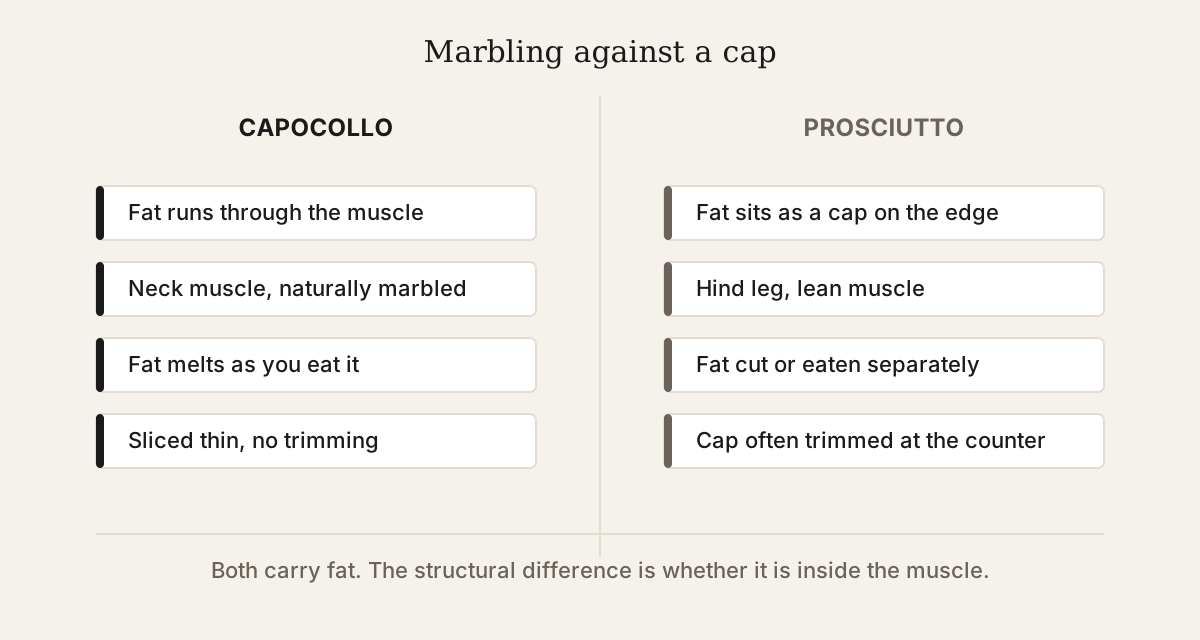
The marbling defines it. The neck muscle is naturally threaded with fat, so a slice shows fat distributed through the meat rather than a cap around the edge. That is why capocollo is softer and more forgiving than a lean salume and why it does not need dressing the way bresaola does.
Seasoning varies substantially by region. Northern versions tend toward wine, garlic and pepper; southern ones frequently carry chilli. Both are traditional.
The cure is shorter than prosciutto, typically three to six months, which is why it costs less.
Why this page is headed capocollo
The word coppa is unusable as an English search term. Searched in the United States on 13 August 2026, the first page of results for it returned the Federal Trade Commission and material on the Children’s Online Privacy Protection Act, which shares the acronym COPPA. Counting rule: a result counts as on-topic when it concerns the cured meat rather than any other sense of the letters. On that rule the first page was almost entirely off-topic.
That is a fact about that search on that date rather than a claim about the word in Italian, where coppa is the ordinary name and is not ambiguous.
The practical consequence for a buyer is that searching for coppa in English is unreliable, and searching for capocollo or gabagool will get you to the meat.
On gabagool. The Italian-American pronunciation, derived from southern dialect, is a legitimate name for the same product and is how a great many American delis label it.
The protected versions
Two DOPs cover regional capocollo and neither covers the category as a whole.
Capocollo di Calabria DOP is the southern version, from Calabria, typically seasoned with chilli and wine.
Coppa Piacentina DOP is the northern one, from Piacenza in Emilia-Romagna, seasoned more restrainedly.
Most capocollo carries no designation. As with guanciale and nduja, the majority of what reaches a United States counter is unmarked, and the judgement rests on the producer and on what you can see.
Domestic American capocollo is widespread and frequently very good. It cannot carry either DOP and should be judged on the marbling, the colour and the cure.
How to judge a slice
Look at the marbling, then the colour of the lean, then the edge.
Fat should be distributed through the muscle in fine veins, white and firm. Large solid blocks of fat suggest a poorly trimmed piece; no visible fat at all suggests the wrong cut entirely.
The lean should be deep pink to red, even across the slice with no grey ring.
A hard dark rim means it dried too fast, which happens with capocollo more than with fattier salumi.
It should be sliced thin but not paper-thin. Thinner than salami, thicker than prosciutto, so the marbling holds together on the slice.
Smell should be clean and slightly sweet, with the seasoning detectable. Any sourness means it has gone.
What it should cost
Expect roughly 20 to 35 dollars a pound in the United States, below prosciutto and above most salami.
The shorter cure and the higher yield relative to culatello keep it cheaper than the premium whole-muscle products, and the fact that it is a single prized muscle keeps it above ground salami.
DOP versions sit at the upper end and are worth the difference mainly for the assurance rather than for a dramatic quality gap over a good unmarked producer.
Checked on 13 August 2026, the first page of United States results for capocollo returned producers and specialist charcuterie sellers, which describes that search on that date rather than recommending any seller. Availability is good, which is not true of culatello.
How to use it
Eat it as it comes, sliced thin, at room temperature. It is a board and sandwich meat rather than a cooking one.
Its marbling means it needs no dressing, unlike bresaola, and it stands up well alongside sharper things: pickled vegetables, a hard cheese, mustard fruits.
It is the standard filling in an Italian-American sub, which is what most gabagool ends up in and is a perfectly good use of it.
Cooking it is a waste. The fat renders and the seasoning dulls, and a cheaper cut does the job better in a hot dish.
Storage
Whole and wrapped in paper, several weeks refrigerated. Sliced, three to four days.
The marbled fat gives it slightly better keeping than a very lean product like bresaola, since the fat protects the cut face.
Wrap the cut end closely and trim a thin slice off before the next use if it has darkened.
White surface bloom on the casing is normal for a dry-cured product. Fuzzy coloured growth is not.
Frequently asked questions
Is capocollo the same as coppa?
Yes, they are two names for the same cured neck muscle, with capocollo the fuller form and coppa the shorter. This site heads the page capocollo because coppa is unusable as an English search term, returning material about the Children’s Online Privacy Protection Act rather than the meat. In Italian there is no ambiguity.
What is gabagool?
The Italian-American pronunciation of capocollo, derived from southern Italian dialect where final vowels are dropped and consonants soften. It refers to the same product and is how many American delis label it. It is a legitimate name rather than a corruption, and asking for gabagool at a counter will get you capocollo.
Is capocollo spicy?
Capocollo’s heat depends on the region. Calabrian versions frequently carry chilli and are genuinely warm; northern versions such as Coppa Piacentina are seasoned more restrainedly with wine and pepper and carry no heat. Neither is more authentic than the other, so check the label or ask if heat matters to you.
How is capocollo different from prosciutto?
The cut and where the fat sits. Capocollo is the neck muscle, marbled with fat running through the meat, cured for three to six months. Prosciutto is the whole hind leg cured bone-in with a fat cap on the outside, for twelve months or more. Capocollo is softer, milder and cheaper.
Does capocollo have a DOP?
Two regional ones do, Capocollo di Calabria DOP and Coppa Piacentina DOP, and the category as a whole does not. Most capocollo on a United States counter carries no mark at all, including good domestic product, so judge it on the marbling, the colour of the lean and the producer rather than expecting a designation.
CalItalia Food covers Italian ingredients: what they are, how to tell a good one from an ordinary one, and where to buy them in the United States.