Salame Toscano: The Big White Fat Cubes, and What They Are For
Coarse Tuscan salami studded with large cubes of back fat and whole peppercorns. Why the cubes are the identity, why it has no designation, how US producers took it up, and how to judge and use it.
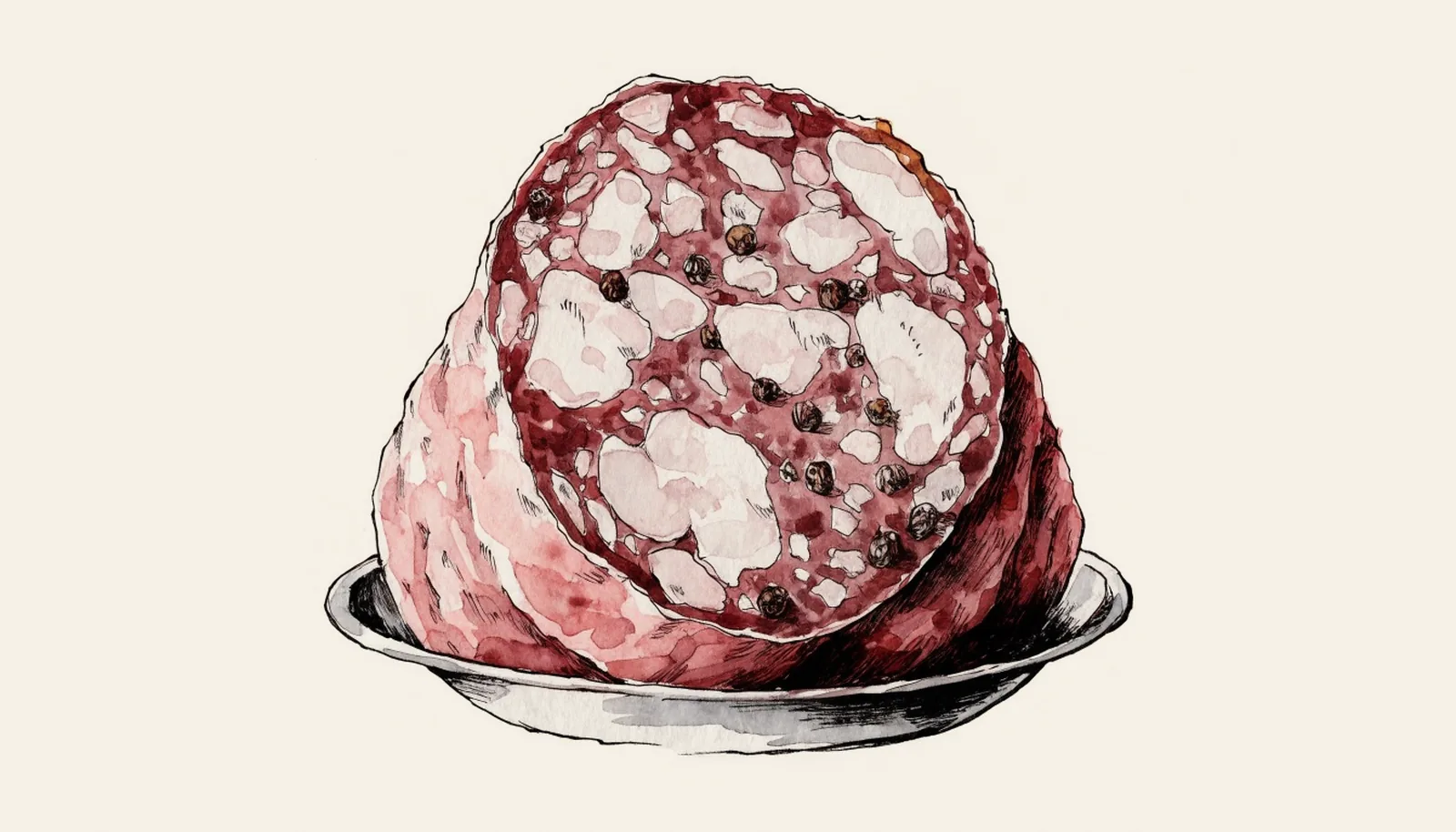
Salame Toscano is a coarse Tuscan pork salami studded with large visible cubes of white back fat and whole black peppercorns, seasoned with salt, garlic and often red wine. The fat cubes are large enough to be the first thing you notice and they are the identity of the style. Reading them is the first step in telling the genuine style from a cheaper copy.
Most writing about it treats those cubes as decoration. They are a technical choice, and understanding what they do is the difference between judging this salami well and judging it as a fattier version of something else.
What salame Toscano actually is
Salame Toscano is coarsely ground pork lean into which cubes of firm back fat are folded whole, seasoned with salt, black peppercorns, garlic and frequently red wine, cased in a wide natural casing and aged for a few months.
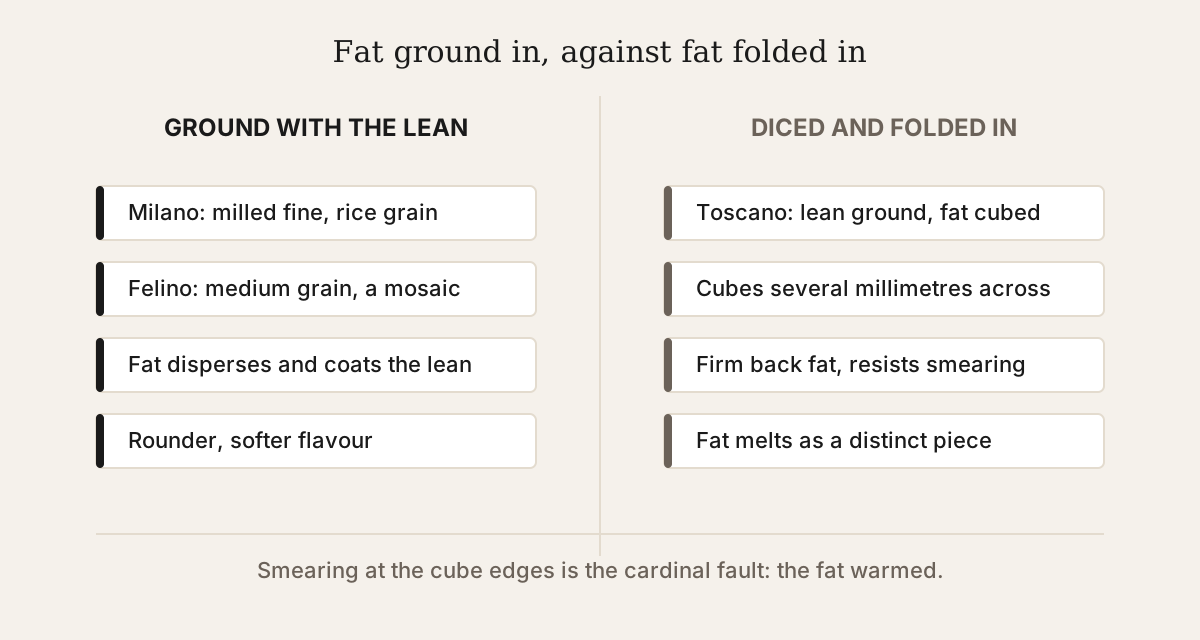
The fat is added as cubes rather than ground in. This is the technique. Lean is ground, fat is diced separately, and the two are combined so the fat survives as discrete pieces rather than dispersing.
The cubes are large by any standard, often several millimetres across and clearly visible from a distance.
Whole peppercorns go in unground. Like the fat, they stay as discrete objects in the slice and deliver an occasional sharp bite.
Garlic is present and forward. Tuscan salumi carry more garlic than the salami of Emilia, which is one of the honest regional differences.
The calibre is wide, giving a large slice, and the cure runs to a few months.
Why the fat is cubed rather than ground
Cubing the fat changes the texture and the flavour release in ways that grinding cannot reproduce, which is why the style survives.
Discrete fat melts on the tongue rather than in the mouth generally. A large cube reaches body temperature and softens as a distinct sensation, which is the eating experience the style is built around.
Firm back fat resists smearing. Back fat is harder than belly fat and holds its shape through grinding and stuffing, which is why it is the cut used.
Ground fat coats the lean and mutes it. Dispersing the fat evenly, as in a Milano, produces a rounder and softer flavour. Keeping it separate leaves the lean tasting of lean.
It is also a visual guarantee. You can see the fat quality directly, which you cannot in a fine-ground salami, and that transparency is part of why the style is trusted.
Smearing is therefore the cardinal fault. If the cubes have blurred at the edges the fat warmed during production, and the whole point has been lost.
Why it carries no designation
Salame Toscano holds no DOP and no IGP, despite Tuscany holding several protected marks for other products.
Tuscany’s protected salumi are specific products rather than the general salami. Finocchiona IGP, Prosciutto Toscano DOP, Mortadella di Prato IGP and Lardo di Colonnata IGP all carry marks.
Salame Toscano is a style description, and anyone may use it, in Italy or elsewhere.
Finocchiona is the closest protected relative and is a different product: fennel-seasoned rather than pepper-and-garlic, and its own IGP covers it.
So the judgement rests on the producer. With no specification behind the name, the cube definition, the fat quality and the ingredient list are the evidence.
The American artisan connection
Salame Toscano is one of the styles American artisan salumi producers took up most enthusiastically, and the United States market reflects that.
Checked on 13 August 2026, the first page of United States results for salame toscano returned American artisan producers alongside an Italian one and a technical reference, which describes that search on that date rather than recommending any seller. The prominence of domestic producers is a real feature of this category rather than an artefact of the search.
The style suits a small producer. Cubed fat and whole peppercorns are visible signals of hand work, and the wide calibre and few months of ageing are within reach of a modest curing room.
Domestic Toscano is frequently excellent and is judged on exactly the same evidence as an import, since neither carries a mark.
Do not assume the Italian one is better. Freshness matters in a fat-heavy salami, and a domestic product that has travelled a few hundred miles has an advantage over one that has crossed an ocean and sat.
How to judge a slice
Judge it on the cubes first, then the lean, then the smell.
The fat cubes should have sharp edges, bright white, clearly bounded against the lean. Blurred or greasy-looking edges mean smearing.
Fat should be white, not yellow or translucent. With this much fat on display, any yellowing is immediately visible and immediately disqualifying.
The lean should be a deep red, coarse-grained, with no grey ring at the rim.
Peppercorns should be whole and intact. Crushed pepper throughout suggests a different recipe.
It should smell of garlic, pepper and cured pork. Rancidity shows up faster in a fat-heavy salami than in a lean one, and a faintly stale or crayon-like note is the first sign.
Slice it thin. The wide calibre and large cubes mean a thick slice is mostly fat, and thin slicing is what balances it.
What it should cost
Expect roughly 18 to 32 dollars a pound in the United States, which puts it in the middle of the salumi counter.
The wide calibre and a few months of ageing put it above an everyday salami, and the absence of a designation keeps it below the protected whole-muscle products.
American artisan versions often sit at the top of the range, which reflects small-batch production rather than an import premium.
Very cheap Toscano is usually a Toscano-style product with ground rather than cubed fat, which is a different salami wearing the name.
How to use it
Eat it as it comes, sliced thin at room temperature, on a board with bread.
Its garlic and pepper want plain company. Tuscan bread is unsalted precisely so that well-salted Tuscan salumi can carry the seasoning, and any plain, sturdy loaf does the same job.
Temperature matters more than for a lean salume. Cold, the large fat cubes are waxy and taste of nothing. At room temperature they soften and release, which is the entire experience.
It sits well with a young pecorino and with fennel, raw or pickled.
Cooking it is a waste. The cubes melt out, the peppercorns dominate and everything the style is built on disappears.
Storage
Whole and wrapped in paper, several weeks refrigerated. Sliced, three to four days.
The high fat content is a mixed blessing for keeping: it protects the cut face from drying and it also goes rancid, which a lean salami will not do.
Keep it in paper rather than plastic so the casing can breathe.
Trim and discard any yellowed fat at the cut face before slicing again.
Watch the smell rather than the date. Rancidity in the fat is the failure mode here, and it announces itself well before anything looks wrong.
Frequently asked questions
Why does salame Toscano have such large pieces of fat?
Salame Toscano carries large fat cubes because the fat is diced and folded in whole rather than ground with the lean, which keeps it as discrete pieces that soften individually on the tongue. Firm back fat is used because it holds its shape through stuffing. Grinding the fat in would coat the lean and produce the rounder, softer character of a Milano instead.
Does salame Toscano have a DOP or IGP?
Salame Toscano holds no protected designation, even though Tuscany has several for other products including Finocchiona IGP, Prosciutto Toscano DOP and Lardo di Colonnata IGP. The name describes a style rather than an origin and may be used by anyone. Judge it on the definition of the fat cubes, the colour of the fat and the ingredient list.
What is the difference between salame Toscano and finocchiona?
Salame Toscano is seasoned with black peppercorns and garlic, while finocchiona is seasoned with fennel, and the two are distinct Tuscan salami rather than variants. Finocchiona also holds an IGP and salame Toscano does not. Finocchiona tends to a softer, crumblier texture, and Toscano is defined by its large cubes of firm white back fat.
Is salame Toscano very fatty?
Salame Toscano carries a high proportion of fat and it is more visible than in most salami because the fat sits in large discrete cubes rather than dispersed through the mix. The total is not necessarily higher than a fine-ground salami where the fat is invisible. Slicing it thin and serving it at room temperature is what keeps the balance right.
Why does my salame Toscano taste waxy?
Waxy salame Toscano is almost always a temperature problem rather than a quality one, since large cubes of firm back fat stay solid and flavourless straight from the refrigerator. Twenty minutes at room temperature before serving resolves it. If the waxiness comes with a stale or crayon-like smell, the fat has gone rancid, which is the real fault to watch for in a fat-heavy salami.
CalItalia Food covers Italian ingredients: what they are, how to tell a good one from an ordinary one, and where to buy them in the United States.