
Salame Milano: The Fine-Grained Archetype, and Why It Has No Designation
The rice-grain grind that made the standard Italian salami. How Milano differs from Genoa, why it carries no DOP or IGP, and why the ingredient list is what you judge before you buy.
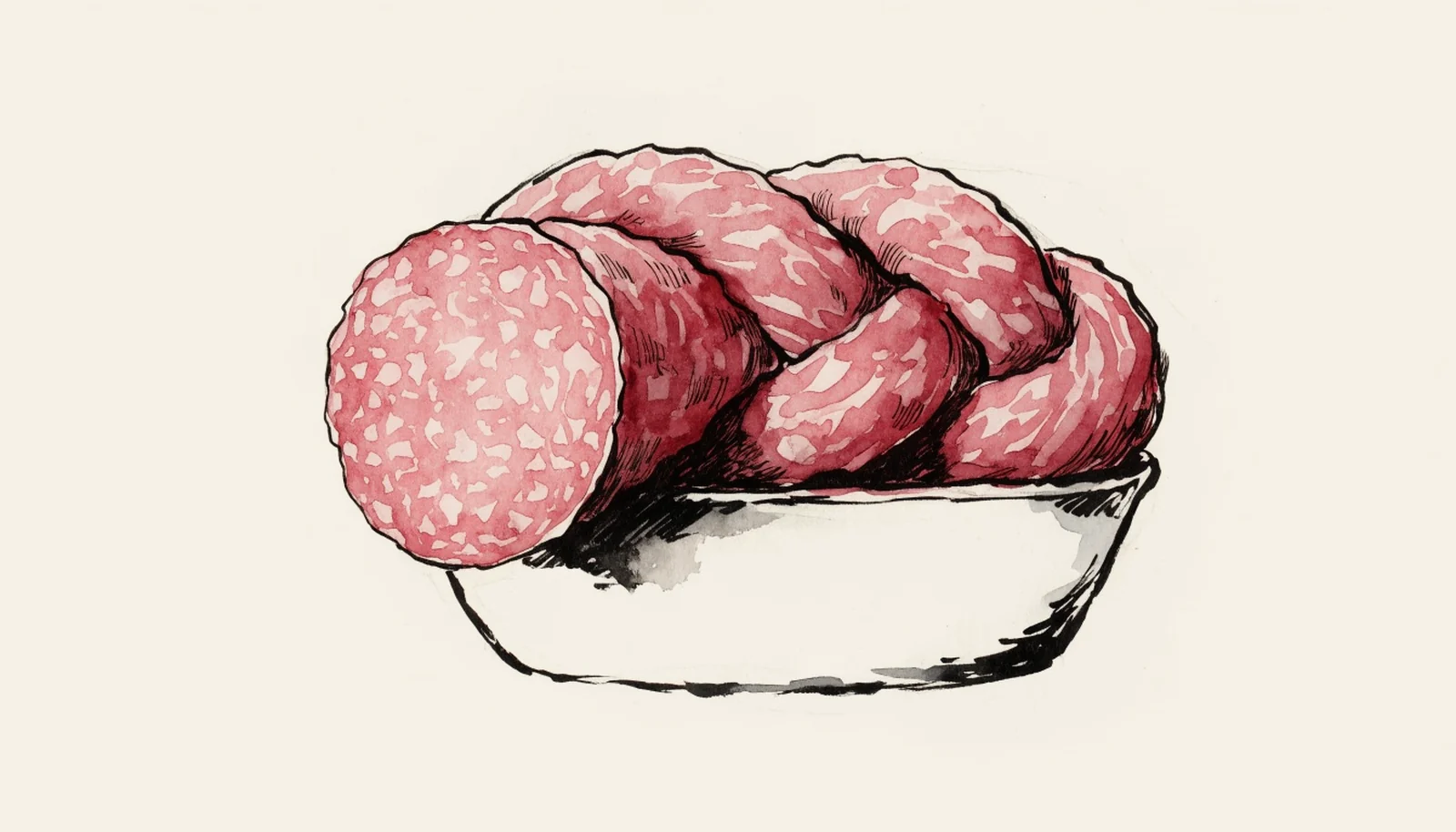
Salame Milano is a mild, finely ground pork salami in which lean and fat are milled to roughly the size of a grain of rice, giving the even pink-and-white speckle that most Americans picture when they picture Italian salami. It is the archetype of the category, and the everyday case among the Italian ingredients this site judges.
It is also, unusually for a salami this well known, entirely unprotected, and that fact should change how you buy it.
What salame Milano actually is
Salame Milano is pork lean and pork fat ground fine together, seasoned with salt, pepper, garlic and usually a little white wine, cased and aged for around two to three months.
The grind defines it. The traditional description is grana di riso, a rice grain, and it refers to the size of the fat particles. Fine, even, and small enough that the slice reads as a single speckled field rather than a mosaic.
Lean and fat are close to balanced. The fat proportion is higher than in a lean salami such as Felino, which is why Milano is soft and rounded rather than firm.
The seasoning is deliberately quiet. Salt, pepper, garlic and wine, with no fennel, no chilli and no aggressive tang. Milano is the neutral one in the family.
It is made in a large calibre. The wide cylinder is part of the identity and is why a slice of Milano is a broad disc rather than a coin.
Why it carries no DOP or IGP
Salame Milano has no protected designation of origin and no protected geographical indication, which puts it in a different position from most of the famous Italian salami.
Several of its neighbours are protected and it is not. Salame Brianza DOP, Salame Piacentino DOP, Salame di Varzi DOP, Salame Cremona IGP and Salame Felino IGP all carry marks. Milano does not, and the name functions as a style rather than as an origin.
So it can be made anywhere, including outside Italy, and be labelled Salame Milano perfectly legally. A great deal of the Milano-style salami sold in the United States is made in the United States.
The name tells you about the grind, not the geography. This is the opposite of how the protected names work, and it is the single most useful thing to understand about the product.
The judgement therefore rests entirely on the producer and the ingredient list, in the same way it does for nduja. There is no mark doing the work for you, so read the label instead of looking for a seal.
Milano against Genoa, the distinction that matters in America
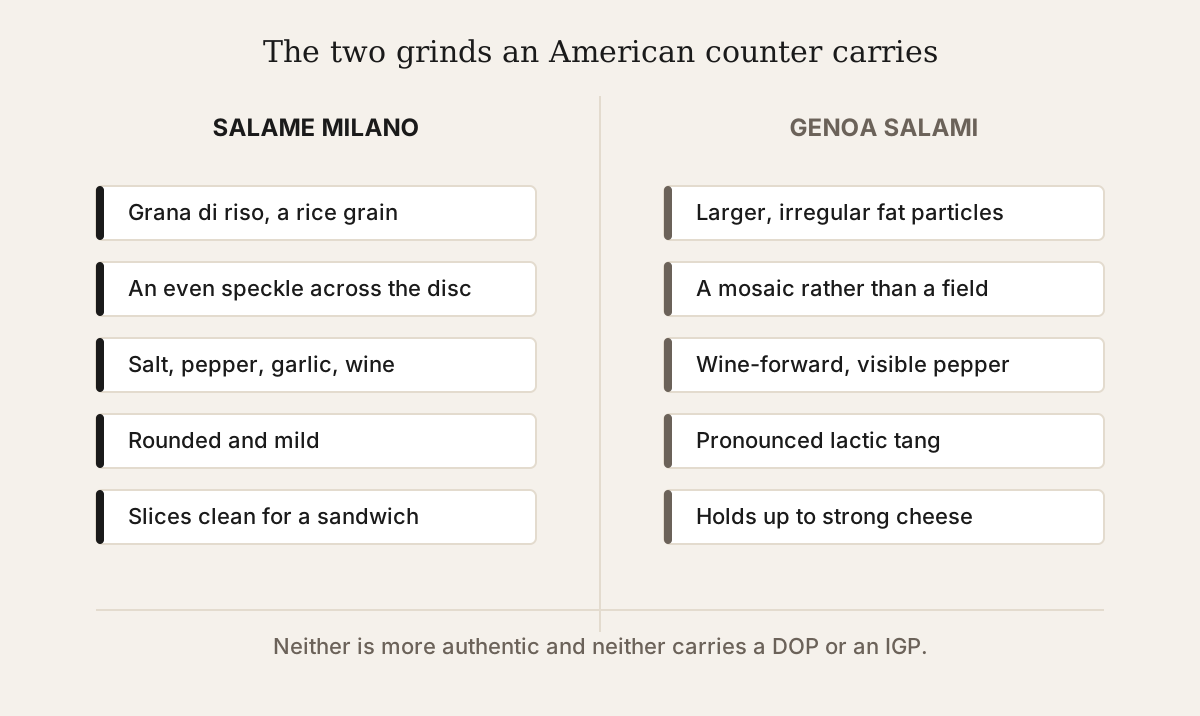
Salame Milano and Genoa salami are the two styles an American deli counter usually carries, and the difference is grind and acidity rather than quality.
Milano is finer and milder. The even rice-grain speckle, a rounded flavour, restrained garlic.
Genoa is coarser and tangier. Larger, more irregular fat particles, more visible wine, and typically a more pronounced lactic sourness from fermentation.
Neither is more authentic. Genoa as sold in America is itself largely an American category, and both descend from real northern Italian practice.
Choose by use. Milano’s fine grain slices cleanly and is the better sandwich and board salami; Genoa’s tang stands up better next to strong cheese and pickles.
How to judge a slice
Look at the evenness of the speckle, then the colour, then the edge.
The fat particles should be uniformly small and evenly dispersed. Clumping, streaking or a smeared appearance means the mix warmed during grinding, which is the most common industrial fault in a fine-ground salami.
The lean should be a clean rose, consistent across the disc. Grey at the rim means oxidation from a cut face left exposed.
Fat should be bright white and firm. Yellow or translucent fat is rancid or old, and in a salami with this much fat that spoils the whole slice.
Read the ingredient list, since nothing else is guaranteed. Dextrose and starter cultures are normal and honest. Milk proteins, caseinates and polyphosphates are binders and water-holders, and their presence marks an industrial product built for yield.
A sour or acetic smell is a fault rather than a style here. Milano should smell sweet, porky and faintly of wine.
What it should cost
Expect roughly 12 to 22 dollars a pound in the United States, which makes it one of the cheaper salumi on a counter.
The large calibre, the short cure relative to whole muscles and the absence of a protected designation all keep the price down, and the low price is not in itself a warning the way it would be for prosciutto.
Checked on 13 August 2026, the first page of United States results for salame milano returned Rovagnati, Veroni, Levoni and Murray’s Cheese, which describes that search on that date rather than recommending any seller. This is a product with genuine retail availability rather than a specialist import.
Italian-made versions cost more and are not automatically better. With no designation in play, a careful American producer and a careful Italian one are judged on the same evidence.
How to use it
Eat it as it comes, sliced thin, at room temperature, or build a sandwich on it. Its neutrality is what makes it useful.
Milano is the salami to reach for when something else on the plate is doing the talking. It supports a sharp provolone, a pickled vegetable or a mustard without competing.
It is the standard salami of an Italian-American sub alongside capocollo and mortadella, and that is a legitimate and excellent use of it.
Cooking it is possible and wasteful. It will render into a pizza or a frittata without disgrace, but a cheaper cured pork will do the same job and Milano’s fine texture is lost entirely under heat.
Storage
Whole and wrapped in paper, several weeks refrigerated. Sliced, four to five days, which is slightly better than a leaner salami because the fat protects the cut face.
Keep it in paper rather than plastic. Plastic traps moisture against a dry-cured surface and produces a slick film.
Trim the cut end if it has darkened or gone hard before slicing again.
The white coating on the casing is an intended mould culture. Coloured fuzzy growth is not, and means damp storage.
Frequently asked questions
What is the difference between salame Milano and Genoa salami?
Salame Milano is ground finer, to roughly a rice grain, and tastes milder, while Genoa salami is ground coarser and tastes tangier from a more pronounced fermentation and a more visible wine character. Both are northern Italian in origin and both are widely made in the United States. The grind is the reliable way to tell them apart on a counter.
Does salame Milano have a DOP or IGP?
Salame Milano carries no DOP and no IGP, which makes it unusual among well-known Italian salami. Salame Brianza, Salame Piacentino and Salame di Varzi hold DOPs and Salame Cremona and Salame Felino hold IGPs, but Milano is a style name that anyone anywhere may use. Judge it on the producer, the grind and the ingredient list instead of looking for a seal.
Is salame Milano made in Italy?
Salame Milano may be made anywhere, and a large share of what is sold in the United States is produced domestically. Because the name is unprotected there is no origin requirement attached to it, so the label phrase to read is Product of Italy rather than the salami’s name. Italian production is not in itself a guarantee of a better salami here.
Why is my salame Milano greasy?
Salame Milano carries a high proportion of fat by design, and greasiness usually means it was served cold, since the fat only softens and reads as smooth at room temperature. A genuinely faulty greasiness comes with yellowed fat or a rancid smell, which indicates age. Smearing during production also produces a slick texture and shows as a blurred rather than crisply speckled slice.
Can I substitute Genoa for Milano?
Genoa can stand in for Milano in a sandwich or on a board, with the difference that it brings noticeably more tang and a coarser bite. Where the recipe or the plate depends on Milano staying in the background, that extra acidity will be audible. Going the other way, Milano will read as flat to anyone expecting Genoa’s sourness.
CalItalia Food covers Italian ingredients: what they are, how to tell a good one from an ordinary one, and where to buy them in the United States.