Salame Napoletano: The Chilli Salami, and the American Name It Lost
A long, narrow, peppery Campanian salami, sometimes lightly smoked. What a PAT listing does and does not guarantee, how it differs from American Napoli salame, and how to judge and use it.
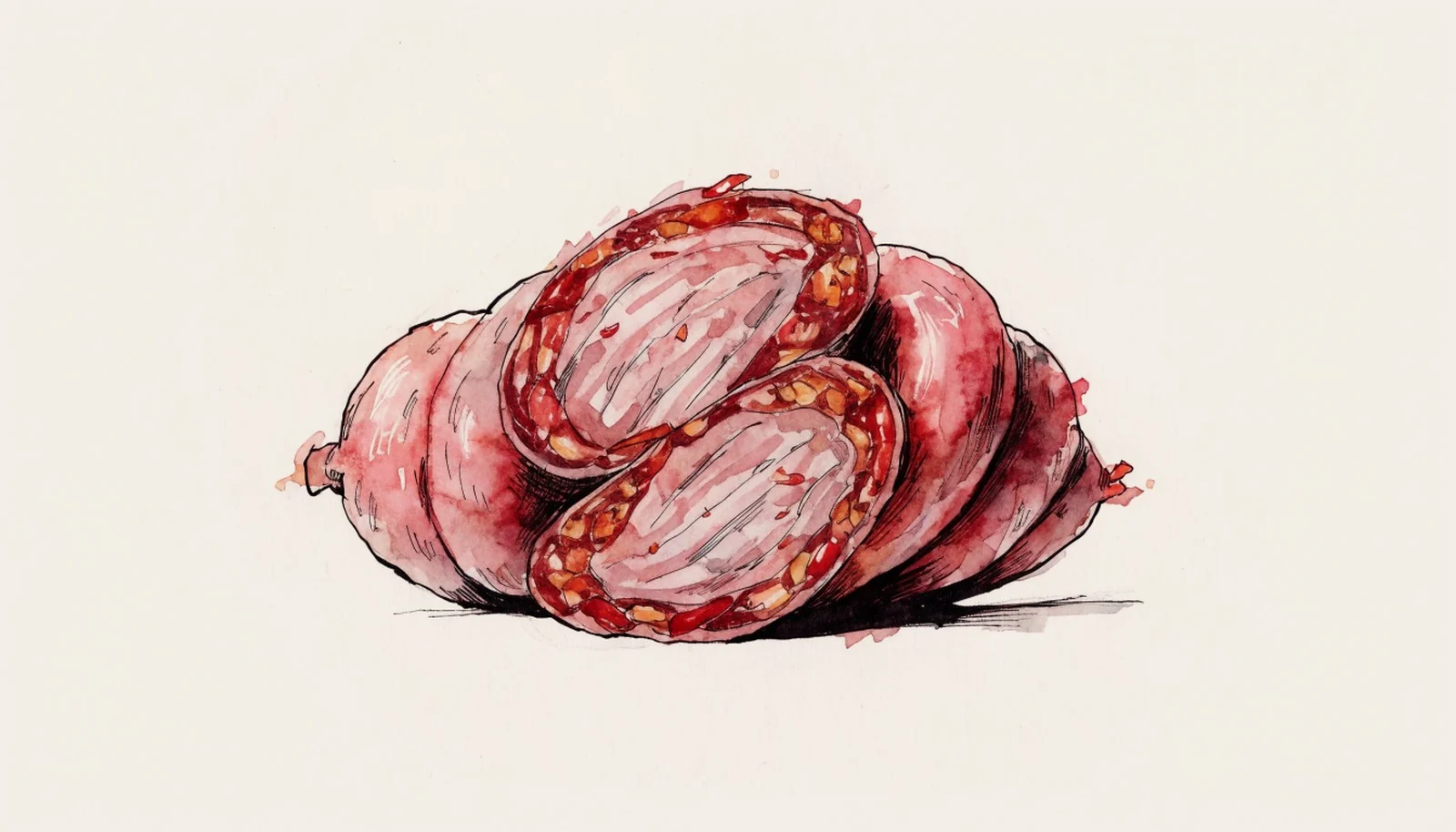
Salame Napoletano is a long, narrow Campanian pork salami seasoned with black pepper and chilli, air-dried and in some traditions lightly smoked. It is a regional speciality with an official listing in Campania and no European protected designation. With no mark behind it, the producer stands in for what a DOP guarantees on other Italian ingredients.
It is also the origin of a widely sold American deli product called Napoli salame, and the two have drifted apart enough that the distinction is worth having before you buy either.
What salame Napoletano actually is
Salame Napoletano is pork lean and fat, ground to a medium grain, seasoned with salt, black pepper and chilli, stuffed into a narrow casing and dry-aged for a few months.
The shape is part of the identity. It is markedly longer and thinner than a Milano or a Felino, which gives it a high surface area and a relatively fast, even cure.
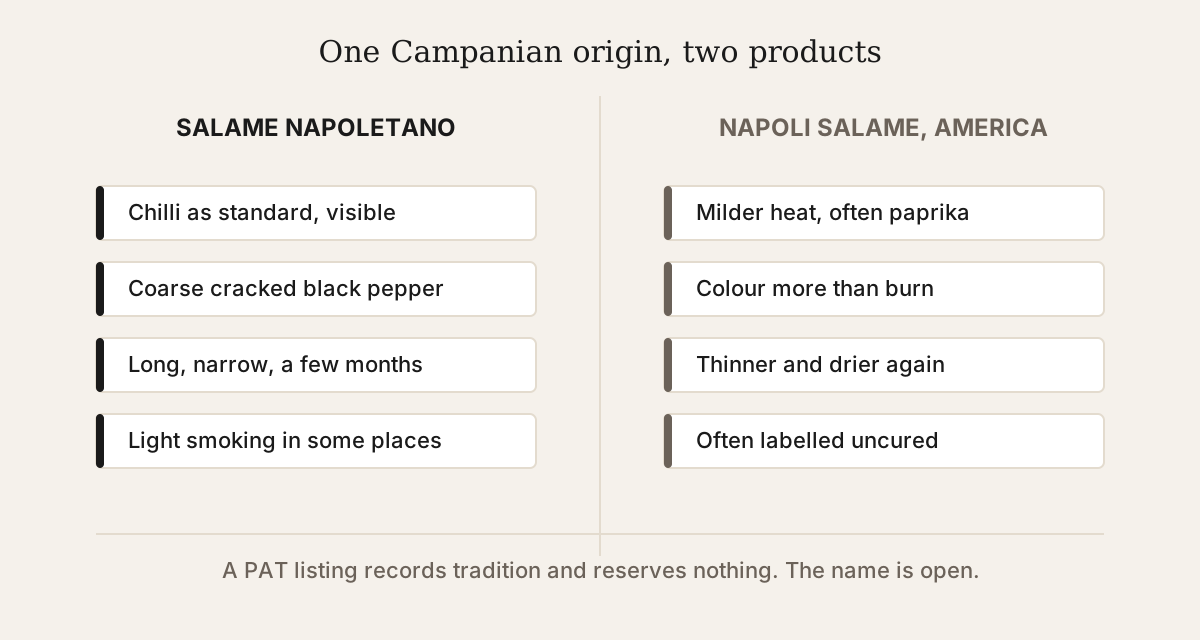
Chilli is standard rather than optional. Campanian salami runs peppery, and a Napoletano without any heat is a different product wearing the name.
Black pepper is used generously alongside the chilli, often coarsely cracked, so the heat has two distinct sources.
Light smoking appears in some traditions. It is a genuine regional practice rather than an industrial addition, and it is not universal, so it is worth checking before you buy if smoke matters to you.
The grain is moderately coarse, coarser than Milano and finer than a knife-cut southern sausage.
What a PAT listing does and does not guarantee
Salame Napoletano appears on Campania’s regional list of traditional agri-food products, a PAT listing, and that is a weaker instrument than a DOP or an IGP.
A PAT records that a product is traditional to a region. The list is compiled at national and regional level in Italy and functions as recognition and inventory.
It does not restrict who may use the name. Unlike a DOP or an IGP, it creates no enforceable exclusive right and imposes no production specification a buyer can rely on.
So the name is effectively open. Anyone may label a salami Napoletano, in Italy or elsewhere, and no mark on the package will tell you whether the method was followed.
This is the same position nduja occupies, and it leads to the same conclusion: with no designation doing the work, the producer and the ingredient list carry the entire judgement.
Do not read a PAT reference as equivalent to a European mark. Producers sometimes cite the listing in a way that invites exactly that confusion.
Italian Napoletano against American Napoli salame
Napoli salame is a common American deli category descended from the Campanian original, and the American version has its own settled character.
The American product is typically thinner and drier, sold in a narrow stick and sliced fine.
Its heat is usually milder and often comes from paprika as much as from chilli, which gives colour with less burn.
It is frequently sold as uncured, meaning cured with celery powder rather than added nitrite, which is a labelling regime rather than a difference in the finished chemistry.
Neither is a counterfeit of the other. Napoli salame is a real Italian-American product with its own century of history, and calling it inauthentic misdescribes what it is.
Checked on 13 August 2026, the first page of United States results for salame napoletano returned a major American deli brand, an Italian producer and a Campanian regional agriculture page, which describes that search on that date rather than recommending any seller. The mixture of the two traditions in one result set is itself the point.
How to judge one
Judge it on the cut face, then the fat, then the aroma.
The grain should be clearly defined, with distinct fat particles against deep red lean. A smeared appearance means the mixture warmed while grinding.
Chilli should be visible as flecks through the slice, not merely tasted. A uniform pink with no visible seasoning suggests colour from paprika alone.
The lean should be a deep red to brick, without a grey outer ring. In a thin salami a grey ring appears easily and means it dried too fast.
Fat should be white and firm. Yellowing fat in a narrow, high-surface-area salami is a common ageing fault.
It should smell of pepper, chilli and cured pork. A dusty, flat smell means old spice, and spice is a large part of what you are buying here.
If it is smoked, the smoke should be faint. A strong smoke note is either a heavy hand or a liquid-smoke shortcut, and neither belongs in the traditional product.
What it should cost
Expect roughly 14 to 26 dollars a pound in the United States, with the domestic Napoli style at the lower end and imported Italian Napoletano at the upper.
The absence of a protected designation keeps the price sensible, and the narrow calibre and short cure keep production costs down relative to a whole-muscle salume.
A very low price is not a warning here in the way it would be for prosciutto, because this has always been an everyday salami rather than a luxury one.
The floor for this page rests on a thin competitor sample. Only two extractable competitors were found for the head, which is a weak measurement, so treat the pricing range as a guide rather than as a surveyed figure.
How to use it
Eat it sliced thin at room temperature, on a board or in a sandwich. Its pepper and chilli make it the assertive member of a mixed plate.
It stands up to strong company in a way a Milano does not: sharp provolone, pickled peppers, a robust bread.
It is a natural pizza salami. The narrow diameter gives small rounds, the chilli survives the oven and the fat renders into the cheese, which is precisely what an American pepperoni is engineered to do.
Cooking it is legitimate rather than wasteful, which sets it apart from the delicate northern salami, because the seasoning is robust enough to survive heat.
Serve it at room temperature on a board. Cold, the fat is waxy and the chilli reads flat.
Storage
Whole and wrapped in paper, several weeks refrigerated. Sliced, four to five days.
The narrow calibre means it continues to dry, so it hardens rather than spoils if kept too long, and a hardened stick is still good chopped into a cooked dish.
Keep it in paper, not plastic. A dry-cured casing needs air, and plastic produces a slick surface within days.
Trim the cut face if it has darkened or gone hard before slicing again.
White bloom on the casing is the intended mould culture. Coloured fuzzy growth is not, and means it was stored damp.
Frequently asked questions
Is salame Napoletano the same as Napoli salame?
Salame Napoletano and American Napoli salame share an origin and have diverged. The Italian product is a peppery Campanian salami seasoned with real chilli and sometimes lightly smoked. The American deli version is typically thinner, drier and milder, often coloured with paprika, and frequently sold as uncured. Both are legitimate products rather than one being a copy of the other.
Does salame Napoletano have a DOP or IGP?
Salame Napoletano holds no DOP and no IGP. It appears on Campania’s regional list of traditional agri-food products, a PAT listing, which records that the product is traditional to the region but creates no enforceable right to the name and sets no specification a buyer can rely on. The producer and the ingredient list are therefore what to judge.
Is salame Napoletano spicy?
Salame Napoletano is genuinely spicy in its traditional form, seasoned with chilli as well as generous cracked black pepper, and heat is part of its regional identity rather than an optional variant. The American Napoli style is usually much milder and takes more of its colour from paprika. A salami sold under the name with no detectable heat is closer to the American product.
Is salame Napoletano smoked?
Some salame Napoletano is lightly smoked and much of it is not, since smoking is a genuine regional practice in Campania rather than a universal step. Where it appears, the smoke should be faint and sit behind the pepper and chilli. A pronounced smoky flavour indicates either a heavy hand or liquid smoke, neither of which belongs in the traditional product.
Can I use salame Napoletano instead of pepperoni?
Salame Napoletano works well in place of pepperoni and is arguably its ancestor, since both are narrow, chilli-seasoned salami that render usefully under heat. The differences are that Napoletano is coarser in grain, more variable between producers, and carries genuine chilli heat rather than pepperoni’s engineered mildness. Expect a less uniform slice and a more assertive result.
CalItalia Food covers Italian ingredients: what they are, how to tell a good one from an ordinary one, and where to buy them in the United States.