
Salame di Felino: The Parma Salami Cut on the Diagonal
Lean pork, whole peppercorns and white wine, aged in natural gut. What the IGP covers, why the slice is cut at an angle, how to judge one, and how to buy the IGP rather than a Felino-style one.
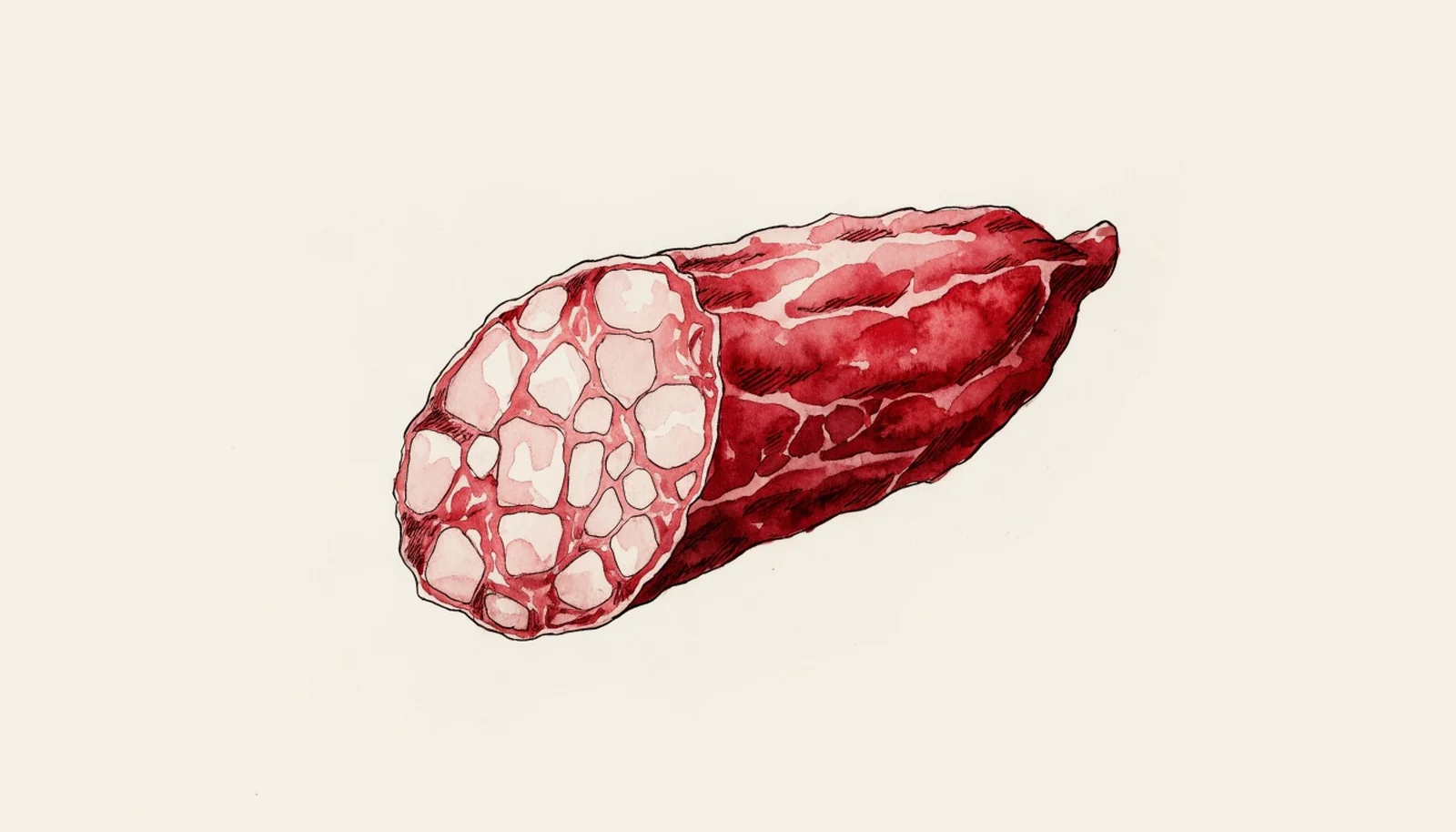
Salame di Felino is a mild, relatively lean pork salami from the province of Parma, seasoned with salt, whole black peppercorns and dry white wine, cased in natural gut and aged for at least twenty-five days. It carries an IGP, and the protected name is Salame Felino. That name is what to look for when buying the protected Italian original.
It is the salami most often described as delicate, and that description hides the thing worth knowing about it: the delicacy comes from what is left out.
What salame di Felino actually is
Salame di Felino is pork shoulder and trimmings ground to a medium grain, mixed with sea salt, whole or cracked black peppercorns and dry white wine, stuffed into natural pork gut, tied by hand and dry-aged.
The grind is medium rather than fine or coarse. Lean and fat stay visible as distinct particles, so a slice reads as a mosaic rather than as a smooth paste. The fine end of that scale is salame Milano.
It is leaner than most Italian salami. The fat proportion is modest and the fat is well distributed, which is why the texture is soft without being greasy.
Garlic is present but muted. In the traditional method whole garlic is steeped in the wine and the wine goes into the mix, so the garlic arrives as an aroma rather than as a bite.
The seasoning list is short. Salt, pepper, wine, garlic. There is no chilli, no fennel, no smoke and no sugar-driven tang, and that restraint is the product’s character rather than an omission.
What the IGP covers, and what it does not
Salame Felino IGP is a protected geographical indication, which ties the production to the province of Parma and to a written method, and it is a narrower promise than a DOP.
IGP requires that at least one production stage happens in the named zone. For Salame Felino the making and ageing are in the province of Parma. The pigs themselves are not required to be born and raised there, which is the difference between this mark and a DOP.
The specification restricts what can go in. Milk derivatives and polyphosphates are excluded, which matters because both are common shortcuts in industrial salami for binding and water retention.
The town of Felino does not have a monopoly on the name. The protected zone is the whole province, so a Salame Felino IGP from elsewhere in Parma is fully legitimate.
“Felino-style” is not the IGP. A salami described as Felino style, or as being in the manner of Felino, is making a claim about the recipe and no claim about origin or method. That is the label distinction to read.
Why it is cut on the diagonal
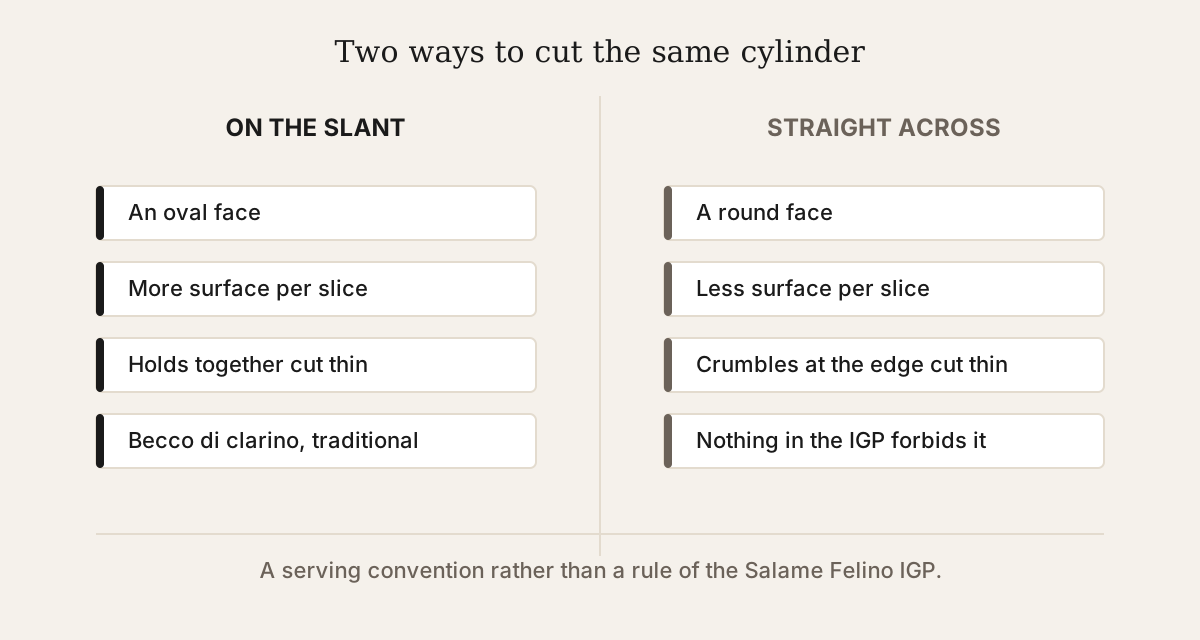
Salame di Felino is traditionally sliced at a pronounced angle rather than straight across, a cut described in Parma as a becco di clarino, the beak of a clarinet.
The angle enlarges the face of the slice. A cylinder cut obliquely gives an oval with more surface than a perpendicular circle, so more of the seasoning meets the palate at once.
It also keeps the slice thin without it falling apart. A medium grind sliced thin and straight tends to crumble at the edge; the longer oval holds together.
This is a serving convention rather than a rule of the specification. Nothing is voided by cutting it straight, and a counter that cuts it on the slant is signalling that it knows the product.
How to judge a slice
Look at the grain first, then the fat, then the casing.
The grain should be clearly defined, with lean and fat readable as separate particles. A smeared or pasty look means the mix warmed during grinding, which dulls both texture and flavour.
Fat should be white and firm, evenly scattered rather than pooled in large lumps. Yellowing fat means age or poor storage.
The lean should be a deep rose to red, uniform across the face. A grey outer ring means it dried too fast or has been cut and left exposed.
Whole peppercorns should be visible and are part of the identity. Ground pepper alone suggests a different recipe.
The casing should be natural gut, irregular and clinging closely to the meat. A perfectly uniform cylinder in a smooth artificial casing is an industrial product, which is not automatically bad and is not this.
What it should cost
Expect roughly 18 to 30 dollars a pound in the United States, which puts it below the whole-muscle hams and in line with other protected salami.
The short minimum ageing keeps it cheaper than a long-cured whole muscle, and the IGP and the natural casing keep it above supermarket salami.
Checked on 13 August 2026, the first page of United States results for salame di felino returned Eataly, Columbus Craft Meats and ParmaShop alongside a reference entry, which describes that search on that date rather than recommending any seller. Availability is reasonable, which is not true of every salume in this section. Salame di Varzi is one that is hard to find.
Domestic American versions of the style are common and some are very good. They cannot carry the IGP and should be judged on the grind, the fat and the casing.
How to use it
Eat it as it comes, sliced thin on the diagonal, at room temperature. It is a board and antipasto salami rather than a cooking one.
Its mildness makes it the one to put next to assertive things rather than against them: it sits well with a young pecorino, with pickles, and with the flatbreads of its own region.
It is the classic filling for torta fritta, the fried dough of Parma, where the heat softens the fat and the salami is the only seasoning needed.
Do not cook with it. The seasoning is too delicate to survive heat and the low fat gives it nothing to render.
Storage
Whole and wrapped in paper, several weeks refrigerated. Sliced, three to four days.
A natural casing continues to breathe, so keep it in paper rather than plastic, which traps moisture and turns the surface slimy.
Trim the cut face before the next use if it has darkened or hardened.
White surface bloom on the casing is the intended mould culture and is wiped off or eaten. Fuzzy green or black growth is not, and means it was stored damp.
Frequently asked questions
What is the difference between Salame Felino and salame di Felino?
Salame Felino is the protected IGP name and salame di Felino is how the product is commonly described in English, with the preposition added. They refer to the same salami. The protected form on the label is Salame Felino IGP, so that is the phrase to look for, and its absence means you are buying an unprotected salami in the same style.
Is salame di Felino spicy?
Salame di Felino is not spicy, and heat is not part of the recipe. It is seasoned with salt, black pepper, dry white wine and a muted garlic note, with no chilli at any stage. The whole peppercorns give an occasional sharp bite when one is caught in a slice, which is a texture rather than a heat.
Why is salame di Felino cut at an angle?
Salame di Felino is cut on a pronounced diagonal to enlarge the face of the slice, a cut known in Parma as a becco di clarino. An oblique cut through a cylinder produces a long oval with more surface than a straight circle, so more seasoning reaches the palate, and the longer slice holds together at a thinness that would otherwise crumble.
Does salame di Felino contain milk?
Salame Felino IGP excludes milk derivatives under its specification, so a product carrying the mark does not contain them. Powdered milk and caseinates are used in some industrial salami as binders, which is one practical reason the IGP is worth reading for. An unprotected Felino-style salami carries no such restriction and the ingredient list is the only guide.
How long is salame di Felino aged?
Salame Felino IGP is aged for a minimum of twenty-five days, and larger calibres are aged considerably longer because the specification scales the minimum with the diameter. That is short by the standards of whole-muscle salumi such as prosciutto, and it is why the product stays soft and mild rather than developing the concentrated depth of a long cure.
CalItalia Food covers Italian ingredients: what they are, how to tell a good one from an ordinary one, and where to buy them in the United States.