Prosciutto Toscano: The Seasoned DOP, and Why It Breaks the Two-Ingredient Rule
Pepper, garlic and juniper on the surface, a deeper trim and a saltier result. How Tuscan prosciutto differs from Parma and San Daniele, and how to judge and use one.
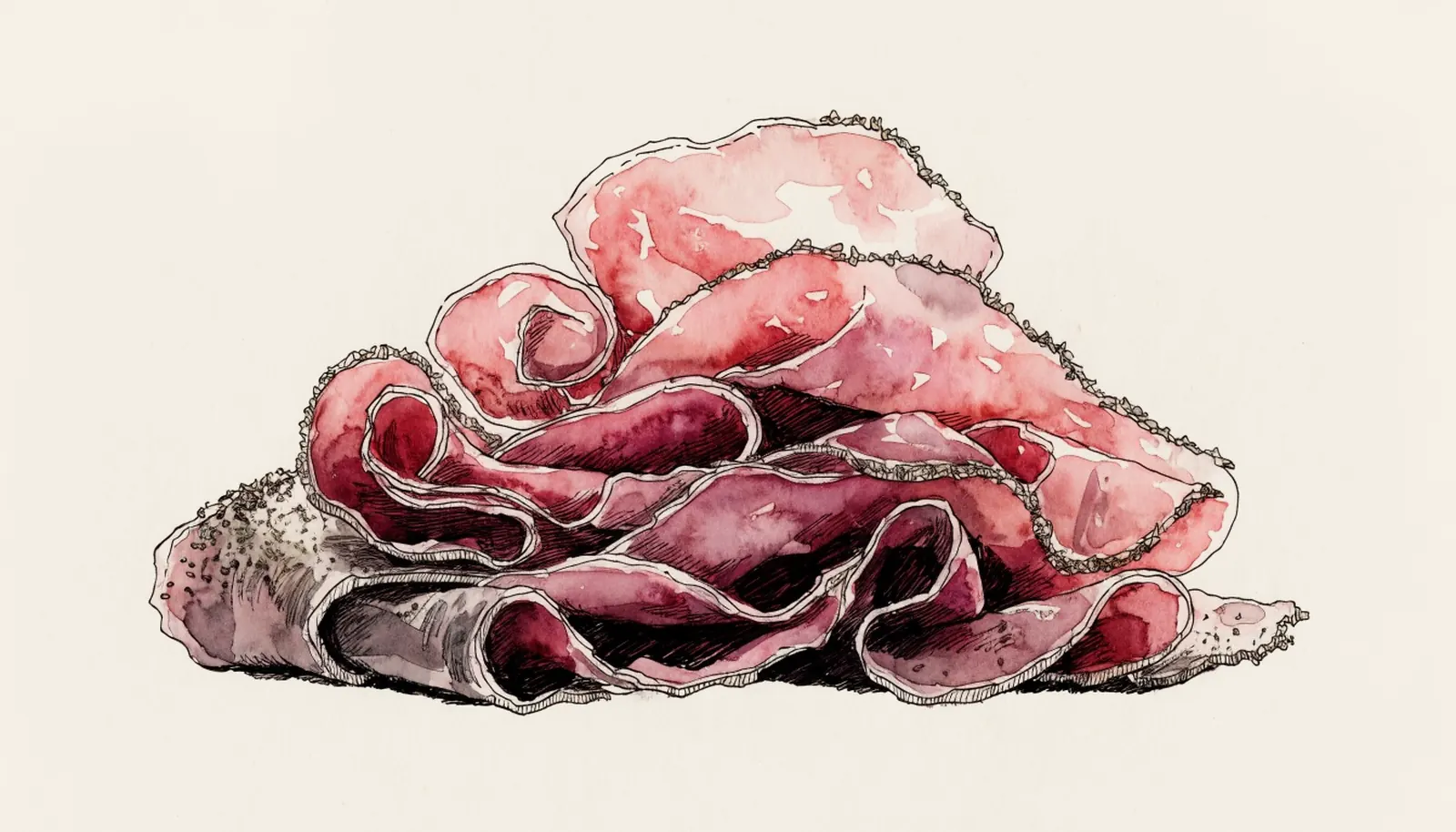
Prosciutto Toscano is a DOP dry-cured ham from Tuscany, distinguished from the other major Italian prosciutti by being seasoned: pepper and a herb mixture including garlic and juniper are worked into the surface before ageing. It is saltier and more assertive than Parma or San Daniele, and no less an authentic Italian ingredient.
Anyone who has learned that real Italian prosciutto contains nothing but pork and salt will find that sentence contradictory. The rule is real, it applies to two famous DOPs, and it was never a rule about prosciutto in general.
What Prosciutto Toscano actually is
Prosciutto Toscano is a whole pork hind leg, salted, rubbed with a seasoning mixture, trimmed in the Tuscan manner and cured for around a year in Tuscany.
The seasoning is the defining feature. Ground pepper together with a herb mixture that typically includes garlic, juniper, rosemary, myrtle and sage is applied to the exterior during salting.
It is salted more heavily than the northern DOP hams, which is a Tuscan preference rather than a technical necessity.
The trim is deeper. The Tuscan cut removes more fat and rind from the inner face of the leg, exposing a larger area of lean, which gives the ham its distinctive arched profile.
That deeper trim is why the seasoning works. More exposed lean means more surface for salt and herbs to act on, and the two choices go together.
The pigs come from the same central and northern Italian pool used by the other heavy-pig DOPs, and must be traceable.
Minimum ageing runs to about a year, scaled to the weight of the leg.
Why the two-ingredient rule does not apply here
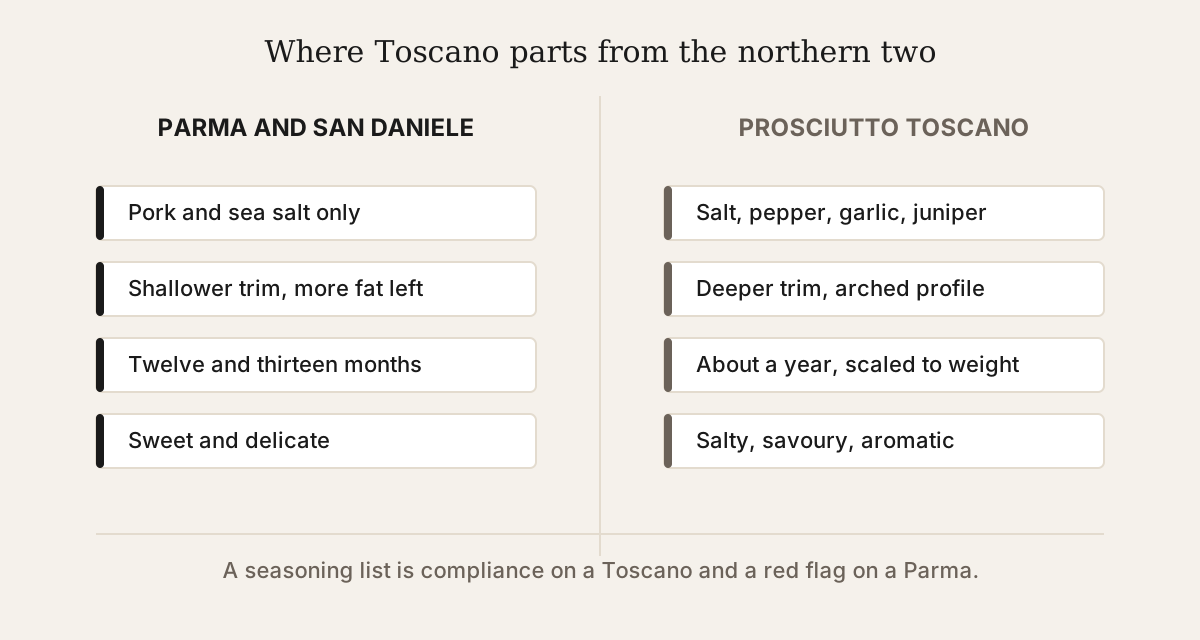
Prosciutto di Parma and Prosciutto di San Daniele are made from pork and sea salt alone, and that restriction belongs to those two specifications rather than to Italian prosciutto as a category.
Each DOP has its own specification. A protected designation guarantees adherence to one written method, not conformity to a national standard.
Toscano’s specification permits the seasoning and in fact requires it, so a Prosciutto Toscano without pepper and herbs would fail its own DOP.
The exclusion the three do share is preservatives. Nitrates, nitrites, phosphates and added water are out of all three, and that is the part of the two-ingredient story that generalises.
So the useful reading is narrower. Real Italian DOP prosciutto contains no preservatives. Whether it contains anything beyond salt depends on which DOP you are holding.
This matters when reading a label. A seasoning list on a Prosciutto Toscano is compliance rather than adulteration, and the same list on a ham claiming to be Parma would be a red flag.
How it tastes different, and why
Prosciutto Toscano is saltier, more savoury and more aromatic than the northern hams, and each of those follows from a production choice.
The salt is simply higher. It reads immediately and is the first thing most people notice.
The pepper and juniper sit behind the pork rather than on top of it, having been absorbed over a year rather than applied at the end.
The deeper trim concentrates it further. Less protective fat means more moisture loss, so the lean is firmer and the flavour is more concentrated.
It is a ham built for bread rather than for melon. Tuscan bread is made without salt, and the region’s salumi are salted to be eaten with it. That relationship is real and it explains the seasoning level better than any tasting note.
It is less delicate and that is the intent. Judging it against San Daniele’s sweetness is judging it against a target it is not aiming at.
How to judge it
Judge it on the brand, then the colour, then the trim.
Look for the DOP brand on the rind. Prosciutto Toscano carries a fire-branded mark, and that mark rather than a paper label is the guarantee. On pre-sliced packs the DOP mark and a producer identifier should be printed.
Visible pepper and herb on the outer surface is correct and expected. Its absence on a whole ham is a reason to ask questions.
The lean should be a deep red, darker than Parma, and firm rather than yielding.
Fat should be white and firm and there should be less of it than on a northern ham, following from the trim.
The arched trim is a signature. A whole Prosciutto Toscano has a distinctive profile from the deep cut into the inner face, and it is worth looking at before it is sliced.
Checked on 13 August 2026, the first page of United States results for prosciutto toscano returned an Italian food publisher alongside specialist importers, which describes that search on that date rather than recommending any seller. Availability here is narrower than for Parma or San Daniele.
What it should cost
Expect roughly 30 to 55 dollars a pound in the United States, broadly alongside the other DOP hams and sometimes slightly below.
The year of ageing and the weight lost to it are the cost, as with any long-cured whole muscle. The deeper trim removes saleable weight before curing even begins, which pushes in the same direction.
It is often slightly cheaper than Parma here, which reflects lower United States demand rather than a lesser product.
A cheap ham labelled Tuscan-style is not this. Style claims carry no origin or method requirement, and the fire brand is the thing to look for.
How to use it
Eat it sliced thin at room temperature, with plain bread. It does not need an accompaniment and it can carry one.
Its salt and pepper mean it holds its own against things that would overwhelm a delicate ham: a mature pecorino, a strong olive oil, a bitter green.
It is the prosciutto that survives a sandwich. Where San Daniele disappears under other fillings, Toscano still reads.
Serve at room temperature. Cold, the salt is harsh and the herbs are muted.
Do not cook it. A year of curing is destroyed by heat, and the seasoning turns bitter, so use an unprotected cured pork for a hot dish.
Melon is a poor match here. The sweet fruit pairing was built for the milder northern hams and fights the pepper.
Storage
Sliced and wrapped, two to three days refrigerated, best on the day it is cut. In a piece with the cut face covered, several weeks.
The higher salt gives it slightly better keeping than a milder ham, which is what salt was for in the first place.
Cover the cut face and trim a thin layer before the next use if it has hardened or darkened.
Keep slices flat and separated so they do not fuse and tear.
Do not freeze it. Freezing coarsens the texture and none of the ageing survives it.
Frequently asked questions
Why is Prosciutto Toscano seasoned when Parma is not?
Prosciutto Toscano is seasoned because its own DOP specification requires pepper and a herb mixture including garlic and juniper, while the Parma and San Daniele specifications permit only pork and sea salt. Each protected designation defines a single written method rather than conforming to a general Italian standard. A Prosciutto Toscano without its seasoning would fail its DOP.
Is Prosciutto Toscano saltier than Parma?
Prosciutto Toscano is noticeably saltier than Prosciutto di Parma, which is a deliberate regional choice rather than a fault. Tuscan bread is traditionally made without salt, and the region’s cured meats are salted to be eaten alongside it. The deeper Tuscan trim, which exposes more lean, concentrates the effect further.
Does Prosciutto Toscano contain preservatives?
Prosciutto Toscano contains no nitrates, nitrites, phosphates or added water, which it has in common with Parma and San Daniele. What sets it apart is the pepper and herb seasoning its specification requires, which is not a preservative. A seasoning list on a Prosciutto Toscano label is compliance with its DOP rather than a sign of adulteration.
How do I know a Prosciutto Toscano is genuine?
Genuine Prosciutto Toscano carries a mark fire-branded into the rind identifying the designation, and on sliced packaging the DOP mark appears with a producer identifier. A paper label or a description such as Tuscan-style prosciutto is not the designation and carries no origin or method requirement. Visible pepper and herb on the exterior of a whole ham is a supporting sign rather than proof.
Can I substitute Prosciutto Toscano for Parma?
Prosciutto Toscano can stand in for Parma with the understanding that it is saltier, more peppery and more assertive, so anything built around the delicacy of the northern ham will read differently. It works better than Parma in a sandwich or against strong cheese, and worse in the classic fruit pairings, which were designed for a milder ham.
CalItalia Food covers Italian ingredients: what they are, how to tell a good one from an ordinary one, and where to buy them in the United States.