
Pesto alla Trapanese Against Genovese: What Actually Changes
The Sicilian pesto built on almonds and raw tomato. What it swaps out, why the almonds are not a substitution, and how to buy or judge one.
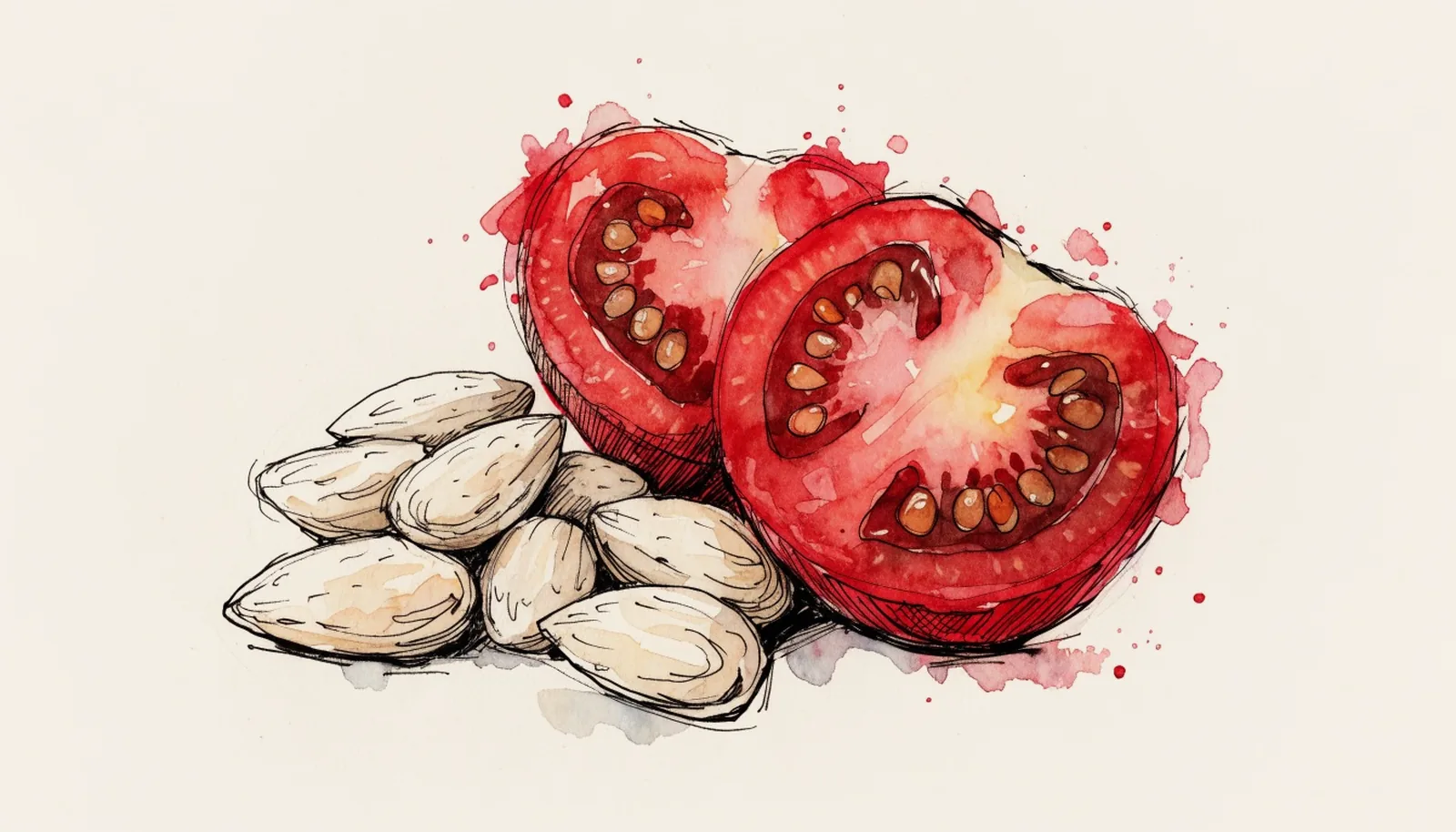
Pesto alla trapanese is a Sicilian pesto built on almonds, raw tomato, basil and garlic, and it differs from pesto genovese in three deliberate places: the nut, the addition of tomato, and the near-absence of cheese. It is a separate preparation rather than a Genovese variant with substitutions. Telling a recipe from a substitution is the habit this site applies to every Italian ingredient.
That distinction matters commercially, because almonds standing in for pine nuts in a jar of genovese is a cost-cutting swap, while almonds in a trapanese are the recipe.
What pesto alla trapanese actually is
Pesto alla trapanese is blanched almonds, ripe raw tomato, basil, garlic, olive oil and salt, pounded or blended into a coarse sauce, usually with little or no cheese. It comes from Trapani, on the western tip of Sicily.
The texture is coarser than genovese. Almonds do not break down to the same smooth paste that pine nuts do, and the raw tomato contributes water and pulp, so the finished sauce is looser, redder and more rustic.
The story usually attached to it is that Genoese ships stopping at Trapani brought the idea, which local cooks rebuilt from what grew there. Whether or not that origin is exact, the substitution pattern it describes is visible in the recipe: the structure of genovese with Sicilian ingredients in it.
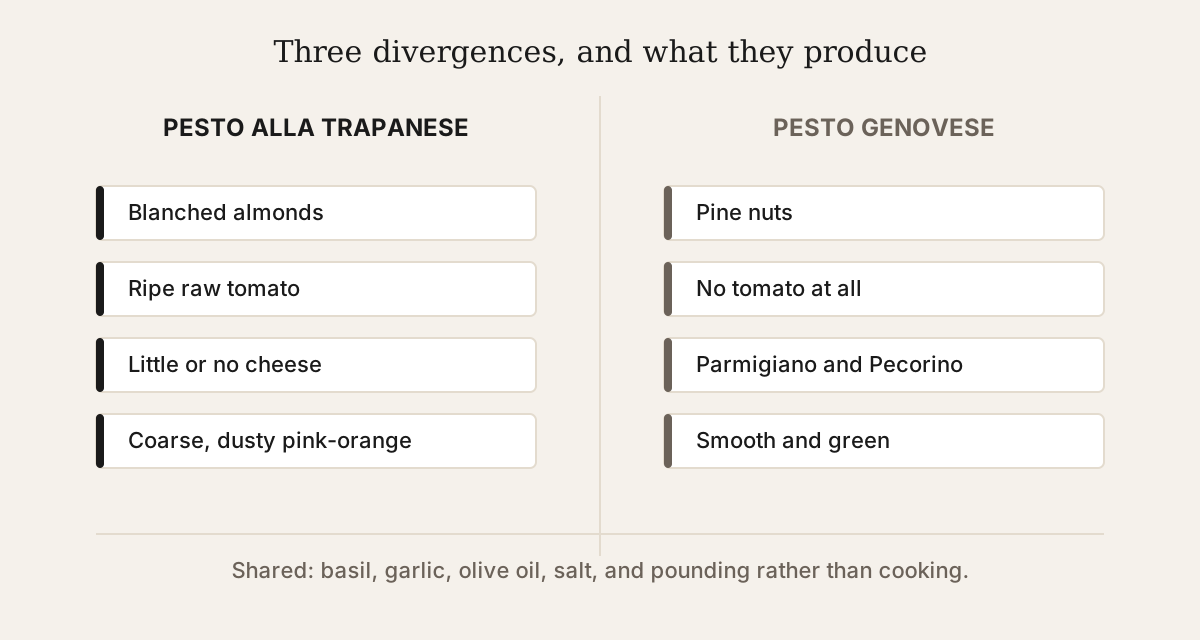
The three points of divergence
One. Almonds instead of pine nuts. Sicily grows almonds in quantity and the local varieties are sweet and soft. This is the defining swap and it changes the texture more than the flavour.
Two. Raw tomato, which genovese does not contain at all. The tomato is not cooked, so it contributes freshness and acidity rather than the depth a cooked tomato sauce would have. This is the change that most separates the two on the plate.
Three. Little or no cheese. Where genovese requires both Parmigiano and Pecorino, trapanese commonly uses a small quantity of pecorino or none. The sauce leans on almond fat and olive oil instead.
What does not change. Basil, garlic, olive oil, salt, and the method of pounding rather than cooking. It is recognisably the same technique applied to a different larder.
Almonds as recipe against almonds as substitution
Almonds in two different contexts mean opposite things, and this is the most useful thing on the page for anyone reading a label.
In a trapanese, almonds are correct. A jar of pesto alla trapanese listing almonds is doing what it says.
In a genovese, almonds are a cost substitution. Pine nuts are expensive and almonds are not, so a jar labelled pesto genovese or simply basil pesto listing almonds has swapped down and should be priced accordingly.
So the label matters more here than in most categories. Read which pesto is being claimed before judging the nut.
How to judge one
Look for whole tomato rather than paste, named almonds, and a coarse rather than smooth texture.
Tomato should be listed as tomato, not as tomato paste or concentrate. Paste indicates a cooked, concentrated ingredient standing in for the raw fruit the preparation is built around, and it makes the sauce taste like a tomato sauce.
Almonds should be named and should ideally be blanched Sicilian. Almond flour or almond meal is a cheaper form and produces a pasty texture.
Texture should be coarse. A perfectly smooth trapanese has been over-processed and loses the character that distinguishes it.
Colour should be a dusty pink-orange rather than red or green. A very red jar has too much tomato or added concentrate; a green one is closer to a genovese with tomato added.
Checked on 13 August 2026, the first page of United States results for pesto alla trapanese vs genovese returned cooking publishers and reference material rather than sellers, which describes that search on that date. The practical reading is that trapanese is much less commercially available in the United States than genovese, and is more often made than bought.
What it should cost, and where to find it
Where it is sold at all, expect a similar band to good genovese, roughly 8 to 18 dollars for a jar in the 180 gram range.
The cost drivers are different. Almonds are cheaper than pine nuts, and the tomato is inexpensive, so a well-made trapanese has a lower ingredient cost than a well-made genovese. Where it costs the same, you are usually paying for a smaller production run.
Availability is the real constraint. Specialist Italian importers carry it, general retail almost never does, and it is common for a shop with six genovese jars to have none.
It is straightforward to make, which given the availability is the practical answer for most people. Blanched almonds, ripe tomatoes, basil, garlic, oil and salt, pounded or pulsed coarse.
How to use it
Serve it with a pasta that catches a coarse sauce, and do not cook it, for the same reasons that apply to genovese.
The traditional pairing is busiate, a long twisted Sicilian pasta, and any shape with twists or ridges works on the same logic. A smooth long pasta lets a coarse sauce slide off.
Stir it through off the heat with a spoonful of pasta water, exactly as with genovese. The raw tomato makes it slightly more forgiving of warmth than a genovese, and it will still dull if cooked.
It is also good on grilled fish and on bread, where the raw tomato reads as fresher than a genovese would.
Making it, and the one decision that matters
Blanch and skin the almonds, use ripe tomatoes rather than good ones, and keep the texture coarse. Those three cover most of the outcome.
Blanched almonds rather than skin-on. The skins are tannic and turn the sauce grey-brown and slightly bitter. Blanched almonds are widely sold and save the step.
Ripeness beats variety in the tomato. This is the decision that matters. A very ripe ordinary tomato makes a better trapanese than a firm expensive one, because the sauce depends on the fruit’s sugar and its willingness to break down under pounding. An underripe tomato produces a watery, acidic sauce that no amount of oil rescues.
Salt the tomato first if it is watery. A short salting and draining concentrates it and prevents the finished sauce from splitting into a puddle.
Keep it coarse. Pulse rather than run a processor, or use a mortar. Trapanese that has been blended smooth loses the texture that distinguishes it and takes on a slightly pasty quality from the almonds.
Cheese last and sparingly, if at all. It is easy to add and impossible to remove, and a heavy hand pushes the sauce toward a genovese.
Storage
Refrigerated under a film of oil, three to four days, which is shorter than genovese because the raw tomato brings water and continues to release it.
Freezing works less well than for genovese, again because of the tomato. The thawed sauce is noticeably wetter and separates more readily.
Make it in the quantity you will use, which is easy given how quickly it comes together.
Frequently asked questions
Is pesto alla trapanese just genovese with tomato?
No. It differs in three places at once: almonds instead of pine nuts, raw tomato which genovese contains none of, and little or no cheese where genovese requires two. It is a distinct Sicilian preparation that shares a technique and a couple of ingredients with the Ligurian one.
Are almonds a legitimate ingredient in pesto?
In pesto alla trapanese, yes, they are the recipe. In a jar labelled pesto genovese or basil pesto, almonds or cashews are a cost substitution for pine nuts, which are expensive. The same ingredient means opposite things depending on which preparation the label claims, so read the name before judging the nut.
Should trapanese contain cheese?
Usually a little pecorino or none at all, which is one of its distinguishing features. Genovese requires both Parmigiano Reggiano and Pecorino; trapanese leans on almond fat and olive oil instead. A trapanese heavy with cheese is drifting toward a genovese with tomato in it.
What pasta goes with it?
Busiate traditionally, and any twisted or ridged shape on the same principle: a coarse sauce needs something to catch on. Smooth long shapes let it slide off and leave the sauce in the bowl. This matters more for trapanese than for genovese because the almond and tomato make it chunkier.
Can I cook with pesto alla trapanese?
Warm it through the residual heat of drained pasta rather than cooking it, exactly as with genovese. The raw tomato makes it marginally more tolerant of warmth, and the basil and raw garlic still dull under real heat. Any hot application should add the sauce after the food comes off the heat.
CalItalia Food covers Italian ingredients: what they are, how to tell a good one from an ordinary one, and where to buy them in the United States.