
Ragù Napoletano: Whole Cuts, Not Mince, and Why a Jar Cannot Hold It
The Neapolitan ragù is whole pieces of meat braised for hours in tomato. Why it is not bolognese, why the jarred versions are something else, and how to judge and use one.
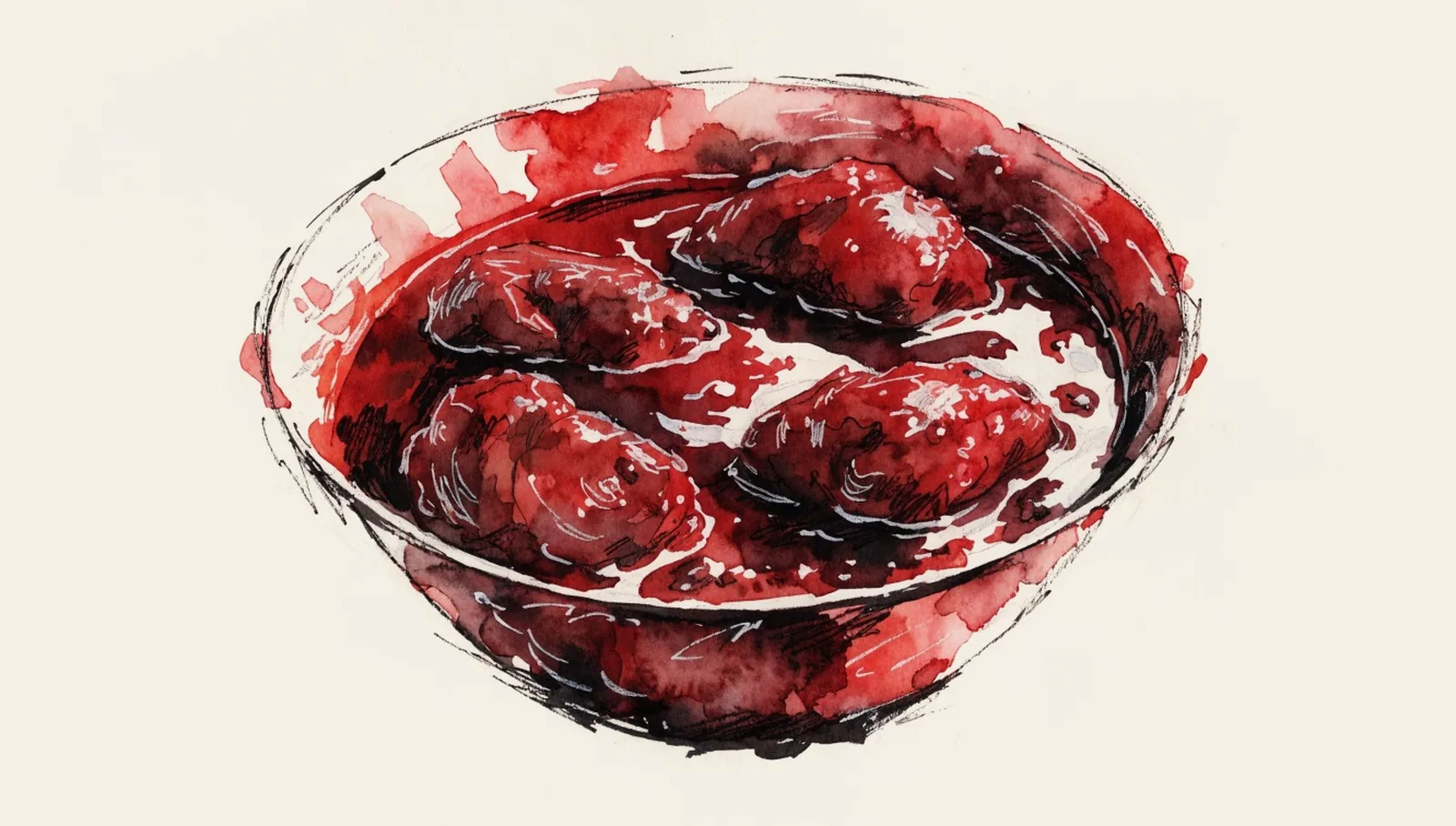
Ragù napoletano is whole pieces of meat, beef and pork, braised for many hours in tomato until they surrender, producing a sauce for pasta and a meat course from the same pot. It is not a minced-meat sauce and it is not bolognese. Its structure is what opens the distance between the Neapolitan dish and the American jar.
That structural difference is why a jar labelled ragù napoletano is almost always something else, and this page is about recognising what you are actually buying.
What ragù napoletano actually is
Ragù napoletano is a long braise of whole cuts in a large quantity of tomato, cooked at a bare simmer for anything from three to eight hours.
The meat goes in whole. Beef in large pieces, pork ribs, sausages, and frequently braciole, which are rolled and tied stuffed slices.
It is not minced. This is the single defining structural fact and it separates the dish from every other Italian ragù most people have met.
Tomato is used generously, far more than in a bolognese, so the result is a genuinely red sauce rather than a meat sauce tinted with tomato.
The cooking is very long and very slow. The traditional description is that the sauce should pippiare, meaning to murmur or blip, barely moving.
The pot yields two courses. The sauce dresses the pasta as a first course and the meat is served afterwards as the second.
It is Neapolitan and it is Sunday food, cooked in quantity and traditionally started very early.
Why it is not bolognese
The two are frequently conflated in English and they are structurally different dishes.
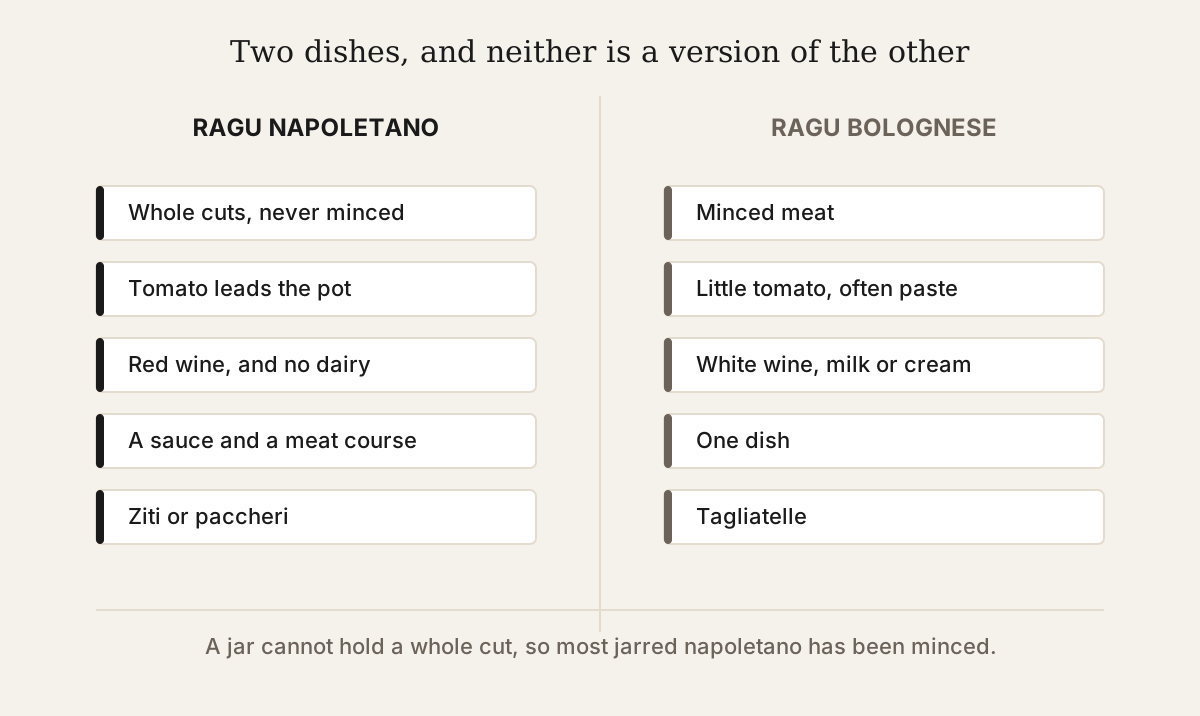
Bolognese uses minced meat; napoletano uses whole cuts.
Bolognese uses little tomato, often only a spoonful of concentrate, and is a meat sauce. Napoletano uses a great deal and is a tomato sauce carrying meat.
Bolognese usually contains milk or cream and white wine; napoletano uses red wine and no dairy.
Bolognese is served with tagliatelle in its home city; napoletano goes with ziti or another substantial dried pasta, traditionally snapped by hand.
Bolognese produces one dish; napoletano produces two.
Neither is a version of the other, and a recipe naming one specifically is not loosely gesturing at meat sauce.
Why a jar cannot really hold it
The structure of the dish resists the format, which is worth understanding before buying.
Whole cuts do not fit a jar. A sauce sold in a 300 gram jar cannot contain a piece of braciole or a pork rib, so any jarred version must break the meat down.
Breaking it down makes it a different sauce. Once the meat is shredded or minced to fit, the textural point of the dish is gone.
The two-course structure disappears entirely. Half of what the pot is for cannot be jarred at all.
So most jars labelled ragù napoletano are a Neapolitan-style meat sauce, which is a fair product under an inaccurate name.
Some producers are honest about it and describe the contents as a sauce in the Neapolitan manner rather than as the dish itself.
Refrigerated and frozen formats come closer, since they can carry larger pieces, and a frozen ragù from a good producer is the nearest a shop gets.
The braciola, and why it is the part that vanishes
Braciole are the component most often lost in a commercial version, and they are the part a Neapolitan cook would consider essential.
A braciola here is a thin slice of beef rolled around a filling, typically garlic, parsley, pine nuts, raisins and cheese, tied with string and braised whole in the sauce.
The filling seasons the sauce from inside the meat over the hours of cooking, which is a different mechanism from adding those ingredients to the pot directly.
The word means something else in other regions. In much of Italy a braciola is simply a chop or a cutlet, so a recipe using the term without explanation is ambiguous outside the south.
Nothing in a jar can reproduce it. A rolled, tied and stuffed piece of beef cannot be packed at 300 grams, and shredding it destroys both the roll and the filling’s placement.
Its absence is not declared on any label, since a producer is not obliged to list what they left out, which is why reading for meat form matters more than reading for meat quantity.
A frozen ragù from a serious producer may include one, and that is the practical route to the complete dish short of cooking it.
How to read the label
Three checks tell you what is in the jar.
Look at how the meat is described. Pieces, chunks or shredded points toward the real structure; minced or ground means a bolognese-shaped product.
Note which meats. Beef and pork together, and especially pork ribs or sausage, indicate a Neapolitan intent. Beef alone points elsewhere.
Look for the tomato proportion. Tomato should lead the ingredient list in a napoletano, unlike a bolognese where meat leads.
Read for milk or cream, which do not belong and indicate a bolognese formulation wearing the wrong name.
Read for carrot in quantity. A large carrot presence points to a bolognese soffritto rather than the simpler Neapolitan onion base.
Checked on 13 August 2026, the first page of United States results for ragu napoletano returned recipe publishers and reference material rather than jarred products, which describes that search on that date rather than recommending any seller. Counting rule: a result counts as a seller when it offers a jarred ragù napoletano for purchase. On that rule the first page carried none.
How to judge one once open
Judge it on colour, then the meat, then the fat.
Colour should be a deep brick red, dark from hours of cooking but unmistakably a tomato sauce rather than a brown meat sauce.
Meat should be in identifiable shreds or pieces rather than a uniform mince, and should be soft enough to fall apart.
There should be visible rendered fat, since the pork contributes a good deal, and a sauce with none has used lean meat or very little of it. Rendered fat is the same sign of real pork in an amatriciana.
It should taste of tomato and meat together, with the tomato slightly ahead. Meat well ahead of tomato indicates a bolognese formulation.
It should not taste of dried herbs. Neapolitan ragù is aromatically simple, and heavy oregano or basil is a cover. A jar of sugo finto is held to the same test.
A thin watery sauce has not been reduced anywhere near long enough.
What it should cost
Expect roughly 10 to 22 dollars for a 300 to 400 gram jar in the United States.
Meat and hours are both expensive, and a genuinely long-cooked meat sauce cannot be made cheaply at any scale.
A cheap jar is a tomato sauce with a little meat, which the ingredient list will confirm by placing tomato far ahead and listing a small meat percentage.
Frozen versions from good producers cost more and are considerably closer to the dish.
Making it is a weekend project rather than a weeknight one, which is a real argument for buying a jar, and it freezes extremely well in batches.
The meat is the expense at home too, so the saving over a jar is smaller here than for a vegetable sauce.
How to use it
Warm it gently and dress a substantial dried pasta with it.
Its long cooking means it needs no further reduction, and hard reheating will only dry it and toughen the meat.
Ziti snapped by hand is traditional, along with paccheri, rigatoni and other large tubes.
Do not boil it. Warm it through and finish the pasta in it briefly.
Grate Parmigiano or a young pecorino over it, which is the Neapolitan finish.
Serve any large pieces separately as a second course if the product contains them, which is the structure the dish is built on.
A spoonful of the pasta water loosens it if it has tightened in the jar.
Storage
Unopened, a year or more in a cool dark cupboard. Once opened, refrigerated, three to four days.
Transfer out of a tin if it came in one, since the acid picks up the metal.
It freezes very well in portions, which is how the dish is traditionally handled at home given the quantity a pot produces.
A layer of separated fat on a refrigerated jar is normal and stirs back in on warming.
Cover the surface so the exposed face does not dry.
Discard any jar with a bulging lid unopened.
Frequently asked questions
What is the difference between ragù napoletano and bolognese?
Ragù napoletano is made from whole cuts of beef and pork braised for hours in a large quantity of tomato, producing a red sauce for pasta and a separate meat course. Bolognese uses minced meat, very little tomato, and usually milk and white wine, producing a single meat sauce. They differ structurally rather than regionally, and neither is a version of the other.
Does ragù napoletano use minced meat?
Ragù napoletano uses whole pieces of meat, not mince, and that is its defining structural feature. Beef in large pieces, pork ribs, sausages and braciole go into the pot and are cooked until they fall apart. Any product containing minced meat under the name has been reformulated to fit a jar and is a Neapolitan-style meat sauce rather than the dish.
Why do jars of ragù napoletano contain shredded meat?
A jar cannot physically contain a pork rib or a piece of braciole, so commercial versions must break the meat down to fit the format, which removes the textural point of the dish and eliminates the second course entirely. Refrigerated and frozen formats come closer, since they can carry larger pieces. Most jars are honestly described as a sauce in the Neapolitan manner.
What pasta goes with ragù napoletano?
Ziti snapped by hand is the traditional Neapolitan pairing, along with paccheri, rigatoni and other large dried tubes that can carry a heavy sauce. Long thin pasta is not used. The sauce dresses the pasta as a first course and, where the dish has been made properly at home, the braised meat is served separately afterwards.
How long does ragù napoletano cook?
Ragù napoletano cooks for three to eight hours at a bare simmer, described in Naples as pippiare, meaning to murmur or blip, with the surface barely moving. That length is what breaks the whole cuts down and concentrates the tomato. A jarred sauce that tastes thin and bright has not had anything approaching that treatment.
CalItalia Food covers Italian ingredients: what they are, how to tell a good one from an ordinary one, and where to buy them in the United States.