
What Real Pesto Genovese Contains, and What Gets Substituted
Seven ingredients, a DOP standard, and a long list of cheaper swaps. How to judge a jar before you buy, what the substitutions cost, and why the mortar is in the specification.
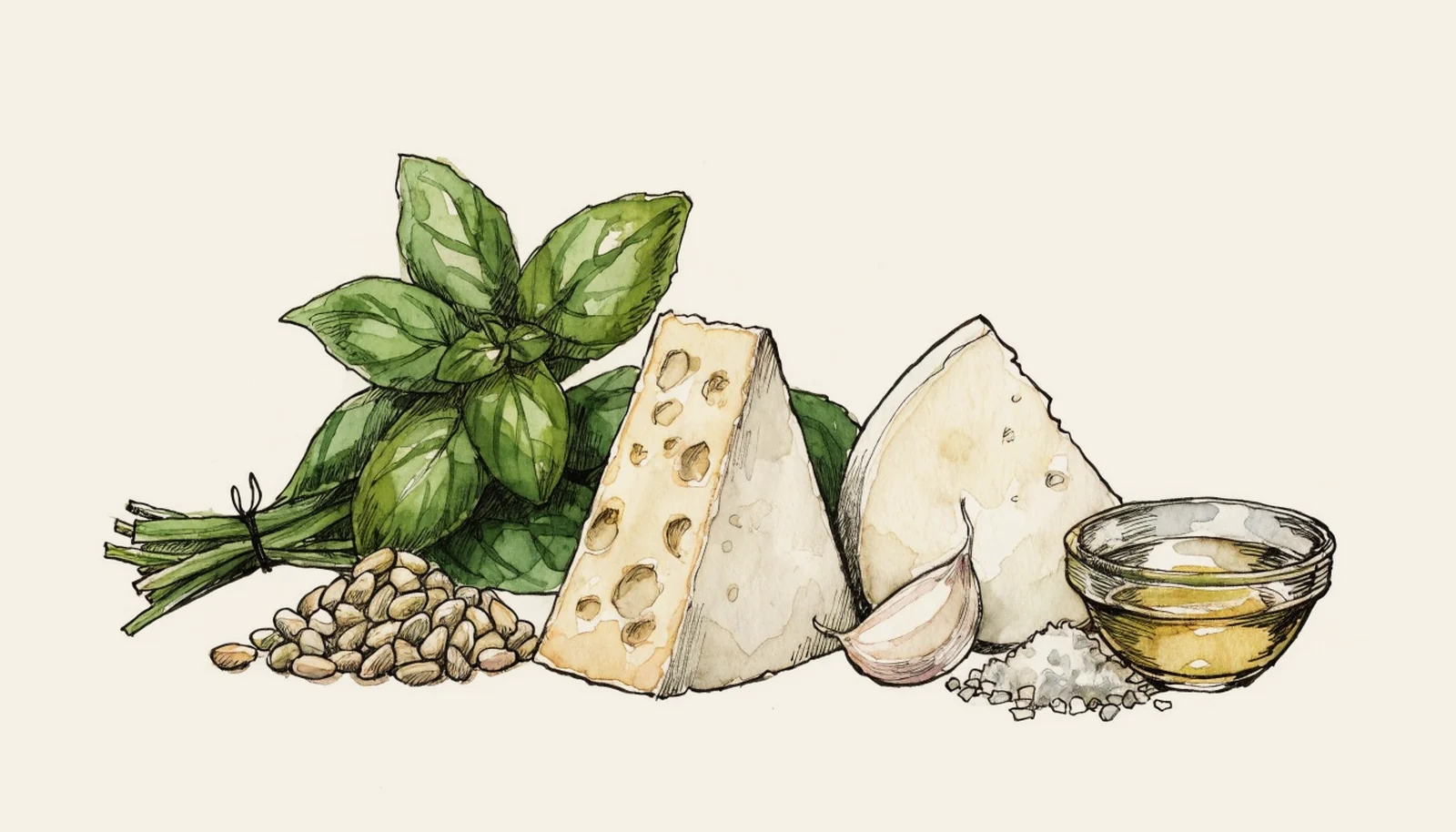
Pesto genovese is Genovese basil, pine nuts, garlic, Parmigiano Reggiano, Pecorino, extra virgin olive oil and coarse salt, and almost every departure from that list in a commercial jar is a cost substitution rather than a regional variation. Seven ingredients, and the list is the whole quality test. That makes it a clear case of the gap between an Italian original and its cheaper copies.
The useful skill here is reading a label, because the substitutions are legal, disclosed and easy to spot once you know the order they appear in.
The seven ingredients
Pesto genovese is basil, pine nuts, garlic, two cheeses, olive oil and salt. Nothing else belongs in it, and the Consorzio del Pesto Genovese specification names all seven.
Basilico Genovese DOP is the protected basil, grown in Liguria, picked young with small leaves and no minty note. Ordinary basil is larger-leaved and more assertive, and the difference is real rather than ceremonial.
Pine nuts, ideally Mediterranean, which are longer and more resinous than the cheaper Asian varieties.
Garlic, in small quantity. Pesto is not a garlic sauce.
Parmigiano Reggiano and Pecorino, both present, in a ratio favouring the Parmigiano in most versions. Using one alone is a departure.
Extra virgin olive oil, traditionally a mild Ligurian oil rather than a peppery southern one, because an aggressive oil overwhelms the basil.
Coarse sea salt, which in the traditional method also does mechanical work in the mortar.
Note what is absent from the list. No lemon, no butter, no cream, no nuts other than pine, and no herb other than basil. Each of those appears in some commercial jar or restaurant version, and each is a departure rather than a regional variant.
What gets substituted, and what each swap costs
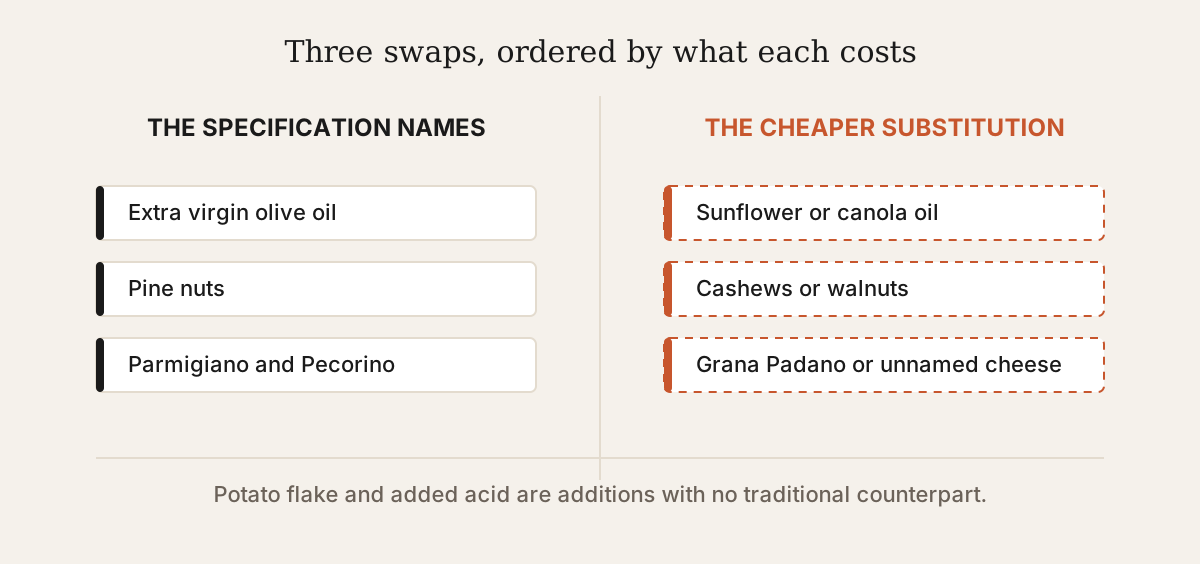
Read the ingredient list in order. The substitutions appear in a predictable sequence and the cheapest jars carry all of them.
Cashews or walnuts for pine nuts. The most common swap by a wide margin, and increasingly common even in Italy because pine nut prices have risen. Cashews are sweeter and softer, walnuts more bitter and tannic. It is the substitution that changes the texture most.
Sunflower, canola or generic vegetable oil for olive oil. Usually visible as a second oil listed after a small quantity of olive oil, which lets the label mention olive oil while using less of it. This is the swap that flattens the sauce most.
Grana Padano or generic hard cheese for the two named cheeses. Cheaper and milder. A jar listing only “cheese” without naming it is telling you something.
Potato flake, breadcrumb or starch as a bulking agent. Present in the cheapest jars to give body without fat. There is no version of the traditional sauce that contains these.
Citric acid, ascorbic acid or added lemon. Present to stop the basil browning. Not traditional, and their presence is a fair trade for a shelf-stable jar rather than a fault in itself.
Checked on 13 August 2026, the first page of United States results for pesto genovese returned a mix of recipe publishers, reference material and specialist sellers, which describes that search on that date rather than recommending any seller.
The mortar, and why it is in the specification
The traditional method calls for a marble mortar and a wooden pestle, and the reason is mechanical rather than sentimental: grinding tears basil differently from how a blade cuts it.
A blade slices the leaf and bruises it, releasing enzymes that accelerate oxidation, which is why blended pesto browns faster. Grinding crushes the cell walls against the salt crystals and releases the oils without the same bruising.
The practical difference is texture and colour more than flavour. Mortar pesto is looser, less uniformly green, and holds its colour longer. Blended pesto is smoother and darkens sooner.
Heat is the other factor. A food processor’s blade warms the basil, and warm basil oxidises faster still. Chilling the bowl and pulsing rather than running the machine mitigates it.
Fresh, jarred and frozen
Fresh from a counter is best and lasts days, frozen is the best compromise, and shelf-stable jars are the most processed of the three.
Refrigerated fresh pesto from a deli or a good producer is closest to the real thing and has the shortest life, usually under a week.
Frozen pesto keeps most of the character because freezing preserves the basil far better than heat treatment does. It is the most underrated format and the one to look for if a fresh source is not available.
Shelf-stable jars require heat treatment or high acid, both of which cost the basil. A good jar is still a useful thing to have; it is not the same sauce.
What it should cost
Expect roughly 8 to 18 dollars for a jar in the 180 gram range from a serious producer, and considerably less for jars carrying the substitutions above.
The cost is driven by pine nuts, the two DOP cheeses and the olive oil, in that order. A jar priced far below that range has saved money on at least one of the three, and the ingredient list will say which.
Fresh pesto from a counter is usually priced by weight and is more expensive again, which is appropriate given its life.
Storage
Refrigerated under a film of olive oil in a sealed jar, fresh pesto keeps three to five days. Frozen in portions, several months.
The oil film matters more here than in most preparations, because basil browns on contact with air within hours. Smooth the surface and pour a thin layer over it after each use.
Freeze in small portions rather than one block. Ice cube trays are the standard approach and thaw in minutes.
Do not heat it. Pesto is stirred into hot pasta off the heat, loosened with a spoonful of pasta water. Cooking it dulls the basil and can split the cheese.
Why the basil variety is named in the discipline
Pesto Genovese made to the traditional standard specifies Basilico Genovese DOP, and the reason is a defect the wrong basil introduces rather than regional pride.
Ligurian basil is picked young and small. The DOP basil is harvested at a few leaves rather than grown on to the large leaf of a mature plant.
Mature basil develops a mint note. As the plant ages the aromatic profile shifts and a distinct minty edge appears, which is why a pesto made with large supermarket leaves can taste faintly of mint.
That note is the usual fault in a home pesto, and it is a raw material problem rather than a technique one, so no amount of care with the mortar corrects it.
Buy the smallest basil available where DOP leaf is not an option, and pick before the plant flowers if growing it.
Frequently asked questions
Why does my pesto turn brown?
Basil oxidises on contact with air, and the enzymes released when the leaf is cut or bruised accelerate it. Blending speeds this up because the blade bruises and slightly warms the leaf. Covering the surface with olive oil, chilling the equipment and using a mortar all slow it. Browning affects appearance well before flavour.
Are cashews acceptable in pesto?
They are a substitution rather than a variation, and they are increasingly common because pine nuts are expensive. Cashews make a sweeter, softer, more uniform sauce. It is a legitimate product and it is not pesto genovese as specified, which is worth knowing when comparing a cheap jar against a costly one.
Do I need both Parmigiano and Pecorino?
The traditional specification names both, and they do different jobs: Parmigiano brings nuttiness and Pecorino brings salt and sharpness. Using only Parmigiano gives a milder, rounder sauce; using only Pecorino gives a sharper, saltier one. Neither is wrong to eat, and both are departures from the named preparation.
Is jarred pesto worth buying?
Yes, jarred pesto is worth buying with the right expectations. A good jar is a useful pantry item and a poor one is mostly oil and bulking agent, and the ingredient list separates them in seconds. If a fresh or frozen option is available, both are closer to the real thing, with frozen being the most underrated of the three.
Can I make pesto in a food processor?
Yes, pesto can be made in a food processor, and most people do. Chill the bowl and blade, pulse rather than run it continuously, and add the oil last. The result is smoother and browns faster than mortar pesto, but the difference in flavour is much smaller than the difference in texture and colour, so it is a reasonable trade for the time saved.
CalItalia Food covers Italian ingredients: what they are, how to tell a good one from an ordinary one, and where to buy them in the United States.