
Made in Italy, Product of Italy, Italian Style: What Each One Means
Three phrases that look interchangeable and are not. What each legally claims, which one means nothing at all, and how to judge a label that carries none of them before you buy.
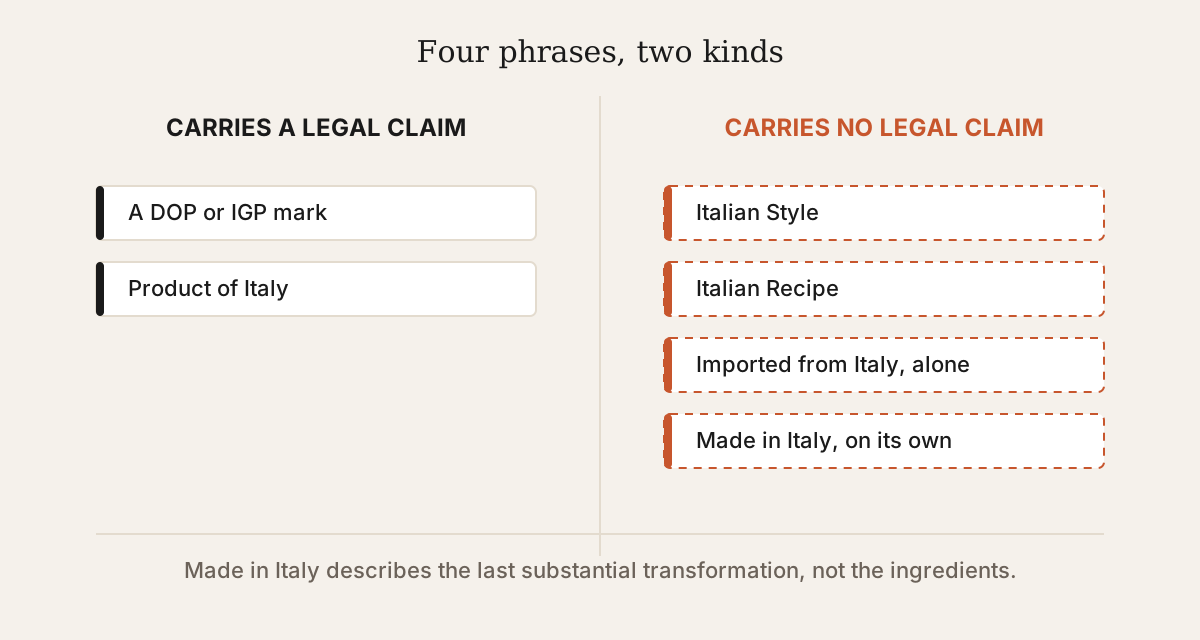
Made in Italy claims that the last substantial transformation happened in Italy, Product of Italy generally implies the same with a stronger suggestion of Italian raw material, and Italian Style explicitly claims neither. Only the third is unambiguous, and what it says is that the product is not Italian. Knowing which is which is a basic step in judging an Italian product at the shelf.
None of the three is a protected designation. That is the fact worth carrying to the shelf, because the phrases sit in the same visual position as DOP and IGP marks and are designed to be read the same way.
Made in Italy
Made in Italy indicates that the last substantial transformation of the product took place in Italy, and it says nothing reliable about where the raw material came from. It is an origin-of-processing claim.
That gap is larger than it sounds for some categories. Olive oil bottled in Italy from oil pressed elsewhere has historically been able to carry Italian labelling, and tomato products processed in Italy from imported paste are a recurring example. In both cases the transformation is real and the raw material is not local.
Where it is more meaningful is in categories where the transformation is the product. A dried pasta extruded and dried in Italy is genuinely an Italian product in the way that matters, even if the durum wheat is partly imported, because the extrusion and drying are what determine quality.
So the phrase is worth different amounts in different aisles, and that is the practical point. It means a great deal on pasta and rather less on oil.
Product of Italy
Product of Italy carries a stronger implication that both the raw material and the processing are Italian, and it is used less consistently than that implication suggests. Treat it as a claim to check rather than a guarantee.
In practice the two phrases are often used interchangeably by producers, and the distinction that exists in principle is not policed with the rigour of a protected designation. A producer wanting to make a firm claim about raw material generally has better options available, such as naming the region or the harvest.
The useful signal is specificity, not the phrase. A label saying Product of Italy and nothing more is weaker than one naming the province, the mill or the harvest year, whichever phrase it uses.
Italian Style, and its relatives
Italian Style, Italian Recipe and Italian Tradition all state explicitly that the product is not from Italy. They are the clearest phrases on the shelf and the least understood.
The construction is doing legitimate work: a producer making a cheese in Wisconsin to an Italian method needs a way to describe it, and Italian Style is honest. The difficulty is that it sits in the same typeface and position as an origin claim and reads, at a glance, as one.
The related traps are place names used as product names. Parmesan, romano and asiago are generic in the United States and can be made anywhere. Their protected counterparts are Parmigiano Reggiano, Pecorino Romano and Asiago DOP.
Checked on 13 August 2026, the first page of United States results for made in italy food label meaning returned regulatory explainers and food-industry sources rather than any single authority, which describes that search on that date. The practical reading is that the phrases are genuinely ambiguous rather than obscure, and that no consumer-facing definition dominates.
What the phrases are worth, aisle by aisle
An origin phrase carries different weight in different categories, because the gap between where a raw material grows and where it is transformed varies enormously by product.
Olive oil is where the gap is widest. Oil can be pressed in one country, shipped, blended and bottled in another, and the labelling can still be technically accurate while the olives never saw Italy. Look for a harvest year, a named estate or mill, and a stated region. A bottle with none of the three and an Italian phrase on the front is making the weakest claim available.
Tinned tomatoes sit in the middle. Processing in Italy is meaningful because the speed between picking and canning determines quality, but imported paste reconstituted and canned in Italy is a real and recurring case. San Marzano DOP with its consortium number is the strong claim; Italian phrasing alone is not.
Dried pasta is where the phrase is worth most. Extrusion through bronze dies and slow low-temperature drying are what separate good pasta from ordinary, and both happen at the factory rather than in the field. A pasta made in Italy is genuinely an Italian product in the way that matters, even where some durum is imported, which producers increasingly disclose.
Cheese and cured meat are where the phrase matters least, because the strong claims already exist. If a product could carry a DOP or IGP mark and instead carries only a country phrase, the absence is the information.
Two labelling regimes, and why they disagree
Italian food sold in the United States is written for two different rulebooks at once, which is a large part of why the phrases are confusing.
European rules govern the protected designations and the disciplines behind them, and they are specific, published and enforced by consortia with inspection regimes. That is the system DOP and IGP belong to.
United States rules govern country-of-origin marking and generic names, and they treat parmesan, romano and asiago as generic terms that any producer may use. The same word is protected in one regime and generic in the other.
The practical consequence is that a package can be simultaneously accurate and misleading. A domestic cheese labelled parmesan is correctly labelled under United States rules and would be illegal under European ones. Neither regime is being violated; they simply disagree, and the shopper is standing between them.
This is why the mark rather than the word is the check. The official DOP and IGP symbols mean the same thing in both places, because they identify a specific certified product rather than describing a style.
What to look for instead
Look for the protected designation mark, then for specificity about the producer, then for the raw material, in that order.
The mark first. DOP or IGP with its official symbol is the only claim on the label that a third party has verified.
Producer specificity second. A named mill, dairy, estate or family is a claim that can be checked and that a producer would not make lightly.
Raw material third. Harvest year on oil, milk origin on cheese, wheat origin on pasta. Producers who control their supply tend to say so.
Ignore flags and colours entirely. The tricolour on a package is design rather than information, and it appears at least as often on products with no Italian origin as on those with one.
How to check a claim you doubt
Most claims on an Italian label can be checked from a phone in the aisle, and the check takes under a minute for the ones that matter.
Consortium registries are the fastest route. Every protected designation is administered by a consortium that publishes a register of authorised producers, and many print a producer or dairy number directly on the pack. Matching that number against the register confirms the product rather than the phrase.
Product-specific marks are checkable by eye. The Parma crown is fire-branded rather than printed. The Parmigiano rind carries repeating pin-dot lettering. San Marzano DOP tins carry a consortium number. In each case the mark is physically difficult to reproduce, which is the point of it.
Where a claim cannot be checked, treat it as marketing. A phrase with no mark, no number, no named producer and no region is not a claim anyone has undertaken to stand behind, and reading it as one is the error the packaging is designed to encourage.
The Italian-origin marks you may also see
Several voluntary marks sit alongside the protected designations and are worth telling apart from them.
Marks asserting fully Italian supply chains exist and are used particularly on pasta, oil and tomato products, generally certifying that both the raw material and the processing are Italian. These are stronger than a bare country phrase and weaker than a DOP, because they certify origin without imposing a production discipline.
Organic certification is a separate axis entirely and says nothing about geography. An organic mark on an Italian product certifies the farming method, not the origin, and the two are frequently confused because they appear together.
Regional consortium logos for areas without a full designation act as a producer group’s assurance rather than a legal designation. They are usually a positive signal and they are not equivalent to DOP or IGP.
The hierarchy worth memorising, strongest first. A protected designation with its official mark. A voluntary supply-chain certification. A named producer with a stated region and harvest. A bare country-of-origin phrase. Anything else.
Where the phrases matter most
Origin phrases matter most in categories where a protected designation does not exist, because there is no stronger claim available to displace them.
Guanciale, most pancetta, nduja, and a great deal of the pantry carry no designation, so the label phrase is doing more work by default. In those cases the phrase is worth reading carefully alongside the ingredient list and the producer name.
They matter least where a DOP exists, because the mark is available and its absence on a product claiming Italian identity is itself informative. A cheese labelled Made in Italy that could have carried a DOP mark and does not is telling you something.
The one phrase that carries no origin claim at all
Italian-sounding brand names and Italian flag colouring on a package are not origin phrases and carry no requirement whatsoever.
A brand may be an Italian word and the company may have no Italian connection. Nothing obliges a trademark to describe an origin.
Flag colouring is decoration. Green, white and red on a label is a design choice and is not regulated as an origin claim.
Italian recipe and Italian tradition are claims about a method, not about a place, and neither is defined in a way that can be checked.
So the hierarchy of phrases matters more than the overall impression of a package. A plain package saying Product of Italy tells you more than a tricolour one covered in Italian words.
Frequently asked questions
Is Made in Italy a legal claim?
It is a regulated origin-of-processing claim rather than a protected designation. It indicates that the last substantial transformation occurred in Italy and does not guarantee that the raw material did. It is enforced as a country-of-origin statement, which is a different and weaker regime than the one governing DOP and IGP names.
Does Product of Italy mean the ingredients are Italian?
It implies it more strongly than Made in Italy does, and it is not applied with enough consistency to be relied on. Producers use the two phrases interchangeably more often than the theoretical distinction would suggest. A specific claim about the region, mill or harvest is worth more than either phrase.
What does Italian Style actually mean?
That the product was not made in Italy. It is an honest description for a product made elsewhere to an Italian method, and it is the clearest phrase on the shelf once you know to read it. The difficulty is that it occupies the same position and typography as an origin claim, so it is frequently misread as one.
Is Parmesan the same as Parmigiano Reggiano?
No. Parmesan is a generic term in the United States with no legal protection and can be applied to hard cheeses made anywhere to any standard. Parmigiano Reggiano is a DOP with a defined area, a controlled discipline and a pin-dot rind marking. Some Parmesan is good cheese; none of it is the protected product.
Should I ignore a label with no origin phrase at all?
Not necessarily. Plenty of good products lead with the producer, the region or the designation rather than a generic phrase, and those are stronger claims. The absence worth worrying about is a label carrying no verifiable specificity of any kind: no mark, no named producer, no raw-material statement.
CalItalia Food covers Italian ingredients: what they are, how to tell a good one from an ordinary one, and where to buy them in the United States.