
Bra: The DOP Named After a Town That Never Made It
A Piedmontese cow milk DOP in tenero and duro grades, named for the market town that traded it rather than the valleys that produced it. How to judge and buy each grade.
Bra is a DOP cow’s-milk cheese from the province of Cuneo in Piedmont, made in two grades, tenero, aged from forty-five days and semi-soft, and duro, aged six months or more and hard. It is named for the town of Bra, which historically traded the cheese rather than producing it, and it is one of the Italian cheeses where the label decides what you get.
That naming quirk is unusual among Italian designations, most of which name the place of production, and it says something real about how the cheese reached its market.
What Bra actually is
Bra is made from cow’s milk, generally partly skimmed, sometimes with small additions of sheep’s or goat’s milk, pressed into cylindrical wheels, salted and aged.
The zone is the province of Cuneo in southern Piedmont, with the alpeggio version restricted to defined mountain communes.
Tenero is the young grade, aged from forty-five days. Semi-soft, pale, elastic, mild and lactic with a light tang, and a thin greyish rind.
Duro is the aged grade, from six months and often much longer. Hard, deep straw to amber, savoury, salty and nutty, with a thick hard rind.
The wheels are medium sized, six to eight kilograms, flat cylinders with straight sides.
Small additions of other milks are permitted under the specification, which is unusual and contributes to the cheese’s character.
Bra d’alpeggio designates wheels made from summer mountain-pasture milk, the same distinction that applies to Castelmagno.
Why the name is a market rather than a source
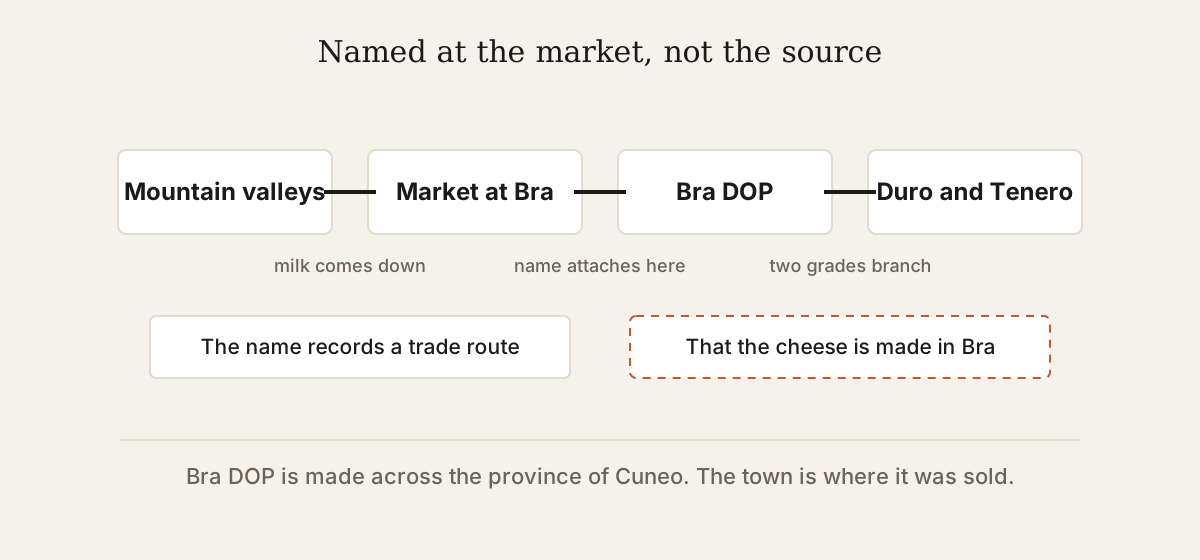
Bra is the rare Italian DOP named for where a cheese was sold rather than where it was made.
The cheese was produced in the mountain valleys of the Cuneo province, in scattered farms and small dairies.
Bra was the market town on the plain where those producers brought their wheels to trade, and where merchants aged and sold them.
The buyers’ name stuck. Cheese leaving Bra was Bra cheese to the people who bought it, whatever valley it came from.
The DOP recorded that usage rather than correcting it, in the same way Pecorino Romano’s name records a Roman association rather than a Sardinian production reality.
The zone is the province rather than the town, so almost none of the cheese is made in Bra itself.
This is a documented commercial history rather than a folk etymology.
Tenero against duro
The two grades are further apart than a single name suggests.
Tenero is an everyday eating cheese. Slice it, melt it, put it on bread. It is mild enough to be unremarkable and good enough to be worth buying.
Duro is a serious aged cheese. Hard, concentrated and savoury, it grates and it holds a board.
The price gap is substantial and reflects six months or more of ageing and the weight lost to it.
Duro d’alpeggio is the top of the range, combining the long ageing with the summer mountain-pasture milk.
Reading the grade matters, since tenero will not grate and duro will not melt smoothly.
How to judge a piece
Judge it on the paste, then the rind, then the smell.
Tenero should be ivory to pale straw, elastic, with small scattered eyes, giving under a thumb.
Duro should be deep straw to amber, hard and close-textured, flaking rather than bending.
White crystals in a well-aged duro are tyrosine and indicate real maturation.
The rind on tenero should be thin and greyish; on duro it should be thick, hard and darker, without deep cracks.
It should smell milky and faintly tangy in tenero, and savoury and nutty in duro. Ammonia is a fault in either.
Look for the DOP mark and the grade, and for alpeggio if you want the mountain version.
Checked on 13 August 2026, United States retail for Bra runs to specialist Italian cheese importers rather than general supermarkets, which describes availability on that date rather than recommending any seller.
What it should cost
Expect roughly 18 to 30 dollars a pound in the United States for tenero and 26 to 40 for duro, with alpeggio above that.
The grades explain most of the spread. Six months of ageing is expensive in time, space and evaporated weight.
It is less well known than its Piedmontese neighbours such as Castelmagno and Gorgonzola, which keeps prices reasonable for the quality.
Availability is the real constraint and it appears intermittently at good counters.
Anything labelled Bra-style carries no designation and may come from anywhere.
How to use it
Slice or melt tenero; grate or serve duro in pieces.
Piedmontese company suits it: bread, grissini, hazelnuts, honey, and the region’s reds, Barbera and Nebbiolo.
Serve either at room temperature, where tenero in particular reads as far more flavourful than cold.
Tenero melts well into a gratin, a toasted sandwich or polenta.
Grate duro over pasta or risotto for a savoury alternative to the usual hard cheeses, and it is less salty than pecorino.
Duro on a board with honey and hazelnuts is the traditional Piedmontese presentation.
Keep the rind of a duro for a soup or a bean pot.
Storage
Wrapped in paper inside a loose bag, refrigerated. Tenero keeps two to three weeks; duro keeps a month or more.
Paper rather than plastic film, so the rind can breathe and the cut face stays dry.
Rewrap after each use with fresh paper.
Surface mould can be cut away on either grade and the rest is sound.
Duro will keep drying and hardening, which is not spoilage.
Do not freeze it. Tenero loses its elasticity and duro turns mealy.
Frequently asked questions
Why is Bra cheese called Bra?
Bra is named for the market town in the province of Cuneo where the cheese was historically traded rather than produced. The wheels were made in the surrounding mountain valleys and brought to Bra to be aged and sold, and the buyers’ name for it stuck. The DOP zone is the province rather than the town, so almost none of it is made in Bra itself.
What is the difference between Bra tenero and duro?
Bra tenero is aged from forty-five days and is semi-soft, pale, elastic and mild, with a thin greyish rind, suiting slicing and melting. Bra duro is aged six months or more and is hard, amber, savoury and nutty with a thick hard rind, suiting grating and a cheeseboard. Both carry the same DOP, so the grade on the label is what distinguishes them.
What does alpeggio mean on Bra?
Alpeggio designates Bra made from summer mountain-pasture milk, produced at altitude while the herds graze high in defined mountain communes. That milk carries a far greater variety of grasses than valley fodder and produces a more complex, aromatic cheese. It is made in limited quantity for part of the year only and costs more, and the same distinction applies to Castelmagno.
Does Bra contain sheep or goat milk?
Bra is predominantly a cow’s-milk cheese and its specification permits small additions of sheep’s or goat’s milk. That permitted addition is unusual among Italian DOPs and contributes to the cheese’s character. The proportion is small enough that Bra reads as a cow’s-milk cheese rather than a mixed one.
Can I substitute Bra for another cheese?
Bra tenero substitutes readily for other mild semi-soft Alpine cheeses such as young Montasio or a generic fontina, in melting and slicing. Bra duro works in place of a hard grating cheese and gives a less salty, nuttier result than pecorino. The two grades do not substitute for each other, since tenero will not grate and duro will not melt smoothly.
CalItalia Food covers Italian ingredients: what they are, how to tell a good one from an ordinary one, and where to buy them in the United States.