
Fontina: The DOP From One Alpine Valley, and the Word Everyone Else Uses
Fontina Val d Aosta is a raw milk cave-aged DOP. Fontina sold with a red wax rind is usually something else entirely. How to judge which is which, when to buy each, and why it matters for fonduta.
Fontina Val d’Aosta is a semi-soft raw cow’s-milk DOP cheese from the Valle d’Aosta, washed-rind and cave-aged for around three months. Fontina sold under a bright red wax rind is generally a Danish, Swedish, Argentine or American cheese with a similar name and a very different character. That split is the gap this whole site is about, seen in a single cheese.
The word fontina is not protected on its own, only the full designation is, and that gap is why two cheeses that share almost nothing sit next to each other on the same shelf. The same split runs through asiago.
What Fontina Val d’Aosta actually is
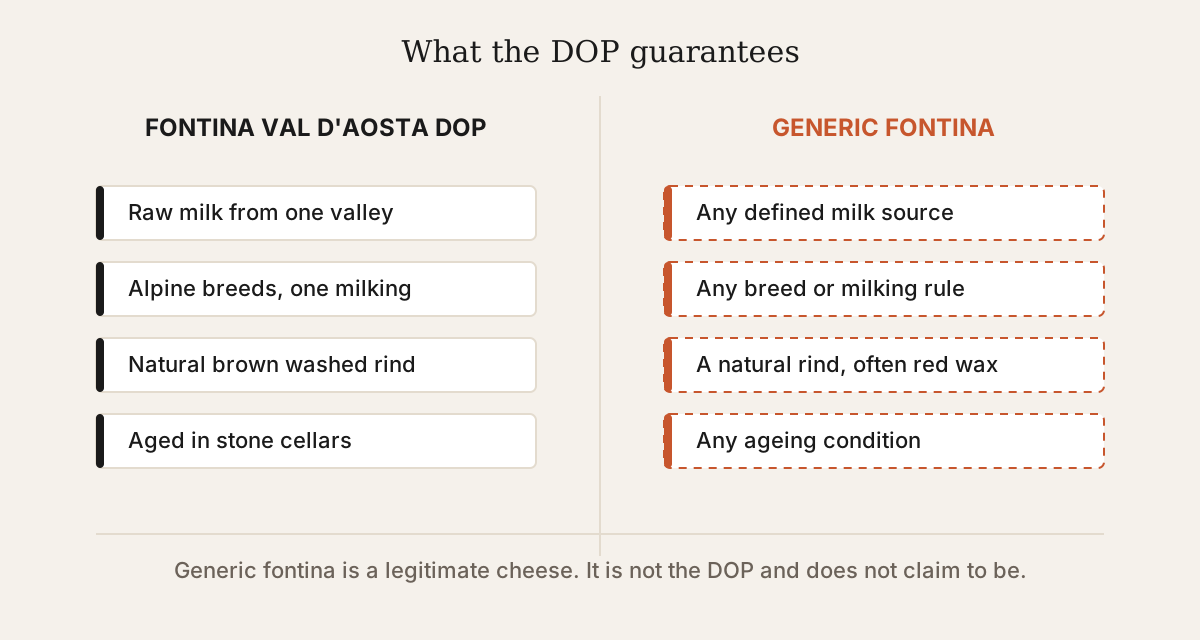
Fontina Val d’Aosta is made from whole raw milk of Valdostana cows, from a single milking, formed into wheels and aged in cool humid stone cellars where the rinds are brushed and salted.
It is a single-valley DOP. The zone is the Valle d’Aosta alone, which is one of Italy’s smallest regions, and the cows must be of the local breed.
The milk is raw and unheated, taken from one milking and worked while still warm, which is unusual and is written into the specification.
It is aged around three months in caves. That period puts it comfortably past the sixty-day threshold, which is why it imports into the United States without difficulty despite being raw.
The rind is natural and washed, thin, brown to orange, and is not eaten.
The paste is pale straw, elastic and semi-soft, with small scattered eyes, and it carries a nutty, faintly earthy, mushroom-like flavour that comes from the cave ageing.
How to tell the DOP from the rest
The distinction is visible before you taste anything.
Look for the Matterhorn stamp. Genuine Fontina Val d’Aosta DOP carries a consortium mark on the rind depicting the mountain, along with the designation.
Judge the rind. The DOP has a natural, thin, brownish washed rind. A thick bright red or orange wax coating is the signature of the generic product.
Judge the paste colour. The Italian cheese is pale straw; many generic fontinas are noticeably more yellow.
The generic versions are milder and rubberier, made from pasteurised milk, aged less, and formulated as an easy melting cheese.
Fontal is the honest name for some of them. European producers making a fontina-style cheese outside the zone often sell it as Fontal, which is a legitimate cheese under a name that does not borrow.
Checked on 13 August 2026, the first page of United States results for fontina returned reference material alongside major American deli and Wisconsin producers, which describes that search on that date rather than recommending any seller. The prominence of domestic producers is a fair description of what the word usually refers to here.
Why it matters for fonduta
Fonduta is the dish the DOP cheese exists for, and it is the one use where the substitution is genuinely audible.
Fonduta is Fontina melted with milk, butter and egg yolks, served as a warm sauce, traditionally with white truffle shaved over it in season.
The DOP cheese melts to a smooth, glossy cream. Its elastic semi-soft paste and its fat content are what allow it to emulsify with the yolks rather than splitting.
A rubbery pasteurised imitation is more likely to break, producing a grainy sauce with oil separating out.
The flavour is the other half. Fonduta made with a mild generic fontina tastes of butter and egg with very little cheese behind it, and the earthy, nutty character the cave ageing gives is precisely what the dish is built around.
For a toasted sandwich the substitution barely matters. This is not a case where only the DOP will do for everything, and it is worth being specific about where the difference shows.
How to judge a piece
Judge it on the rind mark, then the paste, then the smell.
Find the consortium stamp on the rind before anything else.
The paste should be pale straw and pliable, giving under a thumb without being soft, and should not be squeaky.
Small scattered eyes are correct. A completely blind paste or large irregular holes both suggest a different cheese.
It should smell mildly earthy and nutty, faintly of mushroom and hay. A washed rind gives a modest barnyard note that should not tip into ammonia.
A dry cracked cut face means it has sat too long at a counter.
Buy it cut from a wheel where possible rather than pre-wrapped, as with any semi-soft cheese.
What it should cost
Expect roughly 20 to 32 dollars a pound in the United States for Fontina Val d’Aosta DOP, against 8 to 14 for generic fontina.
The small region, the single local breed, the raw single-milking requirement and three months of cave ageing are all cost, and the volume is limited by the size of the valley.
Generic fontina is a fair buy for melting into everyday cooking where its mildness is not a loss.
Fontal is usually cheaper still and is the same idea under a name that makes no claim.
A very cheap cheese labelled Italian fontina is worth checking for the stamp, since the word alone carries no origin requirement.
How to use it
Melt it into fonduta, a gratin or a risotto, or serve it at room temperature on a board.
Its earthy nuttiness pairs with the food of its own valley: rye bread, cured mountain meats, mushrooms, and the region’s reds.
Cut off the rind before melting or serving. It is washed and brushed rather than bloomy and is not intended to be eaten.
Melt it gently. Like any high-fat semi-soft cheese it will split under hard heat.
Grate it cold if you need it grated, since it is soft enough at room temperature to clog a grater.
Serve board slices at room temperature, where the mushroom note is far more legible than it is cold.
Storage
Wrapped in waxed or greaseproof paper, refrigerated, two to three weeks.
Paper rather than plastic film, since a washed-rind cheese, like Taleggio, needs to breathe and plastic accelerates ammonia.
Rewrap after each use with fresh paper.
Surface mould can be cut away on a semi-firm cheese and the rest is sound.
Do not freeze it. The elastic paste turns crumbly and the melting quality, which is the main reason to buy it, does not survive.
Frequently asked questions
What is the difference between Fontina and Fontina Val d’Aosta?
Fontina Val d’Aosta is the protected DOP, made from raw milk of local Valdostana cows in a single Alpine valley and cave-aged around three months, with a natural brown washed rind and a consortium stamp showing the Matterhorn. Fontina without the designation may come from Denmark, Sweden, Argentina or the United States, is usually pasteurised, milder and rubberier, and often carries a bright red wax rind.
Is fontina made from raw milk?
Fontina Val d’Aosta DOP is made from raw whole milk taken from a single milking and worked while still warm, which the specification requires. Its three months of cave ageing puts it past the sixty-day threshold, so it imports into the United States without difficulty. Generic fontina made elsewhere is normally pasteurised.
What can I substitute for fontina in fonduta?
There is no close substitute for Fontina Val d’Aosta in fonduta, because the dish is built on the cheese’s ability to emulsify smoothly with egg yolks and on the earthy cave-aged flavour that carries it. A generic fontina is more likely to split into a grainy sauce and tastes largely of butter and egg. For a toasted sandwich or a gratin the substitution matters far less.
Can you eat the rind of fontina?
The rind of Fontina Val d’Aosta is washed and brushed during ageing and is not intended to be eaten, unlike a bloomy rind such as Brie’s. It should be cut away before serving or melting. The wax coating on generic fontina is inedible in a more straightforward sense and must always be removed.
Why is my fontina rubbery?
A rubbery texture usually means the cheese is a generic pasteurised fontina rather than the DOP, since those are formulated as easy melting cheeses and aged for a shorter period. Fontina Val d’Aosta is pliable and semi-soft with small scattered eyes and gives under a thumb. Serving any fontina cold also makes it read as firmer and squeakier than it is.
CalItalia Food covers Italian ingredients: what they are, how to tell a good one from an ordinary one, and where to buy them in the United States.