
Gorgonzola Piccante: The Older Half, and the One the Cheese Was Originally
Firm, densely veined and genuinely sharp. Why piccante is closer to historical gorgonzola than dolce is, what the labels mean, how to judge one, and when it is the right one to use.
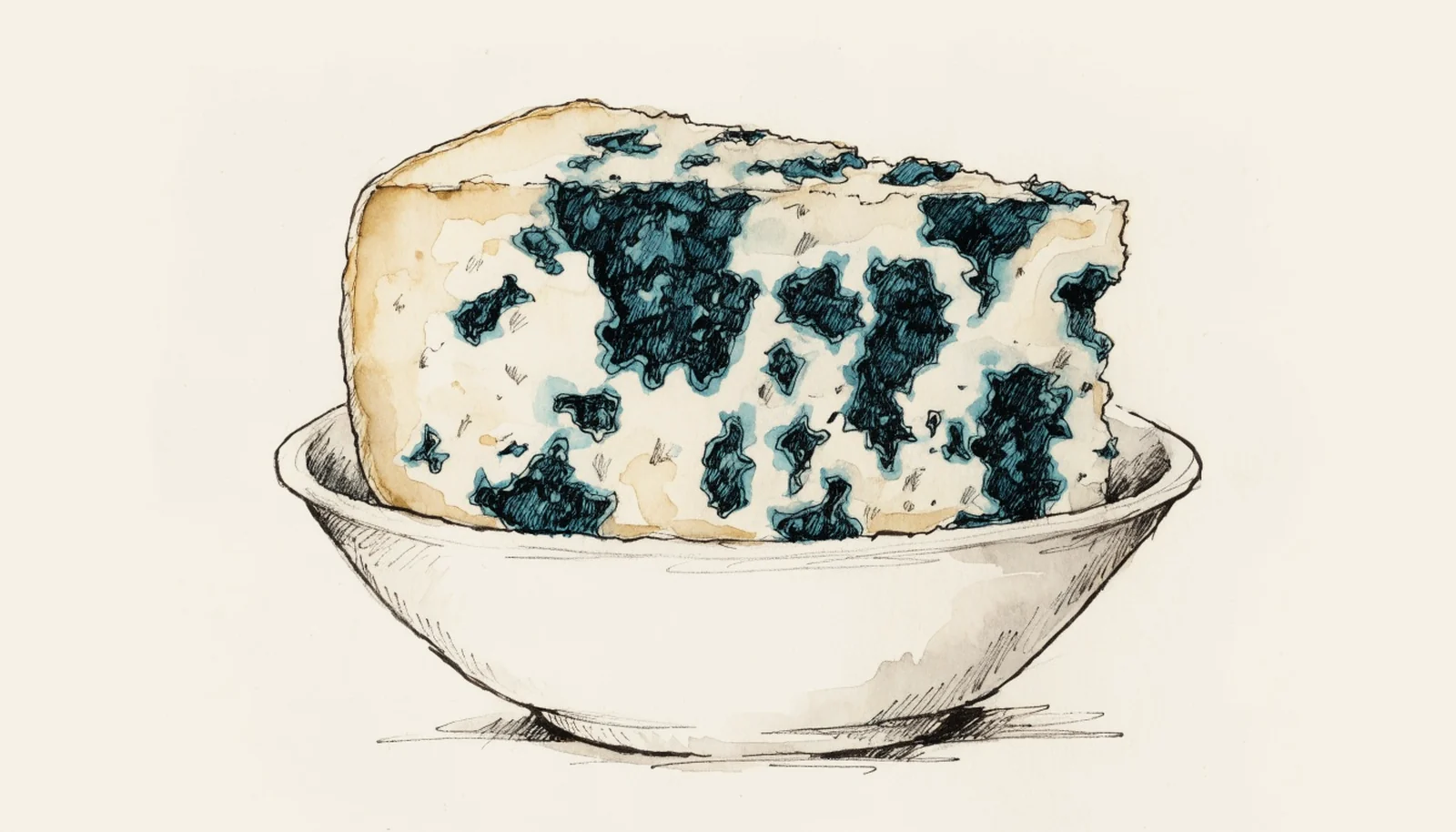
Gorgonzola piccante is the aged form of the gorgonzola DOP, held four months or more, firm enough to crumble and slice, densely veined and genuinely sharp with a peppery bite. It is the version most people picture when they picture a blue cheese, and one of the Italian ingredients where the imported original earns its premium.
It is also closer to what gorgonzola was for most of its history than dolce is, which reverses the usual assumption that the older-tasting version is the modern refinement.
What gorgonzola piccante actually is
Gorgonzola piccante is made from whole pasteurised cow’s milk inoculated with Penicillium, drained more thoroughly than dolce, salted more heavily, pierced more often and aged four months or longer.
It carries the same DOP as dolce. One designation across Lombardy and Piedmont, two styles, and piccante is the aged one.
The paste is firm and slightly crumbly, holding a clean edge when cut and breaking rather than spreading.
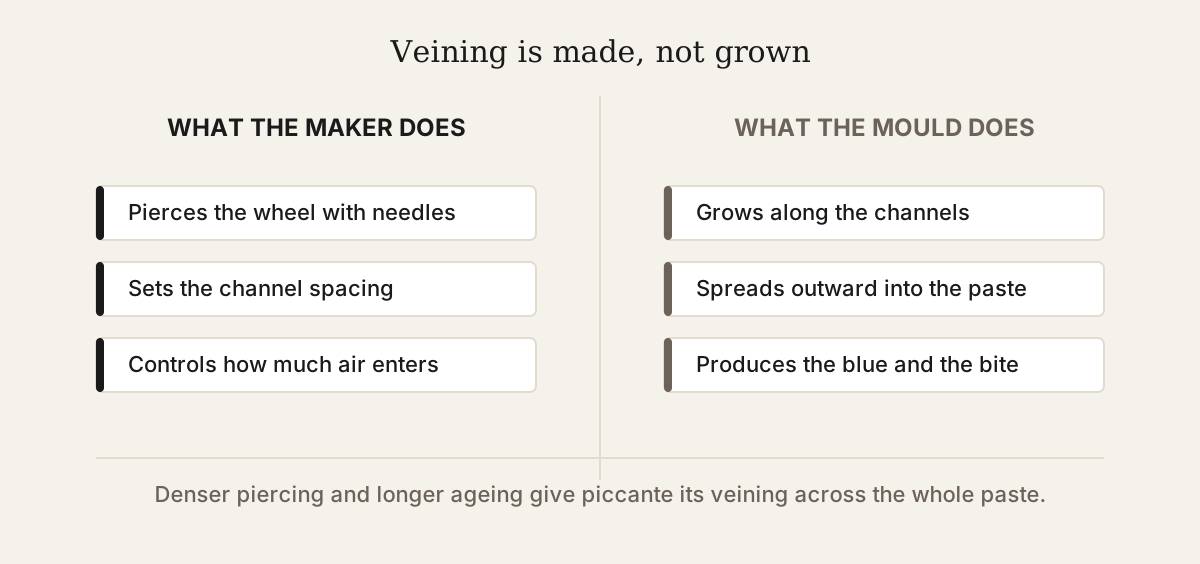
The veining is dense and dark, running through the whole paste rather than in occasional thin lines.
It is drier and saltier, which is what allows the longer ageing and what concentrates the flavour.
Naturale, montagna and stagionato all appear on labels pointing to this style, alongside piccante itself.
The flavour is sharp and peppery, with a savoury depth and a genuine bite at the back, and a lingering finish that dolce does not have.
Why it is the older style
The modern soft dolce is the newer product, and piccante is nearer the historical cheese.
Gorgonzola was historically made with two curds. An evening curd and a morning curd were layered in the mould, and the imperfect join between them left channels through which air and mould could travel.
That method produced a naturally veined, firmer cheese, aged for months in cold cellars, which is broadly the piccante character.
Single-curd production and needle piercing came later and made consistent veining possible without relying on the layering.
The soft creamy dolce is a twentieth-century development, made to a market that wanted something milder and more spreadable, and it now outsells piccante substantially.
So calling piccante the traditional one is fair, which is worth saying because the mild version is the one most people meet first and assume is the default.
When it is the right choice
Piccante earns its place where sharpness is the point rather than a problem to manage.
On a board with strong company. Alongside a mature cheese, cured meat or a robust wine, dolce disappears and piccante holds.
Crumbled over bitter leaves. Radicchio, chicory and endive need a cheese that answers them, and piccante does.
With beef. A crumbled piccante on a steak is a classic pairing precisely because the cheese is assertive enough to survive it.
Where a small amount must do a lot of work. Its concentration means a little seasons a dish, which is the opposite of dolce’s use.
Not in a delicate sauce. It is drier and saltier, so it clumps and releases oil more readily than dolce, and its sharpness takes a cream sauce over.
How to judge a piece
Judge it on the veining, then the paste, then the smell.
Veining should be dense, blue-green and evenly distributed through the paste, following the needle channels.
The paste should be pale straw to light amber, deepening with age, and firm enough to crumble cleanly rather than smear.
It should not be grey or brown at the edges, which indicates a cut face left exposed.
It should smell sharply of mould with a savoury depth. That pungency is correct and expected here.
Ammonia is still the disqualifier. Sharpness is the style; a nose-catching ammonia note is spoilage and does not recover.
Checked on 13 August 2026, the first page of United States results for gorgonzola piccante returned specialist cheese retailers including one whose page directly compares piccante and dolce, which describes that search on that date rather than recommending any seller. The presence of that comparison at the top of the results is a fair indication of how routinely the two are confused.
What it should cost
Expect roughly 18 to 30 dollars a pound in the United States, generally above dolce.
Four or more months of cellar ageing and the weight the wheels lose over that period account for the difference.
Buy a cut piece from a wheel where possible rather than a pre-wrapped wedge.
It keeps considerably better than dolce, so buying a larger piece is more reasonable here.
Imported DOP is worth the premium for this style more than for dolce, since the sharpness and depth are what the longer ageing buys and a shortcut version tastes merely salty.
How to use it
Serve it at room temperature on a board, crumble it over food, or melt a little into something robust.
Its sharpness wants sweetness or fat opposite it: honey, pears, walnuts, mostarda, a sweet wine, or a piece of beef.
Take it out of the refrigerator thirty minutes before serving. Cold, the sharpness reads as harsh rather than deep.
Crumble it at the last moment, since it dries out quickly once broken up.
Use less than you would use of dolce. Substituting piccante one for one into a dolce recipe usually produces something too sharp to eat.
It melts, with care. Off the heat and in modest quantity it will enrich a risotto or a polenta without taking it over.
Storage
Wrapped in waxed or greaseproof paper, refrigerated, two to three weeks, which is longer than dolce manages.
Paper, not plastic film. A blue needs to breathe, and plastic is what produces the ammonia people blame on the cheese.
Rewrap after each use with fresh paper.
Keep it in a closed container away from other cheeses, since blue moulds travel readily.
Its lower moisture and higher salt are why it keeps, which is the same reason it tastes sharper.
Do not freeze it. The paste turns crumbly and watery and the texture is lost.
Frequently asked questions
What does piccante mean on gorgonzola?
Piccante designates the aged style of gorgonzola, held four months or more, which is firm, densely veined, drier, saltier and genuinely sharp. It is contrasted with dolce, the young soft mild style aged around two months. Naturale, montagna and stagionato appear on some labels pointing to the same aged style.
Is gorgonzola piccante the traditional version?
Gorgonzola piccante is closer to the historical cheese than dolce is. Gorgonzola was traditionally made by layering two curds, whose imperfect join left channels for mould, producing a firmer and naturally veined cheese aged for months. The soft creamy dolce is a twentieth-century development made for a market wanting something milder, and it now outsells the older style.
How sharp is gorgonzola piccante?
Gorgonzola piccante is genuinely sharp, with a peppery bite and a savoury depth that lingers, and it is comparable in assertiveness to other well-aged blue cheeses. It is a large step up from dolce, which is mild and sweet. Anyone who found gorgonzola gentle has almost certainly been eating dolce.
Can I substitute piccante for dolce in a recipe?
Substituting piccante for dolce changes the dish rather than adjusting it, because piccante is drier, saltier and much sharper. In a cream sauce it will clump more readily, release oil and dominate the other flavours. If it is all that is available, use considerably less than the recipe states and expect a different result.
Why does my gorgonzola smell of ammonia?
An ammonia smell means the cheese is past its point and does not recover, and it is distinct from the sharp mouldy pungency that is correct for piccante. The most common cause is storage in plastic film, which stops a blue cheese breathing. Waxed or greaseproof paper, rewrapped after each use, prevents it.
CalItalia Food covers Italian ingredients: what they are, how to tell a good one from an ordinary one, and where to buy them in the United States.