
Grana Padano: The Cheaper Wheel, and Exactly Where It Differs From Parmigiano
A DOP hard cow cheese from the Po valley, and the closest thing Parmigiano Reggiano has to a rival. The four real differences, how to judge one, and when the cheaper wheel is the right buy.
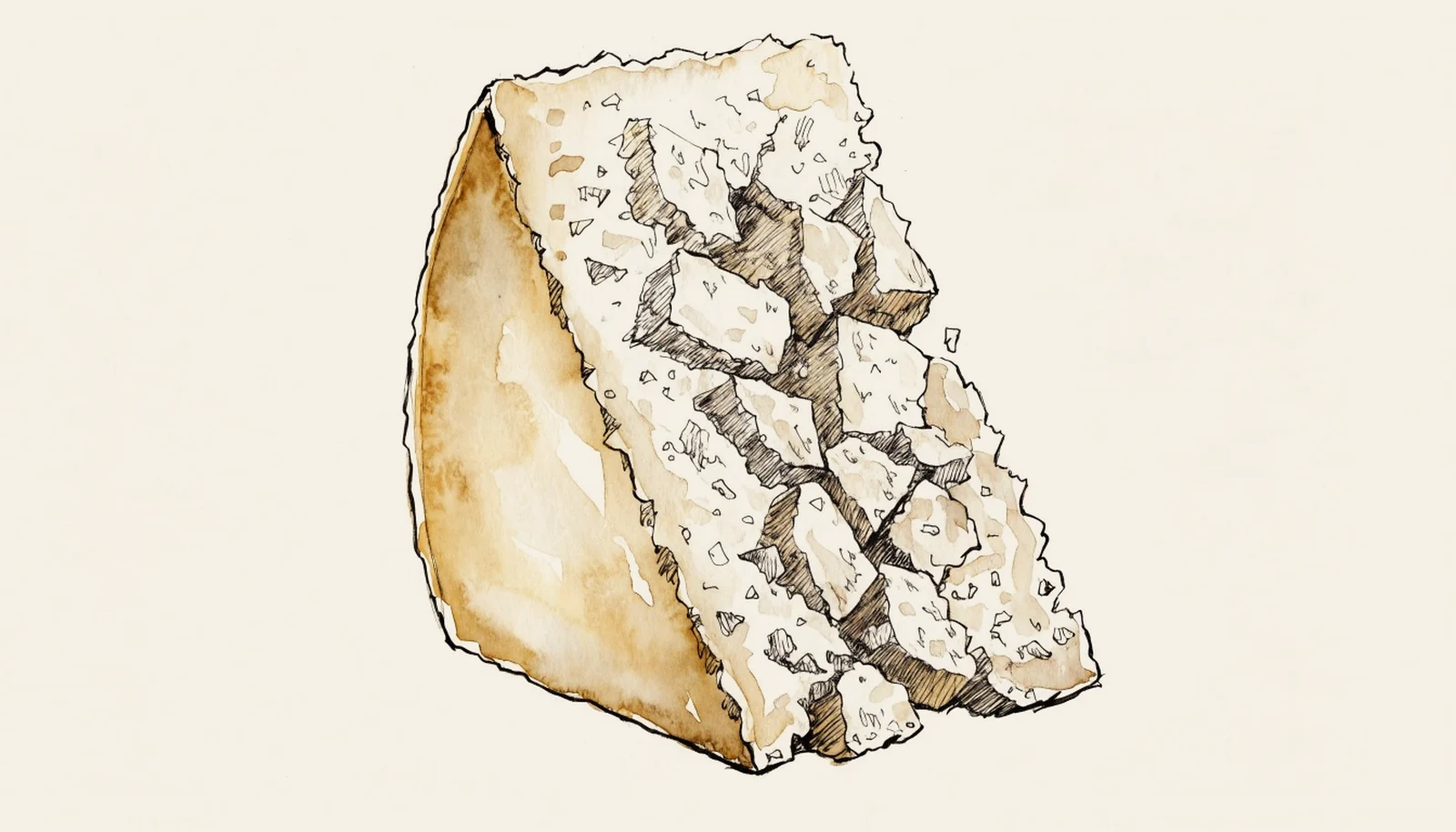
Grana Padano is a hard, granular DOP cow’s-milk cheese from the Po valley, aged from nine months upward, and it is the most-produced protected cheese in Italy. It is routinely described as Parmigiano Reggiano’s cheaper alternative, which is accurate and unhelpful. Where it sits against Parmigiano is a question of what the extra money for an Italian ingredient actually buys.
The differences between the two are specific and small in number, and knowing them tells you when the cheaper wheel is the sensible buy and when it is a false economy.
What Grana Padano actually is
Grana Padano is made from partly skimmed raw cow’s milk, coagulated, cooked, pressed into large wheels, brined and aged for a minimum of nine months.
Grana means grain, and it refers to the granular, crystalline texture of the paste, which is the family characteristic rather than a brand.
The wheels are large, in the same format as Parmigiano, and are aged on wooden boards in vast warehouses.
It is a raw milk cheese, and its ageing well past sixty days is why it imports into the United States without difficulty, as Fontina Val d’Aosta does.
It comes in three age grades. Roughly nine to sixteen months, over sixteen months, and Riserva at twenty months and above, and the differences between them are substantial.
The zone is the Po valley, spanning a large area of northern Italy across several regions, which is much broader than Parmigiano’s.
The four differences that actually matter
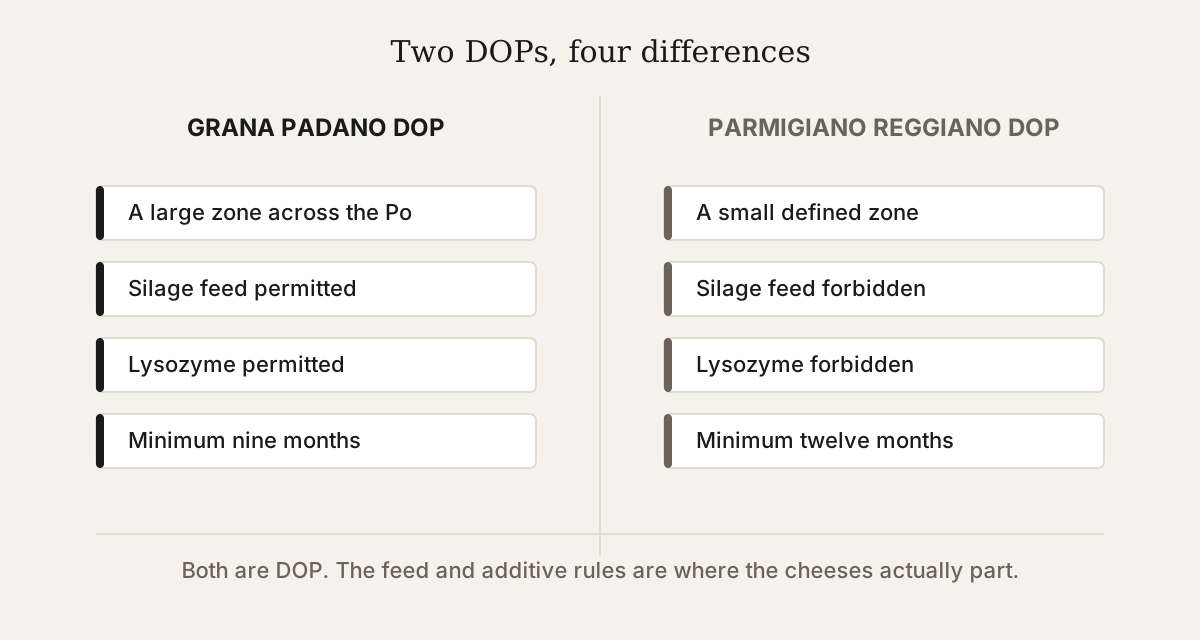
Grana Padano and Parmigiano Reggiano are close relatives, and the distinctions between them come down to four things.
The zone is much larger. Grana Padano is made across a wide band of the Po valley; Parmigiano Reggiano is restricted to Parma, Reggio Emilia, Modena and defined parts of Bologna and Mantua. A smaller zone means tighter conditions and less milk.
The feed rules differ. Parmigiano Reggiano prohibits silage in the cows’ diet. Grana Padano permits it, which is the single largest reason the two cheeses taste different, since silage changes the milk.
Grana Padano permits lysozyme. An egg-derived preservative is allowed to control late blowing in the wheels. Parmigiano Reggiano permits nothing beyond milk, salt and rennet. This matters directly to anyone avoiding eggs, and it is not always obvious on a label.
The minimum ageing differs. Nine months against twelve, and in practice Parmigiano is commonly sold at twenty-four months or more where Grana Padano at nine to sixteen is the volume product.
Everything else is broadly shared. Both are raw milk, both are large-format granular hard cheeses, both are DOP, both carry a fire-branded rind mark.
When the cheaper wheel is the right buy
Grana Padano costs meaningfully less and there are uses where the difference is invisible.
For cooking into a dish, buy Grana Padano. Stirred into a risotto, melted into a sauce or baked under a topping, the extra complexity of a two-year Parmigiano is largely lost.
For grating over pasta, it depends on the age. A young Grana Padano is noticeably milder and less crystalline; a Riserva at twenty months or more competes properly.
For eating in pieces on a board, buy Parmigiano. This is where the difference is most audible and where the price gap is worth paying.
For anyone avoiding egg, read the label, since lysozyme is egg-derived and is permitted here.
Buying a Riserva rather than a young wheel is usually a better use of money than moving up to Parmigiano, if the goal is depth rather than the specific Parmigiano character.
How to judge a piece
Judge it on the rind mark, then the paste, then the crystals.
Look for the fire-branded rind. Grana Padano wheels carry the designation mark and a clover-leaf motif with the producer identifier, and a proper wedge shows part of it.
The paste should be straw-yellow, dense, and should flake rather than slice cleanly.
White crystals are a good sign. Tyrosine crystals appear with age and indicate genuine maturation, exactly as they do in Parmigiano.
Check the age grade on the label. The difference between a nine-month wheel and a Riserva is larger than most buyers expect, and the price difference between them is smaller than the quality gap.
Avoid pre-grated tubs with anti-caking agents, which dull a hard cheese quickly.
Checked on 13 August 2026, the first page of United States results for grana padano returned the consortium, specialist retailers and a discussion thread, which describes that search on that date rather than recommending any seller.
What it should cost
Expect roughly 12 to 22 dollars a pound in the United States, against roughly 20 to 35 for Parmigiano Reggiano.
The larger zone, the permitted silage and the shorter minimum ageing all lower production cost, and the price reflects that rather than reflecting a poor cheese.
Riserva sits at the top of the range and is the value purchase within the category.
Anything sold as grana without the Padano is not the DOP. Grana is a descriptive word for the texture and is not itself protected, so a generic grana is an unprotected hard cheese from anywhere.
How to use it
Grate it fresh over pasta, stir it into risotto, or eat a Riserva in pieces with a glass of red.
Its lower price is what makes it the sensible everyday grating cheese, keeping the Parmigiano for occasions where it is tasted directly.
Grate it fresh. Like any hard cheese it loses aroma quickly once grated.
Add it off the heat where possible, so it emulsifies rather than seizing.
Keep the rind for stock. A Grana Padano rind in a minestrone or a bean pot is standard practice and is not waste.
A Riserva takes a board well with fruit, nuts and a substantial red, where a young wheel will read as bland.
Storage
Wrapped in paper inside a loose bag, refrigerated, a piece keeps a month or more.
Paper rather than plastic film, since plastic against the cut face traps moisture and produces a slick surface.
Rewrap with fresh paper after each use.
Surface mould can be cut away on a hard cheese and the rest is sound.
Do not freeze it. The texture becomes crumbly and mealy.
A drying piece is still useful. Once it has hardened past pleasant eating it grates and cooks perfectly well.
Frequently asked questions
What is the difference between Grana Padano and Parmigiano Reggiano?
Four things separate them: Grana Padano’s production zone across the Po valley is much larger, its cows may be fed silage where Parmigiano’s may not, it permits the egg-derived preservative lysozyme where Parmigiano permits nothing beyond milk, salt and rennet, and its minimum ageing is nine months against twelve. Both are raw milk DOP hard cheeses and both are granular.
Does Grana Padano contain egg?
Grana Padano may contain lysozyme, a preservative derived from egg white, which its specification permits to control fermentation faults in the wheels. Parmigiano Reggiano does not permit it. Anyone avoiding egg should read the label rather than assume, since not every producer uses it and the labelling is not always prominent.
Is Grana Padano as good as Parmigiano Reggiano?
Grana Padano is a genuinely good cheese that tastes different rather than simply worse, being milder and less complex. For cooking into risotto, sauces and baked dishes the difference is largely lost and Grana Padano is the sensible buy. For eating in pieces on a board the gap is audible and Parmigiano is worth the money. A Grana Padano Riserva narrows the gap considerably.
What does Riserva mean on Grana Padano?
Riserva designates Grana Padano aged twenty months or more, the oldest of its three age grades, against roughly nine to sixteen months for the youngest and over sixteen for the middle. The differences between the grades are substantial, and a Riserva is markedly more crystalline and more complex. It is usually better value than moving up to Parmigiano Reggiano.
Is grana the same as Grana Padano?
Grana is a descriptive Italian word for the granular texture of this family of hard cheeses and is not itself protected. Grana Padano is the specific DOP. A cheese sold simply as grana carries no designation, may come from anywhere and is judged on the producer alone. The fire-branded rind mark is what distinguishes the protected cheese.
CalItalia Food covers Italian ingredients: what they are, how to tell a good one from an ordinary one, and where to buy them in the United States.