
Asiago: Two Cheeses Under One DOP, and Neither Is the American One
Asiago Pressato is soft, mild and young. Asiago d Allevo is hard, sharp and aged. American asiago is usually a third thing. How to judge which you need, and how to use it.
Asiago is a DOP cow’s-milk cheese from the Veneto and Trentino made in two entirely different forms: Pressato, which is young, soft, moist and mild, and d’Allevo, which is aged, hard, dry and sharp. The American cheese sold as asiago is usually neither, which puts it squarely in the gap between the real article and the imitation.
Three products under one word is one more than gorgonzola manages, and it makes asiago the most misleading cheese name on an American shelf.
The two DOP forms
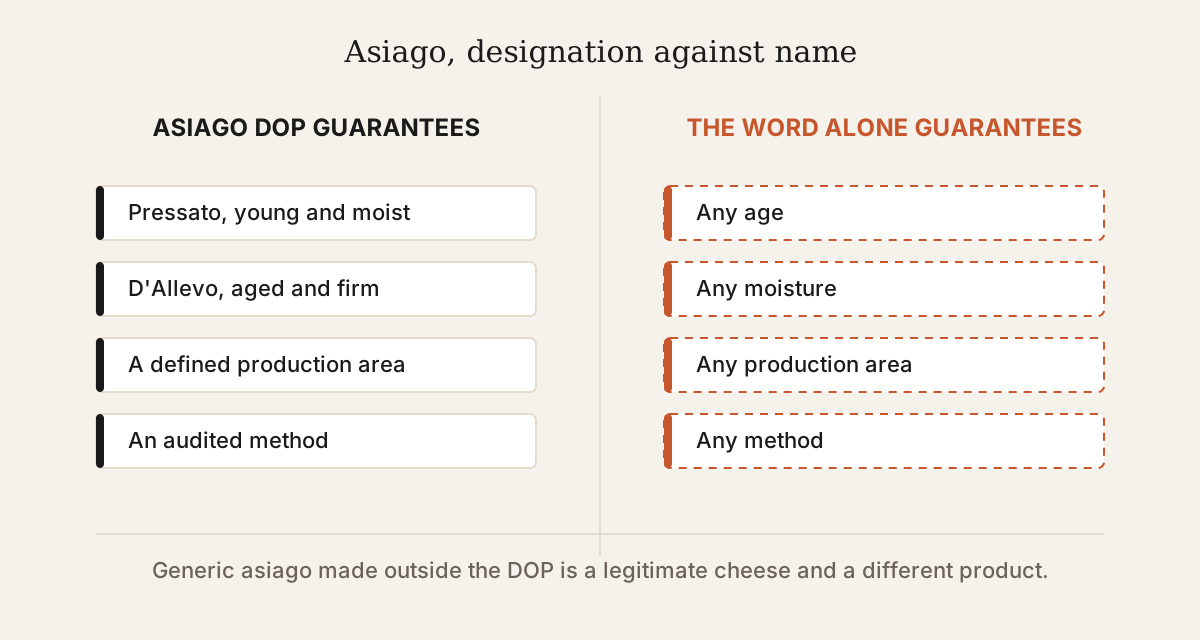
Asiago Pressato and Asiago d’Allevo share a designation and a zone and differ in almost every respect that matters to a cook.
Asiago Pressato is the fresh form. Made from whole milk, pressed, and aged only around twenty to forty days. Soft, elastic, white to pale straw, with irregular eyes, and mild and milky in flavour.
Asiago d’Allevo is the aged form. Made from partly skimmed milk and aged far longer, producing a hard, dry, granular cheese that is sharp and savoury.
D’Allevo has its own age grades. Mezzano at around four to six months, vecchio at ten or more, and stravecchio beyond fifteen, each markedly drier and sharper than the last.
The milk treatment differs before ageing even begins. Pressato uses whole milk and d’Allevo partly skimmed, so the divergence is built in at the vat rather than emerging over time.
Pressato is a table and melting cheese; d’Allevo is a grating cheese. They are not interchangeable in either direction.
What American asiago usually is
Asiago is among the most naturalised Italian cheese names in the United States, and the domestic product follows its own logic.
It is normally a hard, dry grating cheese, sold shredded or in wedges, positioned as a cheaper alternative to Parmesan.
It is often much younger than its texture suggests, dried to a grating consistency rather than aged to it.
Asiago bagels and asiago dressings are built around this domestic version, and they are the main way most Americans meet the word.
Checked on 13 August 2026, the first page of United States results for asiago returned reference material alongside Wisconsin producers and a cheesemaking supplier, which describes that search on that date rather than recommending any seller. The dominance of domestic producers is a fair description of the category here.
The American cheese is legitimate and is not the DOP. It is closer in role to d’Allevo than to Pressato, and it is milder and less complex than either.
Which one your recipe means
English-language recipes rarely specify, and the instruction in the recipe usually gives it away.
If it says shred or grate over a finished dish, it means an aged cheese, so d’Allevo or the American product.
If it says slice, melt or use in a sandwich, it means Pressato, and using a hard aged asiago will give a dry, sharp result the dish did not ask for.
If it appears in a list with Parmesan and pecorino, it means an aged grating cheese.
If it appears with mozzarella and provolone, it means the fresh form.
Substituting across the two changes the dish rather than adjusting it. A Pressato will not grate and a stravecchio will not melt smoothly.
How to judge a piece
Judge it on which form you are holding first, then on the paste.
Look for the DOP mark on the rind, which both protected forms carry along with the producer identifier.
Pressato should be elastic and moist, white to pale straw, with irregular scattered eyes, and should give under a thumb.
D’Allevo should be firm to hard and granular, deeper straw to amber with age, and should flake rather than bend.
White crystals in an aged d’Allevo are a good sign, being tyrosine from genuine maturation, exactly as in Parmigiano.
A cracked, dry cut face on either form means it has been sitting.
Read the age grade on d’Allevo. Mezzano and stravecchio are very different cheeses and the label is the only way to know.
What it should cost
Expect roughly 12 to 20 dollars a pound for Asiago Pressato and 16 to 28 for d’Allevo in the United States, with domestic asiago well below both.
The longer ageing and the greater weight loss account for d’Allevo’s premium, and the domestic product’s price reflects industrial scale.
Domestic asiago is a sensible buy for cooking where its mildness is not a loss, and it is not a poor cheese for its purpose.
For eating in pieces, buy the DOP. This is where the gap is audible and where the extra money does something.
Anything simply labelled asiago with no designation may be from anywhere and is judged on the producer alone.
How to use it
Melt or slice Pressato; grate d’Allevo over pasta, soup or risotto.
Pressato is a good sandwich and melting cheese and suits company that will not bury it. D’Allevo is a seasoning cheese in the same register as pecorino, and it is used that way in the Veneto.
Grate d’Allevo fresh. Like any hard cheese it loses aroma quickly once grated.
Serve either at room temperature on a board, where Pressato in particular reads as flat when cold.
Keep the rind of an aged d’Allevo for a soup or a bean pot, which is standard practice with any hard cheese rind.
Do not grate Pressato. It is too moist and elastic and will clog rather than shred.
Storage
Wrapped in paper inside a loose bag, refrigerated. Pressato keeps one to two weeks; d’Allevo keeps a month or more.
Paper rather than plastic film for both, so the cut face does not turn slick.
Rewrap after each use with fresh paper.
Surface mould on d’Allevo can be cut away and the rest is sound. On a moist Pressato it is a better reason to discard the affected area generously.
Do not freeze either. Pressato loses its elasticity and d’Allevo turns mealy.
Frequently asked questions
What is the difference between Asiago Pressato and Asiago d’Allevo?
Asiago Pressato is made from whole milk and aged only twenty to forty days, producing a soft, moist, elastic and mild cheese for slicing and melting. Asiago d’Allevo is made from partly skimmed milk and aged from four months to well over a year, producing a hard, dry, granular and sharp cheese for grating. Both carry the same DOP, so the form on the label rather than the designation is what tells you which you have.
Is American asiago the same as Italian asiago?
American asiago is a domestic cheese that shares the name and is usually a third product distinct from both protected Italian forms. It is normally a hard dry grating cheese, often dried to that texture rather than aged to it, and milder and less complex than Asiago d’Allevo. It is a legitimate cheese for its purpose and it is not the DOP.
Can I substitute asiago for Parmesan?
An aged Asiago d’Allevo can stand in for Parmigiano Reggiano as a grating cheese, with the result being sharper, saltier and less sweet and nutty. Asiago Pressato cannot substitute at all, since it is moist and elastic and will not grate. American asiago substitutes acceptably in cooking and reads as noticeably milder.
Which asiago melts?
Asiago Pressato is the melting form, being moist and elastic with a high water content, and it suits sandwiches, gratins and anything baked. Asiago d’Allevo is hard, dry and granular, so it grates rather than melting smoothly and will turn oily under heat. If a recipe calls for asiago to be melted or sliced, it means Pressato.
What are the white crystals in aged asiago?
The white crystals in an aged Asiago d’Allevo are tyrosine, an amino acid that comes out of solution during long maturation, and they indicate a properly aged cheese rather than a fault. They are slightly crunchy and pleasant to eat. The same crystals appear in Parmigiano Reggiano, Grana Padano and long-aged prosciutto for the same reason.
CalItalia Food covers Italian ingredients: what they are, how to tell a good one from an ordinary one, and where to buy them in the United States.