
Canestrato: The Cheese Named After the Basket It Was Pressed In
A southern Italian sheep cheese whose woven rind marks record the basket mould. Which canestrati hold designations, how to read the rind, and how to judge and use a piece.
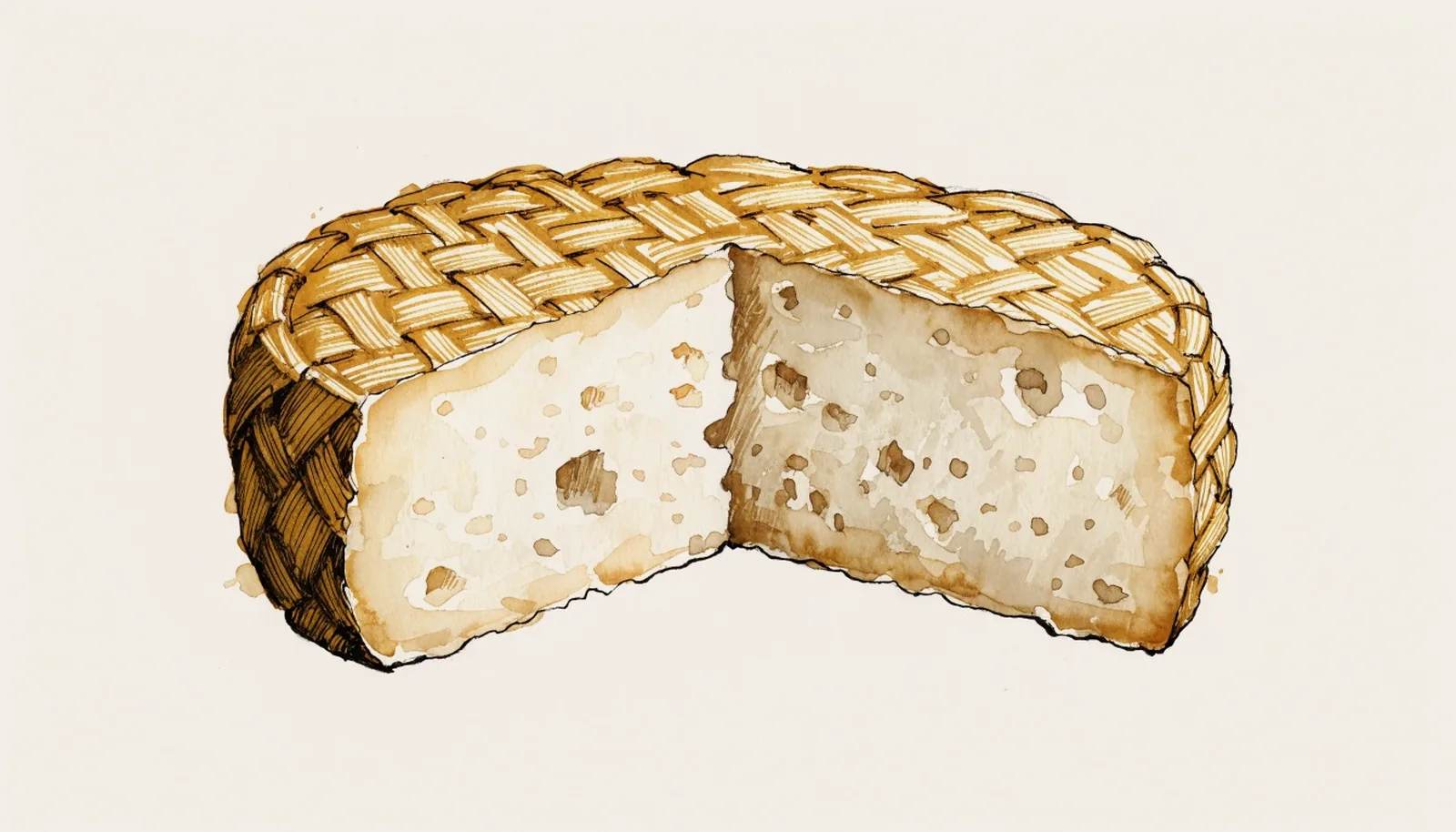
Canestrato names a group of southern Italian sheep’s-milk cheeses pressed in woven reed baskets, which leave a characteristic ridged pattern on the rind. The word describes the mould rather than a recipe, so several distinct cheeses carry it. It is one of the southern sheep cheeses among the Italian ingredients worth learning to read.
The basket marks are the one reliable thing the name promises, and they are also the quickest way to tell a traditionally made wheel from an industrial one.
What canestrato actually is
Canestrato is made from sheep’s milk, sometimes with goat’s milk added, coagulated with rennet, the curd pressed into a woven basket to drain and take shape, then salted and aged.
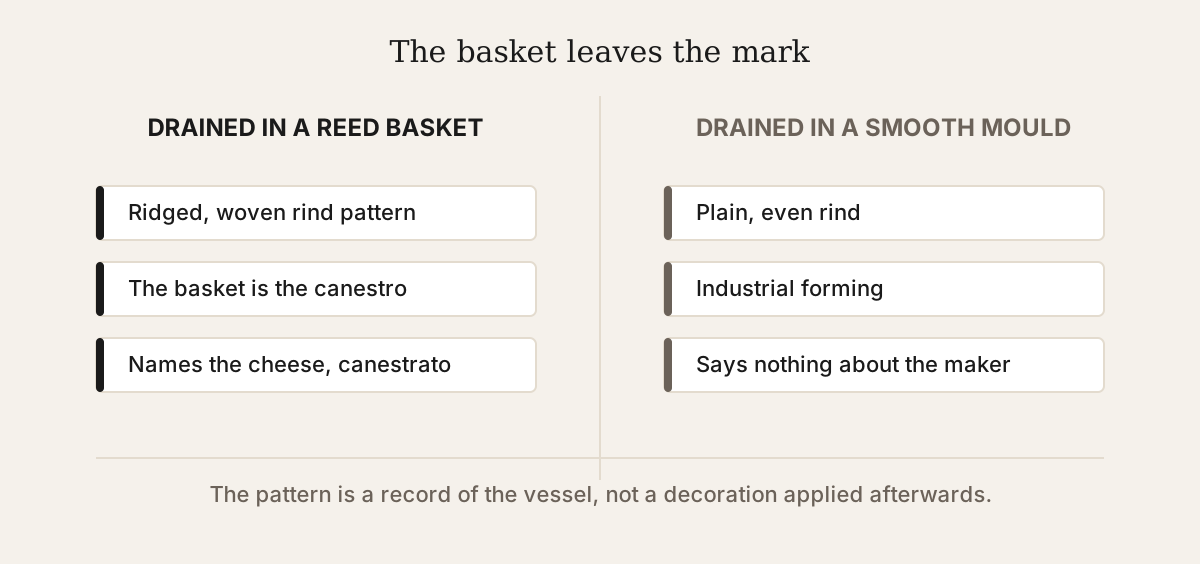
Canestro means basket. The name records the mould, which was traditionally woven from reed or cane.
The basket does two jobs. It drains the whey through its gaps and it shapes the wheel, and the weave presses into the surface as the curd firms.
Sheep’s milk is standard, and goat is added in some traditions, with cow’s milk generally absent.
Ageing runs from a couple of months to a year or more, so the family spans semi-hard table cheeses to hard grating ones.
It is southern. Sicily, Puglia, Basilicata, Abruzzo, Sardinia and Campania all have canestrati, and they are not the same cheese.
Lamb rennet appears in several versions, contributing the sharp piquancy it also gives Pecorino Romano and Fiore Sardo.
Which ones hold designations
The bare word protects nothing, and several named canestrati are protected.
Canestrato Pugliese DOP is from Puglia, made from the milk of Gentile di Puglia sheep, aged from two months.
Pecorino Siciliano DOP is frequently made in baskets and shows the marks, and it is designated under its own name rather than as a canestrato.
Canestrato di Moliterno IGP is from Basilicata, a mixed sheep and goat cheese aged in traditional storerooms.
Several regional traditional listings exist for others, recording tradition without reserving a name.
Plain canestrato with no mark may come from anywhere and is judged on the producer, which is the usual position for a format name.
So the practical question is which canestrato, exactly as it is with caciotta and pecorino.
Reading the rind
The basket marks are the identifying feature and they carry information.
Deep, irregular ridges indicate a real woven basket. Handmade reed moulds are not uniform, so the pattern varies across the wheel and between wheels.
Shallow, perfectly regular ridges indicate a plastic mould moulded to imitate the pattern. This is extremely common and is not fraud, since the shape is traditional and the mould material is not specified by most designations.
The marks tell you nothing about the milk or the age on their own.
A wheel with no marks at all is not a canestrato, whatever the label says, since the name refers to the basket.
Rind colour runs pale straw to deep amber with age, and some producers rub the rind with oil, which darkens it.
Checked on 13 August 2026, the first page of United States results for canestrato returned reference material and specialist cheese retailers, which describes that search on that date rather than recommending any seller. Availability here is limited to proper cheese counters.
How to judge a piece
Judge it on the paste, then the rind, then the smell.
The paste should be white to deep straw depending on age, compact, with few small eyes.
A young one should be semi-hard and give slightly; an aged one should be hard and flake.
White crystals in an aged wheel are tyrosine and indicate genuine maturation.
The rind should be dry and firm, ridged, without cracks running into the paste or stickiness.
It should smell of sheep’s milk, lanolin-like, sharpening with age. Ammonia is a fault.
Ask which canestrato it is, since a Pugliese and a Moliterno are genuinely different cheeses and the counter will know.
What it should cost
Expect roughly 20 to 34 dollars a pound in the United States, with the designated versions at the upper end.
Sheep’s milk costs more than cow’s, the wheels are handled individually into moulds, and the ageing is longer than for the fresh southern cheeses.
It sits below Fiore Sardo and above Pecorino Romano for most versions, which reflects scale rather than quality.
Designated versions carry a premium and a real guarantee about milk and zone.
Availability rather than price is the constraint, as with most southern Italian farmhouse cheeses.
How to use it
Eat a young wheel in pieces at room temperature; grate an aged one over food.
Its sheep character and salt suit robust southern company: bread, olives, tomatoes, cured meat, a full-bodied red.
Serve it at room temperature, where the lanolin note opens and the paste stops reading as waxy.
Grate an aged wheel over pasta and vegetables, where it does a job close to pecorino with a slightly rounder result.
A young one melts adequately but is better eaten than cooked.
Keep the rind for a soup or a bean pot, which is standard for any hard sheep cheese.
Do not assume it will substitute for Pecorino Romano in a Roman dish. Most canestrati are less salty, so the seasoning of the dish will need adjusting.
Storage
Wrapped in paper inside a loose bag, refrigerated. A young piece keeps two to three weeks; an aged one a month or more.
Paper rather than plastic film, so the ridged rind stays dry.
Rewrap after each use with fresh paper.
Surface mould can be cut away and the rest is sound.
It will keep drying and hardening, which is not spoilage and moves it toward being a grating cheese.
Do not freeze it. The paste turns crumbly and mealy.
Frequently asked questions
What does canestrato mean?
Canestrato comes from canestro, meaning basket, and refers to the woven reed mould the curd is pressed into. The basket drains the whey through its gaps and shapes the wheel, and the weave presses a ridged pattern into the rind as the cheese firms. The name therefore describes the mould rather than a recipe, which is why several distinct cheeses carry it.
Is canestrato a single cheese?
Canestrato is a family rather than one cheese. Sicily, Puglia, Basilicata, Abruzzo, Sardinia and Campania all have their own canestrati, made from sheep’s milk and sometimes goat’s, aged from a couple of months to a year or more. Canestrato Pugliese holds a DOP and Canestrato di Moliterno an IGP; the bare word protects nothing.
Are the rind marks on canestrato always from a real basket?
Deep, irregular ridges indicate a genuine woven reed basket, since handmade moulds are never uniform. Shallow, perfectly regular ridges indicate a plastic mould shaped to imitate the pattern, which is extremely common. That is not fraud, because most designations specify the traditional shape rather than the mould material, but the irregularity is a fair sign of traditional production.
Is canestrato the same as pecorino?
Canestrato is a sheep’s-milk cheese and so falls within what pecorino describes, so the two words overlap rather than competing. Pecorino names the milk and canestrato names the mould, which is why a cheese can legitimately be both. Pecorino Siciliano DOP, for instance, is frequently basket-pressed and shows the ridged rind while being designated under its own name.
Can I substitute canestrato for Pecorino Romano?
Most canestrati are less heavily salted than Pecorino Romano, so a substitution will leave a Roman pasta dish under-seasoned unless salt is added back. An aged canestrato grates comparably and gives a rounder, less aggressive result. Where a dish simply wants a hard sheep cheese rather than Romano’s specific salt level, it works well.
CalItalia Food covers Italian ingredients: what they are, how to tell a good one from an ordinary one, and where to buy them in the United States.