
Olive Oil Polyphenols: The Bitterness Is the Point
The compounds behind the peppery catch at the back of the throat. What raises them, why they fade, how to buy and use a high polyphenol oil, and what the EU health claim permits.
Polyphenols are the antioxidant compounds in olive oil responsible for its bitterness and for the peppery catch at the back of the throat, and they are the reason a good oil tastes assertive rather than smooth. They are one of the signals that separate a good Italian oil from a flat one.
The sensation most people first read as a fault is the marker of the compounds most worth having.
What polyphenols are
Polyphenols are a family of phenolic compounds carried in the water-soluble fraction of the olive fruit and retained in the oil during pressing.
Oleocanthal is the one responsible for the throat catch, and it acts on the same receptor as some anti-inflammatory drugs.
Oleuropein and its derivatives carry much of the bitterness.
Hydroxytyrosol and tyrosol are the compounds named in the European health claim below.
They are antioxidants, which is why they also slow the oil’s own degradation.
Refined olive oil contains almost none, since refining strips them along with the flavour.
What raises the number
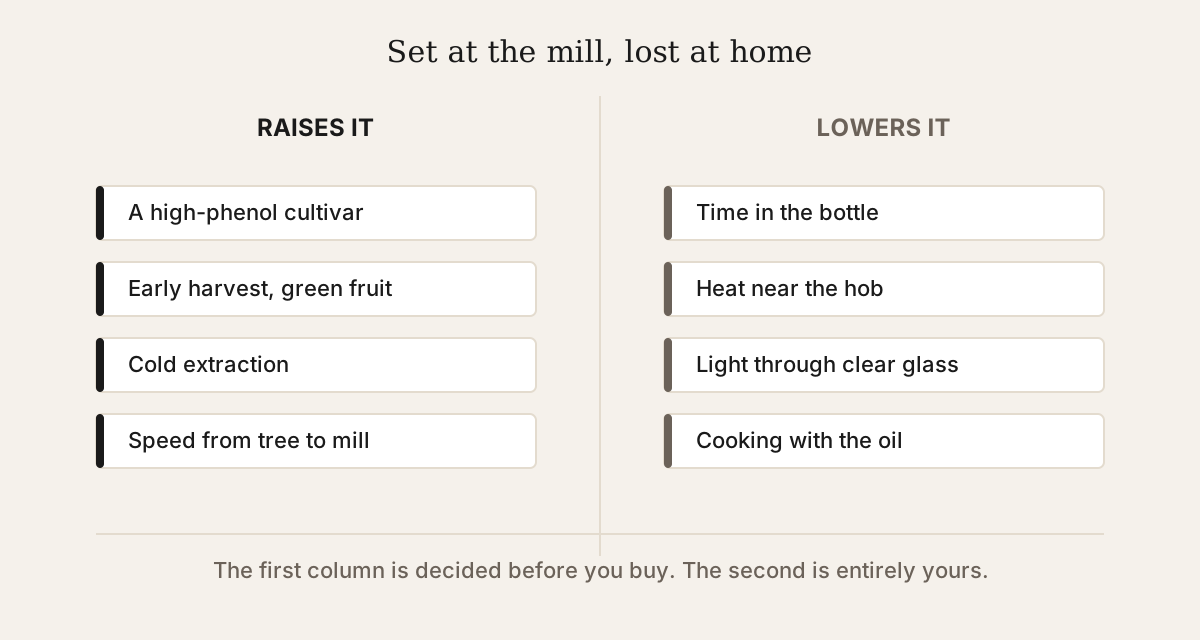
Polyphenol content is set at the grove and the mill, and four factors decide most of it.
Cultivar matters most. Coratina, moraiolo and picual are naturally high; taggiasca and arbequina are naturally low.
Early harvest raises it sharply. Green, unripe fruit carries far more polyphenol than ripe black fruit.
Cold extraction preserves it. Malaxation above roughly twenty-seven degrees drives phenolics off.
Speed from tree to mill limits the enzymatic losses.
High polyphenol oils are more bitter and more pungent, which is a trade-off rather than a straight upgrade, and mild oils have their uses.
What lowers it
Polyphenols decline from the moment of pressing, and the losses are largely under the buyer’s control after purchase.
Time is the main one. Content falls steadily over months.
Heat accelerates it, which is why the bottle beside the hob is a mistake.
Light does the same, which is the argument for dark glass and tin.
Oxygen in the headspace of a part-used bottle continues the process.
Cooking with the oil destroys much of it, which is a reason to finish dishes with a good oil rather than to fry in one.
The European health claim, stated precisely
European Union regulation permits one specific claim, and its conditions are narrow.
The permitted claim is that olive oil polyphenols contribute to the protection of blood lipids from oxidative stress.
It applies only where the oil contains at least 5 milligrams of hydroxytyrosol and its derivatives per 20 grams of oil.
It requires a daily intake of 20 grams of that oil to be meaningful, which the label must convey.
Most supermarket oil does not meet the threshold and cannot carry the claim.
This site reports the regulatory position and does not evaluate the underlying science or offer health advice.
How to find a high polyphenol oil
Look for a stated measurement, an early harvest, and a high-phenol cultivar. Where to find one is covered in where to buy Italian ingredients.
Some producers print a milligram-per-kilogram figure. Anything above roughly 300 is high, and above 500 is very high.
Early harvest on the label is a strong signal.
Named high-phenol cultivars are the next best proxy where no figure is given.
Taste for it. Bitterness on the tongue and a cough-inducing catch at the throat mean the compounds are present. Oils are sometimes graded informally by how many coughs they provoke.
Checked on 13 August 2026, United States listings for imported Italian extra virgin olive oil rarely stated a polyphenol figure. Counting rule: a listing counts as stating polyphenols when a numeric content appears in the product description or on the pictured label. That describes what was visible on that date and is not a recommendation of any seller.
Frequently asked questions
Why does good olive oil make me cough?
Because of oleocanthal, a polyphenol that stimulates receptors at the back of the throat. The catch, and the cough it can provoke, is a marker of high polyphenol content rather than a fault. Oils are sometimes described informally by how many coughs they cause, and a one-cough or two-cough oil is a genuine, if unscientific, shorthand.
Are high polyphenol oils better?
They carry more of the antioxidant compounds and they keep their character longer, and they are also more bitter and more pungent, which does not suit every dish. A mild low-phenol oil is the right choice for a delicate fish or a mayonnaise. Better depends on what the oil is for.
Does cooking destroy polyphenols?
Heat degrades them substantially, so an oil bought for its polyphenol content is better used raw, finishing a dish rather than frying in it. Olive oil remains a perfectly good cooking fat, and the polyphenols you paid for are largely spent in the pan.
What is the EU health claim on olive oil polyphenols?
European Union regulation permits the claim that olive oil polyphenols contribute to the protection of blood lipids from oxidative stress, conditional on the oil containing at least 5 milligrams of hydroxytyrosol and derivatives per 20 grams, and on a daily intake of 20 grams. Most supermarket oil does not meet the threshold. This site reports the regulation rather than evaluating the science.
Which olive varieties are highest in polyphenols?
Coratina from Puglia, moraiolo from Tuscany and picual from Spain are among the naturally high ones. Taggiasca from Liguria and arbequina from Spain are naturally mild and low. Harvest timing shifts the figure as much as cultivar does, so an early harvest taggiasca can exceed a late harvest coratina.
CalItalia Food covers Italian ingredients: what they are, how to tell a good one from an ordinary one, and where to buy them in the United States.