
Taggiasca Olive Oil: The Cultivar Behind Ligurian Oil
A small Ligurian olive giving a sweet, low-bitterness oil. Where the name comes from, why it is expensive, how monocultivar differs from a regional blend when you buy, and how to use it.
Taggiasca is a small dark Ligurian olive cultivar producing a sweet, delicate, low-bitterness oil, and it is the variety that gives Ligurian oil its character. Its price puts it among the Italian ingredients where the real article costs more to make.
Buying a monocultivar taggiasca is a narrower purchase than buying a Riviera Ligure DOP, which may blend it with other permitted varieties.
What taggiasca is
Taggiasca is an olive cultivar grown on the Ligurian Riviera, particularly in the province of Imperia in the west.
The name comes from Taggia, a town in Imperia where the variety was propagated by Benedictine monks.
The fruit is small, considerably smaller than most oil olives, and dark brown to purple-black when ripe.
It is closely related to the Provençal cailletier, sold in France as the Niçoise olive, and the two are generally regarded as the same or near-identical cultivar.
It grows on terraces, which is what makes it expensive.
It is dual purpose, giving both a well-known table olive and an oil.
What the oil tastes of
Taggiasca oil is sweet, delicate and lightly fruity, with almond and pine nut and very little bitterness.
Sweetness leads, which is unusual among Italian oils.
Almond and pine nut are the notes named most consistently.
Bitterness is minimal and pungency is slight, reflecting the cultivar’s naturally low polyphenol content.
The finish is short and clean rather than lingering.
It is the mildest well-known Italian monocultivar oil, which makes it the natural opposite of coratina.
Monocultivar against DOP
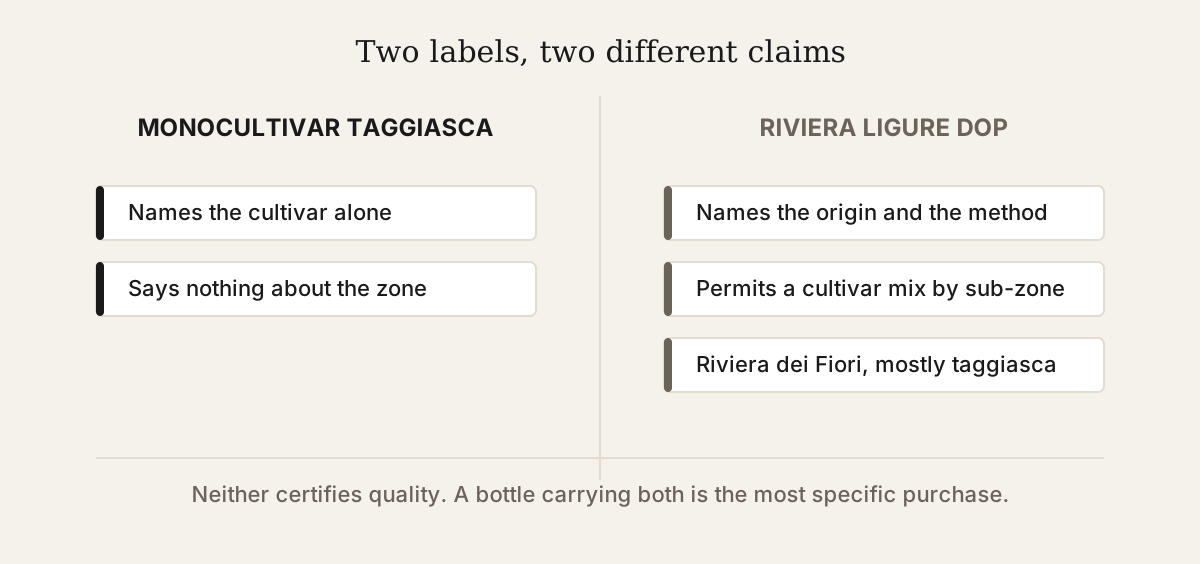
A bottle labelled taggiasca and a bottle labelled Riviera Ligure DOP are making different claims.
Monocultivar taggiasca states that the oil comes from that variety alone.
Riviera Ligure DOP states origin and method, and permits a cultivar mix that varies by sub-zone.
Riviera dei Fiori, the western sub-zone, requires a high taggiasca proportion and is the closest the DOP comes to a varietal statement.
Neither claim certifies quality, and both are worth having for what they do state.
A bottle carrying both is the most specific purchase available.
Why it costs what it does
Taggiasca is expensive because the fruit is small, the yield is low and the terrain is difficult.
Small fruit means more picking labour per litre of oil.
Terraced coastal slopes prevent mechanisation.
Yields per hectare are low compared with Pugliese groves.
The cultivar is also in demand as a table olive, which competes for the fruit.
Checked on 13 August 2026, United States listings for monocultivar taggiasca extra virgin olive oil clustered between roughly twenty-five and sixty-five dollars per 500 millilitres. Counting rule: a listing counts when it is an imported oil naming taggiasca as the cultivar. That describes what was visible on that date and is not a recommendation of any seller.
What to use it for
Taggiasca oil belongs on delicate food, and it is wasted where a robust oil is wanted.
Pesto, which is the Ligurian use and the one the cultivar’s mildness serves.
Raw fish and lightly cooked seafood.
Delicate vegetables and salads.
Mayonnaise and emulsions, where bitterness would be unpleasant.
Not on grilled red meat or bean soups, which want a Tuscan or Pugliese oil.
Frequently asked questions
Is taggiasca the same as the Niçoise olive?
Taggiasca and the Provençal cailletier, sold in France as the Niçoise olive, are generally regarded as the same or near-identical cultivar, separated by a national border rather than by botany. The cured products differ because Ligurian and Provençal curing practices differ, not because the fruit does.
What is the difference between taggiasca oil and Ligurian oil?
Taggiasca is a cultivar and Ligurian is a region. Most Ligurian oil is taggiasca-dominant, and a bottle labelled Riviera Ligure DOP may include other permitted varieties depending on the sub-zone. A monocultivar taggiasca bottle is the more specific claim of the two.
Why is taggiasca oil so expensive?
The fruit is small, so picking labour per litre is high; the groves sit on hand-built coastal terraces where machinery cannot work; yields per hectare are low; and the same fruit is in demand as a table olive. Every factor pushes the cost up, and none of them is a marketing premium.
Is taggiasca oil low in polyphenols?
Taggiasca is naturally low in polyphenols compared with cultivars like coratina or moraiolo, which is precisely why the oil is sweet and barely bitter. That means less of the compounds the European Union health claim concerns, and it also means the oil suits dishes a high-polyphenol oil would ruin.
Can I use taggiasca oil for cooking?
Cooking with it is possible and wasteful. Its qualities are aromatic and delicate, and heat removes exactly those. Given the price, it belongs on the table rather than in the pan, and a cheaper Pugliese oil does the frying perfectly well.
CalItalia Food covers Italian ingredients: what they are, how to tell a good one from an ordinary one, and where to buy them in the United States.