
Strozzapreti: The Twisted Shape With the Alarming Name
Hand-rolled twists from Emilia-Romagna whose name means priest stranglers. What they are, how they differ from casarecce, how to judge a box you buy, and the stories behind the name.
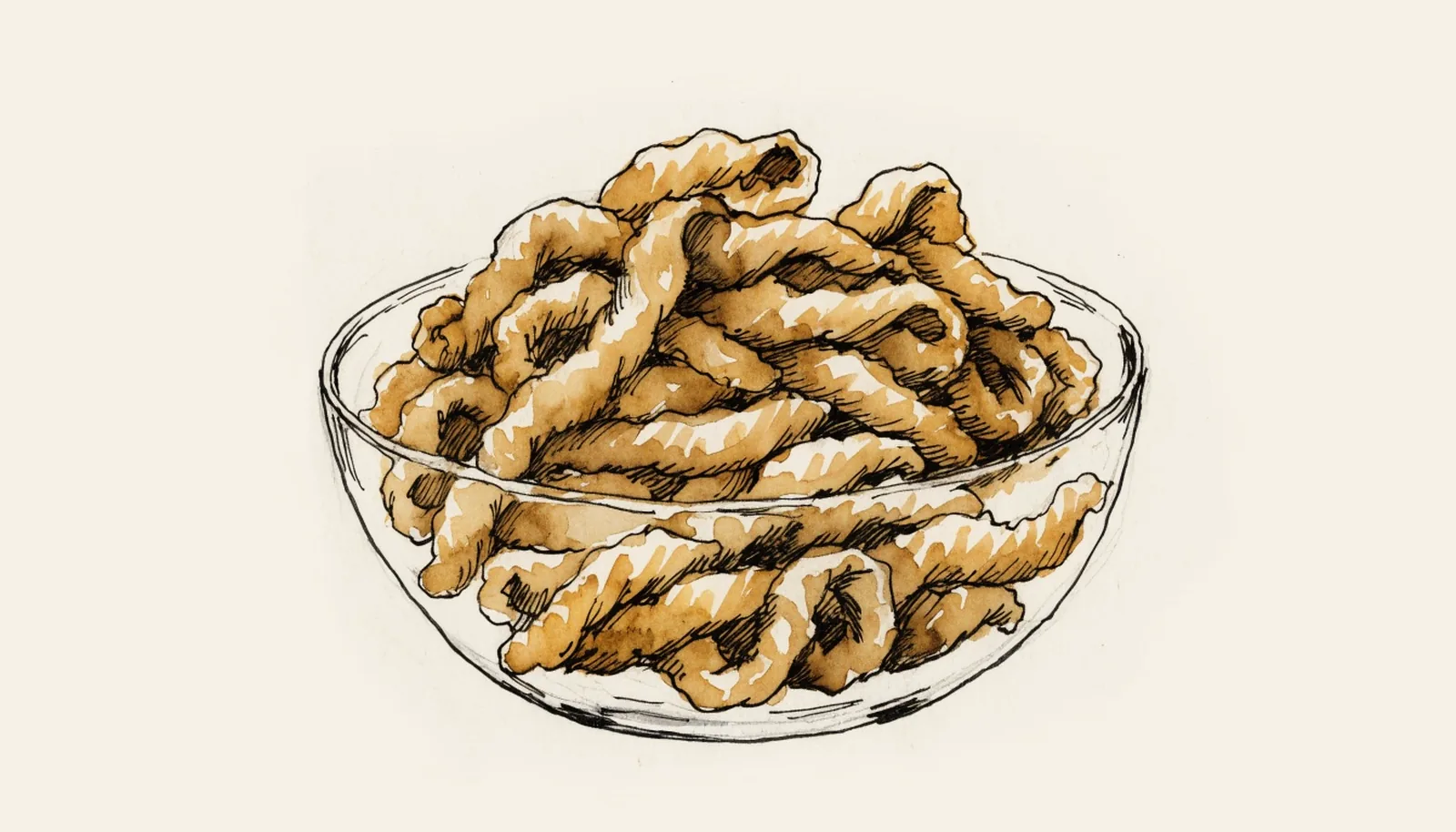
Strozzapreti are short hand-rolled pasta twists from Emilia-Romagna and the Marche, made by rolling a strip of dough between the palms so it forms an irregular twisted rope. They are one of the regional Italian pastas sold dried in the United States.
The name means priest stranglers, and the explanations for it are folklore rather than etymology.
What strozzapreti are
Strozzapreti are irregular twisted pasta ropes roughly four to seven centimetres long, made from durum semolina and water or from soft wheat and water depending on the area.
They are from Emilia-Romagna, particularly Romagna, and from the neighbouring Marche.
They are formed by hand-rolling, a strip of dough rubbed between the palms so it twists on itself.
The twist is irregular by nature, and uniformity in a dried version is a sign of machine forming rather than a fault.
They are thicker than trofie and longer, with a denser chew.
Some versions use egg and most traditional ones do not.
The name, and what is actually known
Strozzapreti means priest stranglers, and several stories explain it, none of which is documented.
One account has housewives making pasta as payment in kind to the clergy, muttering the name as they worked.
Another describes gluttonous priests eating too fast and choking.
A third links it to the anticlerical sentiment of the Romagna region, which was historically strong.
None of these is established. They are folk etymologies collected after the fact, and the honest position is that the origin is unknown.
Similar names exist elsewhere in Italy for unrelated shapes, including a gnocchi-like preparation, which is why recipes under this name vary so widely.
Strozzapreti against casarecce
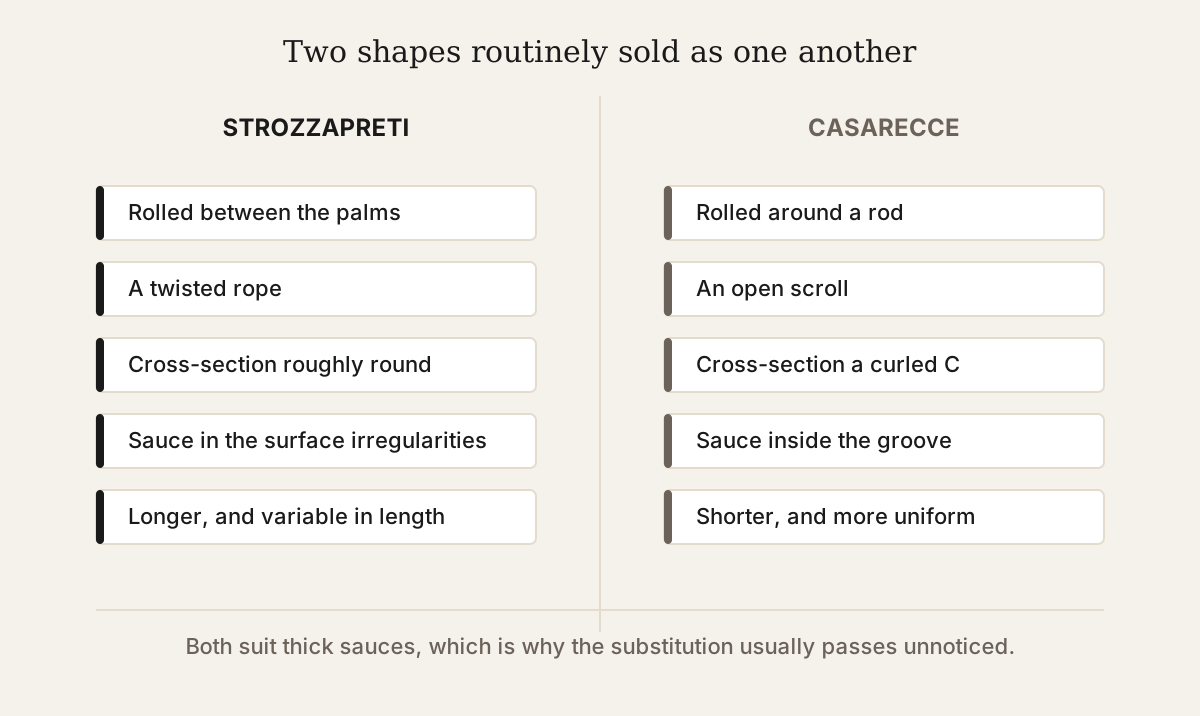
The two shapes are frequently confused and sold as one another, and they are formed differently.
Strozzapreti are rolled between the palms into a twisted rope, so the cross-section is roughly round and irregular.
Casarecce are rolled around a rod into an open scroll, so the cross-section is a curled C with a groove.
Strozzapreti are longer and more variable in length.
Casarecce hold sauce inside the groove; strozzapreti hold it in the surface irregularities and between pieces.
Both suit thick sauces, which is why substituting one for the other is usually acceptable in practice.
What to serve them with
Strozzapreti suit meat ragù, sausage and mushroom sauces, and the robust preparations of Emilia-Romagna.
Ragù alla romagnola is the regional pairing.
Sausage and cream sauces suit the dense chew.
Mushroom sauces, particularly with porcini.
They stand up to strong sauces better than a delicate shape, which is what the thickness is for.
They are wrong for a light seafood dressing, being too substantial for it.
Buying them
Look for irregular twists and a durum semolina base, and expect variation between producers.
Irregularity is correct. A perfectly uniform strozzapreti has been extruded rather than rolled.
Durum semolina and water is the most common ingredient list for the dried version.
Bronze extrusion applies where the shape is extruded rather than rolled.
Checked on 13 August 2026, United States listings for imported dried strozzapreti clustered between roughly four and nine dollars for a 500 gram box. Counting rule: a listing counts when it is an imported Italian dried strozzapreti. That describes what was visible on that date and is not a recommendation of any seller.
Cooking them
Cook to just under the box time, and allow longer than the length suggests because the twist is dense.
The centre of the twist is the thickest point and is what to test.
They take longer than casarecce of similar length, being solid rather than rolled.
Finish in the sauce with a little cooking water.
They hold their shape well and are forgiving of a minute’s overcooking, unlike a rolled scroll.
Storage
Dried strozzapreti keep two to three years airtight and are robust in the box.
They resist breakage better than long shapes.
Keep them dry.
They stale rather than spoil.
Frequently asked questions
What does strozzapreti mean?
The word translates as priest stranglers. Several folk explanations circulate, involving pasta given to clergy as payment, gluttonous priests choking, and the anticlerical politics of Romagna. None of them is documented, and the honest position is that the origin of the name is not established.
What is the difference between strozzapreti and casarecce?
Forming method and cross-section. Strozzapreti are rolled between the palms into a twisted rope with a roughly round section. Casarecce are rolled around a thin rod into an open scroll with a groove. Strozzapreti are longer and denser; casarecce hold sauce inside the channel.
Are strozzapreti made with egg?
Traditionally most are not, being durum semolina and water, though egg versions exist particularly in the fresh pasta of Emilia-Romagna. The dried product sold in the United States is usually eggless. Either is legitimate and they cook differently, with the egg version softer and faster.
What sauce suits strozzapreti?
Robust ones. Meat ragù, sausage and cream, and mushroom sauces are the regional pairings, and the density of the twist stands up to them. A light oil or seafood dressing is overwhelmed by the shape rather than complemented by it.
Can I substitute casarecce for strozzapreti?
In practice yes, and most sauces will not suffer. The two shapes hold sauce differently, casarecce inside a groove and strozzapreti in surface irregularity, but both are short, thick and made for the same category of sauce. Gemelli and fusilli are the next closest.
CalItalia Food covers Italian ingredients: what they are, how to tell a good one from an ordinary one, and where to buy them in the United States.