
Busiate: The Sicilian Spiral Twisted Around a Reed
A long coiled pasta from Trapani, named for the buso it was wound on. Why the spiral suits pesto alla trapanese, how to judge a dried box, and how to use it.
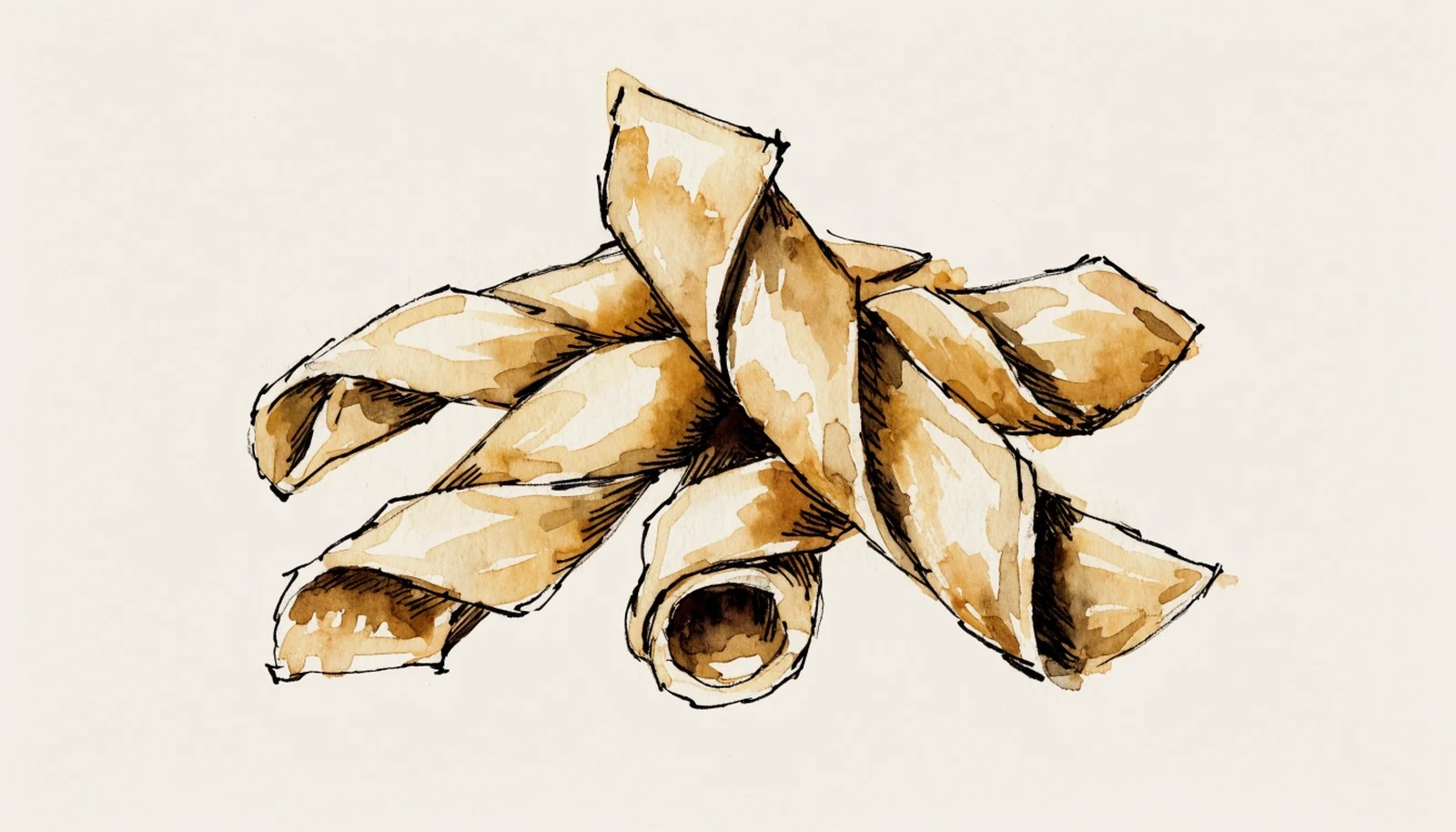
Busiate are a long spiral pasta from western Sicily, traditionally made by winding a strip of dough around a thin reed and sliding it off to leave an open coil. The name comes from that reed, and the shape exists to hold a specific sauce. They belong to the regional Italian foods that rarely reach American shelves fresh.
Almost every English description calls them a corkscrew, which understates them. The coil is long and loose rather than tight, and the difference is what makes the shape work.
What busiate actually are
Busiate are a durum wheat semolina pasta formed into a long open spiral, from the province of Trapani in western Sicily.
The buso is the reed. A thin stem, traditionally from a local grass, around which a rope of dough was wound by hand and then withdrawn.
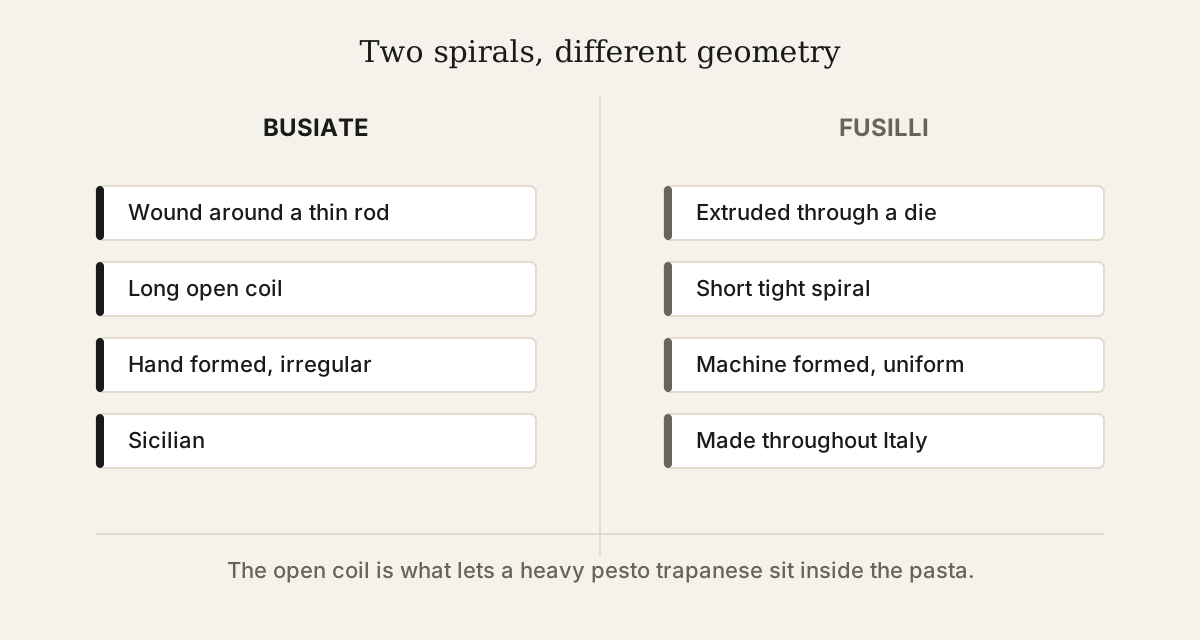
The coil is long and loose, several centimetres of open spiral rather than the short tight twist of fusilli.
The centre is hollow along the axis where the reed was, which is what distinguishes the shape structurally.
They are made from semolina and water, with no egg, in the southern Italian manner.
Busiate, busiati and maccaruna di casa all appear for the same shape across western Sicily.
They carry no DOP or IGP as a shape, since pasta shapes are not protected in that way; Pasta di Gragnano IGP protects a place and a process rather than a form.
Why the shape suits pesto alla trapanese
Busiate and pesto alla trapanese come from the same corner of Sicily and are made for each other.
Pesto alla trapanese is a loose sauce of raw tomato, almonds, basil and garlic, thinner and wetter than a Genovese pesto.
A loose sauce needs somewhere to collect. The open coil traps it along its length and inside the hollow core, which a smooth shape would shed.
Almonds and tomato are chunky rather than smooth, and the wide open spiral catches the solids as well as the liquid.
The pasta is substantial enough to carry it. A thin strand would be overwhelmed by a sauce with that much body.
This is the pairing to reach for if you buy a box, and it is the reason the shape survived.
It also suits other Sicilian sauces, notably those built on tomato and fish, for the same structural reason.
Handmade against extruded
Handmade and extruded busiate both exist and are visibly different products.
Handmade busiate are irregular. The coils vary in length, tightness and thickness, and the surface is rough from being rolled on a board.
Extruded busiate are uniform, pushed through a die that produces a consistent spiral.
Bronze extrusion still gives a rough surface, which matters for sauce adhesion and is the thing to look for in a dried box.
Teflon extrusion gives a smooth, pale, slippery pasta that sheds a loose sauce, which is exactly wrong for this shape’s purpose.
Fresh handmade busiate are sold in Sicily and rarely reach the United States, so a dried bronze-extruded box is the realistic purchase.
Neither is inauthentic. Dried extruded pasta is a legitimate Italian tradition of its own, covered on this site’s bronze die page.
How to judge a box
Judge it on the surface, then the colour, then the coils.
The surface should look matte and floury, not glossy. That roughness is bronze extrusion and it is what holds sauce.
Colour should be a pale wheat gold, not bright yellow. Bright yellow in an eggless pasta suggests a low-quality semolina or additives.
The coils should be intact with few broken fragments in the bottom of the box.
The hollow core should be visible when you look down the axis of a piece.
Read for durum wheat semolina alone, which with water is the whole ingredient list for this pasta.
Origin is worth reading. The shape is now made outside Italy, and the wheat and the drying differ.
Checked on 13 August 2026, the first page of United States results for busiate returned reference material and Italian cooking publishers rather than sellers, which describes that search on that date rather than recommending any seller. Counting rule: a result counts as a seller when it offers dried busiate for purchase. On that rule the first page carried none, which reflects that this is a specialist shape here.
What it should cost
Expect roughly 6 to 14 dollars for a 500 gram box in the United States.
The shape is slower to extrude and more fragile than a straight pasta, which raises handling costs, and slow low-temperature drying adds time.
Gragnano IGP producers make it and their boxes sit at the upper end, buying a defined process rather than the shape itself.
A cheap box is usually Teflon-extruded, which the matte or glossy surface reveals immediately and which undermines the shape’s purpose.
Availability rather than price is the constraint, and it appears at Italian grocers and specialist online sellers rather than in supermarkets.
How to use it
Cook it in plenty of well-salted water and finish it in the sauce.
Its structure means it takes a sauce with body, and it is wasted under a thin dressing.
Pesto alla trapanese is the traditional pairing and is what the shape was designed around.
Undercook by a minute and finish it in the pan with the sauce and a little pasta water, which is the general rule for any dried pasta.
Do not rinse it. The surface starch is what binds the sauce to the rough exterior.
Drain it with a spider or tongs rather than tipping into a colander, since long coils tangle and break.
It suits chunky sauces generally, and a smooth cream sauce is the one register it does not flatter.
Storage
Unopened, two years or more in a cool dry cupboard. Once opened, keep it sealed and use within a year.
Keep it dry and away from heat. Dried pasta does not spoil so much as go stale and brittle.
Transfer an opened box to a sealed container, since a folded packet lets in moisture and pantry smells.
Broken coils are still usable, and a box that has been knocked about is a cosmetic problem rather than a quality one.
Do not refrigerate it. Dried pasta picks up moisture in a fridge and can go soft.
It does not need freezing and there is no benefit to it.
Frequently asked questions
What does busiate mean?
Busiate takes its name from the buso, a thin reed or stem around which a rope of dough was wound by hand and then withdrawn, leaving a long open spiral with a hollow core. The name therefore records the tool rather than the shape or a place. Busiati and maccaruna di casa appear as regional variants of the name across western Sicily.
What is the difference between busiate and fusilli?
Busiate form a long, loose, open coil several centimetres in length with a hollow core along the axis, while fusilli are a much shorter and tighter twist. The busiate spiral is wide enough to trap a loose chunky sauce along its length and inside the core, which is why it suits pesto alla trapanese. Calling busiate a corkscrew understates how open the coil is.
What sauce goes with busiate?
Pesto alla trapanese is the traditional pairing and the shape was developed around it. That sauce of raw tomato, almonds, basil and garlic is loose and chunky, and the open coil catches both the liquid and the solids where a smooth shape would shed them. Busiate also suits other Sicilian tomato and fish sauces for the same structural reason, and flatters a smooth cream sauce least.
Should I buy bronze-extruded busiate?
Bronze extrusion gives a rough matte surface that holds sauce, which matters more for this shape than for most since it exists specifically to carry a loose dressing. Teflon extrusion gives a smooth, glossy, slippery pasta that sheds sauce and undermines the point of the coil. The surface finish is visible through the packaging and is the quickest quality check.
Can I buy fresh busiate in the United States?
Fresh handmade busiate are sold in Sicily and very rarely reach the United States, so a dried bronze-extruded box is the realistic purchase here. Dried extruded pasta is a legitimate tradition in its own right rather than a compromise. The shape appears at Italian grocers and specialist online sellers rather than in general supermarkets.
CalItalia Food covers Italian ingredients: what they are, how to tell a good one from an ordinary one, and where to buy them in the United States.