
Casarecce: The Rolled Scroll from Sicily
A short twisted shape with a groove down its length, made to trap thick sauce. What casarecce are, where they come from, how to judge a box before you buy, and what they suit.
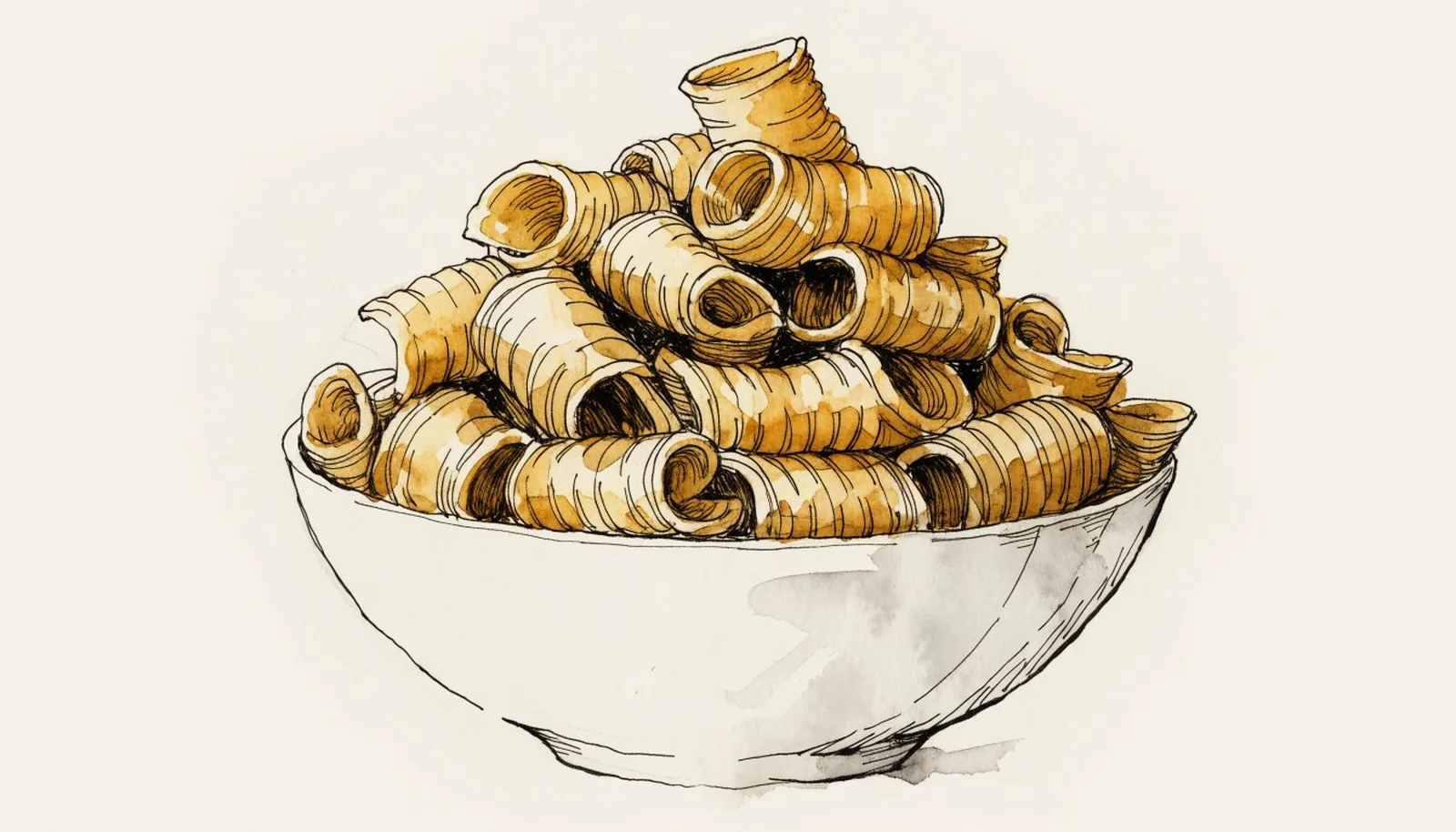
Casarecce are short Sicilian pasta shapes formed by rolling a flat strip around itself so it curls into an S, leaving a deep groove running the length of each piece. They are among the Italian pasta shapes chosen for what they hold.
The groove is the point, and it makes casarecce one of the most sauce-retentive short shapes available.
What casarecce are
Casarecce are short twisted shapes roughly four to five centimetres long, formed by curling a flat strip of dough lengthways so the edges nearly meet.
The name means homemade, from casa, and reflects the shape’s domestic origin.
They are Sicilian in origin and now made throughout Italy.
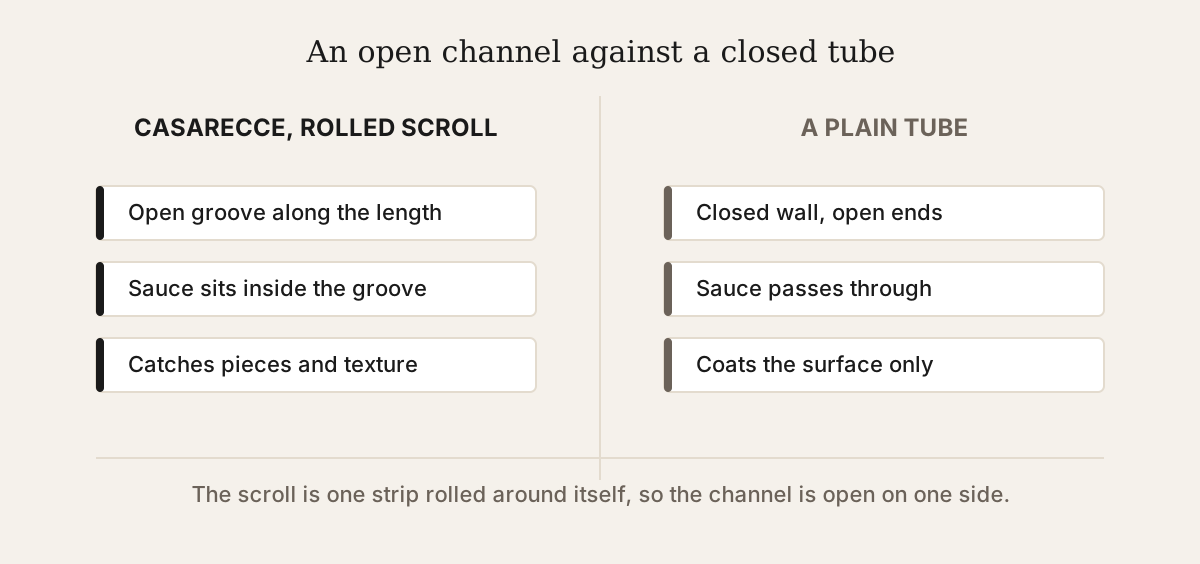
The cross-section is a rolled scroll, not a tube, so the channel is open along one side rather than enclosed.
They are made from durum semolina and water, with no egg in the traditional form.
A slight twist along the length is characteristic and distinguishes them from a simple folded strip.
Why the shape works
The open channel holds sauce that a closed tube would only coat, and the twist gives the piece structure.
Sauce sits inside the groove rather than passing through, which is the difference between an open scroll and a tube.
The twist stiffens the piece, so casarecce hold their shape better than a flat strip of the same thickness.
They are substantial enough for chunky sauces without being as large as paccheri.
They tangle slightly in the bowl, which helps them carry sauce to the fork.
What to serve them with
Casarecce suit thick sauces with texture: pesto alla trapanese, ragù, vegetable sauces and anything with small pieces in it.
Pesto alla trapanese is the Sicilian pairing, almond and tomato pesto sitting in the groove.
Meat ragù works because the channel catches the pieces.
Aubergine and tomato, as in a Norma-style sauce, suits it.
Cream and cheese sauces cling well to the twist.
A light oil dressing wastes the shape, which is chosen precisely to hold something thicker.
Buying them
Look for bronze-extruded casarecce with a visibly open groove and an even twist.
The groove should be open and deep. A shallow one has been extruded through a worn or poorly cut die.
Bronze extrusion matters for the same reason as on every shape meant for a clinging sauce.
Durum semolina and water is the correct ingredient list.
Checked on 13 August 2026, United States listings for imported casarecce clustered between roughly four and nine dollars for a 500 gram box. Counting rule: a listing counts when it is an imported Italian dried casarecce. That describes what was visible on that date and is not a recommendation of any seller.
They are widely stocked, being one of the more popular short shapes in United States retail.
Where to buy them in the United States
Casarecce are among the more widely stocked Italian short shapes and are carried by general supermarkets as well as importers.
Checked on 13 August 2026, a United States search for the shape returned grocery retailers, specialist Italian importers and recipe publishers on the first page. Counting rule: a result counts as a seller when it offers dried casarecce for purchase. Sellers were present on that rule, which describes that search on that date and is not a recommendation of any seller.
Supermarket own-brands exist and are frequently bronze extruded, which was not true a decade ago.
Sicilian producers are the reference point for the shape, and good casarecce are made throughout Italy.
Check the origin. The shape is now produced outside Italy, and the wheat and drying regime differ.
Making them by hand
Casarecce can be rolled at home from a semolina and water dough with nothing but a board and a thin rod.
Roll the dough thin and cut it into strips roughly four centimetres by two.
Lay a thin rod or skewer diagonally across each strip and roll the dough around it, pressing lightly.
Slide the rod out and the strip holds its scroll.
Twist slightly as you withdraw, which produces the characteristic curve.
They dry in a few hours on a floured tray and can be cooked fresh in three or four minutes.
Irregularity is expected and is what a homemade shape looks like.
Cooking them
Cook to just under the box time and finish in the sauce, and expect them to take slightly longer than a thin shape.
The rolled section is double thickness, so casarecce cook a little more slowly than their size suggests.
Test the thickest part, at the centre of the roll, rather than the edge.
Finish in the pan with a little cooking water so the sauce works into the groove.
Do not overcook them. The scroll unrolls as it softens and the shape loses its structure.
Storage
Dried casarecce keep two to three years airtight, and they are more robust than long or very large shapes.
They resist breakage well, being short and thick.
Keep them dry, which is the only real requirement.
They stale rather than spoil.
Frequently asked questions
What is the difference between casarecce and gemelli?
Casarecce are a single strip of dough rolled around itself into an S with an open groove. Gemelli look like two strands twisted together and are in fact one strand folded and twisted, with no open channel. Casarecce hold more sauce inside the piece; gemelli hold it on the surface.
Are casarecce Sicilian?
Casarecce are Sicilian in origin. The shape comes from Sicily and the name means homemade, reflecting its domestic roots. It is now made across Italy and by producers outside it, so a box of casarecce is not necessarily Sicilian.
What sauce is best with casarecce?
Thick sauces with texture. Pesto alla trapanese is the traditional Sicilian pairing, and meat ragù, vegetable sauces and cream sauces all work because the open groove catches them. A thin oil-based dressing is the one category the shape does not reward.
Do casarecce contain egg?
The traditional form does not. Durum semolina and water is the standard ingredient list, as with most southern Italian dried shapes. Egg versions exist and are a different product rather than a better one.
Why do mine unroll when cooked?
Almost always overcooking. The scroll relies on the dough holding its rolled structure, and once the pasta is fully soft the shape relaxes and opens. Pulling them a minute before the box time and finishing in sauce keeps the roll intact.
CalItalia Food covers Italian ingredients: what they are, how to tell a good one from an ordinary one, and where to buy them in the United States.