
Italian Egg Pasta: What the Egg Actually Changes
Soft wheat and whole eggs, from the north rather than the south. What the traditional ratio is, why dried egg pasta is a real category, and how to judge a nest before you buy.
Italian egg pasta, pasta all’uovo, is made from soft wheat flour and whole eggs rather than from durum semolina and water, and it belongs to the north of Italy where the south uses semolina. Knowing which tradition a packet belongs to is part of judging Italian pasta properly.
The egg is not a richness upgrade to southern pasta. It is a different tradition using a different wheat for a different result.
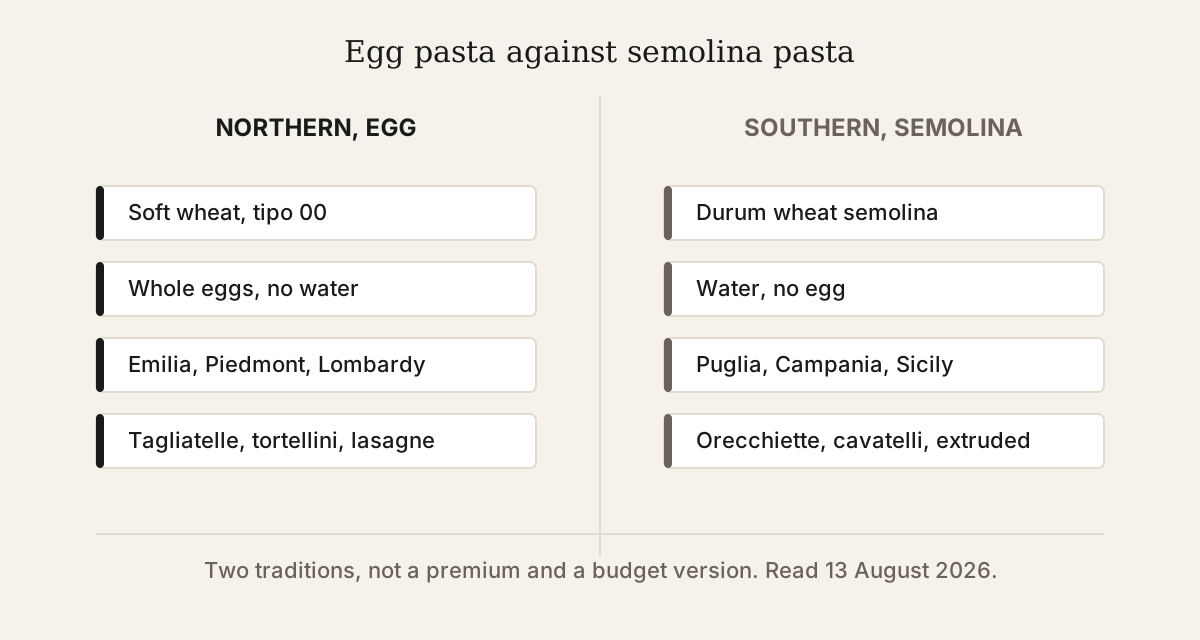
What it is made of
Traditional Italian egg pasta is soft wheat flour, usually tipo 00, mixed with whole eggs and nothing else.
The classic Emilian ratio is one egg per hundred grams of flour. That is the figure Bolognese sfoglina tradition works to.
Soft wheat, not durum. Tipo 00 is finely milled soft wheat and is what northern pasta uses.
Whole eggs, yolk and white, in the standard ratio. Yolk-only doughs are a restaurant refinement rather than the tradition.
No water and no oil in the classic dough. Both appear in shortcut recipes and neither belongs.
No salt in the dough in the Emilian tradition, since the sauce and the cooking water carry it.
Why the north and not the south
The division follows the wheat, and the wheat follows the climate.
Durum grows in the hot dry south and mills into semolina, which extrudes and dries well.
Soft wheat grows in the cooler north and mills into fine flour that suits a rolled sheet.
Eggs were available in the northern farmyard economy in a way they were not in the poorer south.
The shapes follow. Tagliatelle, pappardelle, tortellini and lasagne are northern egg shapes; orecchiette, cavatelli and extruded dried shapes are southern semolina ones.
Neither is more authentic. They are two traditions, and treating egg pasta as an upgrade misdescribes both.
Fresh, dried and the difference
Dried egg pasta is a real category with its own standards, not a compromise version of fresh.
Dried egg pasta is regulated in Italy, which requires at least four whole eggs per kilogram of flour.
It keeps for months where fresh keeps days.
It has a firmer bite than fresh and holds sauce differently.
Fresh egg pasta cooks in two to four minutes; dried takes six to ten.
Nests are the usual dried format, tagliatelle and pappardelle coiled to protect the ribbons.
The northern shapes, and which region owns which
Egg pasta produces a family of shapes that are regional rather than generic, and the name usually identifies the place.
Tagliatelle are Bolognese, cut about eight millimetres wide, and the Bologna chamber of commerce famously deposited a reference width.
Pappardelle are Tuscan, considerably wider, made for hare and wild boar sauces.
Tagliolini or tajarin are Piedmontese, very thin, and the Piedmontese version is famously yolk-heavy.
Lasagne sheets are Emilian, and the traditional green version takes spinach into the dough.
Tortellini, cappelletti and agnolotti are filled shapes, each with its own region and its own filling convention.
A shape name is a regional claim, and a producer using it is asserting a tradition rather than describing a width.
Rolling it at home
A hand-rolled sheet differs from a machine-rolled one in surface and in how it holds sauce.
A wooden pin on a wooden board gives a slightly porous surface that a steel roller does not.
The dough should rest at least thirty minutes wrapped, which relaxes the gluten and makes it rollable.
Roll to translucency. The Emilian test is being able to see your hand through the sheet.
Flour the sheet with semolina rather than soft flour when cutting, since the coarse grain stops the ribbons welding.
Dry the cut ribbons briefly before cooking or storing, ten to twenty minutes, so they hold their shape.
A machine is not a failure. It produces a smoother sheet that suits filled shapes particularly well.
How to judge a packet
Look at the egg count, the colour and the condition of the nests.
Check the egg declaration. Italian dried egg pasta states eggs per kilogram, and more than the four-egg minimum is a quality signal.
Colour should be a deep even yellow from the yolks rather than a pale beige.
Nests should be intact. A box of shattered nests has been handled badly and will cook unevenly.
Bronze extrusion or hand-rolled both give a rougher surface than a smooth machine sheet.
Checked on 13 August 2026, United States listings for imported Italian dried egg pasta clustered between roughly five and fourteen dollars for a 250 to 500 gram box. Counting rule: a listing counts when it is an imported Italian dried pasta declaring egg in its ingredients. That describes what was visible on that date and is not a recommendation of any seller.
Where to buy it in the United States
Imported Italian dried egg pasta is stocked by Italian grocers and online specialists, and fresh is mostly domestic.
Checked on 13 August 2026, a United States search for Italian egg pasta returned specialist importers, general grocery retailers and recipe publishers on the first page. Counting rule: a result counts as a seller when it offers Italian egg pasta, fresh or dried, for purchase. Sellers were present on that rule, which describes that search on that date and is not a recommendation of any seller.
Dried nests are the reliable import, since fresh egg pasta does not travel.
Fresh egg pasta in United States retail is generally made domestically, which is not a defect and is worth knowing when a package implies Italian origin.
Italian grocers with a pasta counter are the best source for genuinely fresh sheets and filled shapes.
Frozen filled shapes travel better than fresh ones and are widely imported.
Cooking it
Egg pasta cooks faster than semolina pasta and needs a gentler hand.
Salt the water as always.
Drop nests in whole and let them unfurl rather than breaking them up dry.
Stir gently. Egg ribbons tear where semolina ones do not.
Test early. Dried egg pasta can be done in six minutes and overcooks quickly after.
Finish in the sauce, and use less cooking water than with semolina pasta since egg pasta releases less starch.
What sauces suit it
Egg pasta suits butter, cream, meat ragù and anything rich, and it is poorly matched to sharp oil-based sauces.
Ragù alla bolognese with tagliatelle is the canonical pairing.
Butter and sage, butter and cheese, and cream sauces all cling to the porous egg sheet.
Mushroom and truffle sauces are northern and pair naturally.
Sharp tomato and oil dressings belong to semolina pasta and read as mismatched here.
The rule of thumb is fat with egg pasta, oil with semolina, which is regional as well as gastronomic.
Storage
Dried egg pasta keeps six to twelve months, less than semolina pasta, because the egg fat oxidises.
It has a shorter life than plain dried pasta, which keeps for years.
Keep it airtight and dark.
Fresh egg pasta keeps two to three days refrigerated and freezes well on a floured tray.
A stale smell means the egg fat has turned and the pasta should go.
Frequently asked questions
What is the traditional ratio for Italian egg pasta?
One whole egg per hundred grams of soft wheat flour is the classic Emilian ratio, worked to by the sfogline of Bologna. No water, no oil and no salt in the dough. Variations using extra yolks are restaurant refinements rather than the tradition.
Is egg pasta better than semolina pasta?
Neither is better; they are two regional traditions using different wheats. Egg pasta belongs to the north and suits butter, cream and meat sauces. Semolina pasta belongs to the south and suits oil and tomato. Treating egg pasta as a premium version of the other misdescribes both.
Does dried egg pasta count as real egg pasta?
Yes, and it is a regulated category in Italy requiring at least four whole eggs per kilogram of flour. Dried egg pasta has a firmer bite and keeps for months, where fresh keeps days. It is a different product from fresh rather than an inferior one.
Why does egg pasta cook faster?
The sheet is thinner and the dough is softer, being soft wheat rather than durum, so water penetrates more quickly. Dried egg pasta runs six to ten minutes against ten to twelve for a comparable semolina shape, and fresh takes two to four. Testing early matters because the window is short.
Should I use tipo 00 flour?
For the traditional northern dough, yes. Tipo 00 is finely milled soft wheat and produces the silky sheet the tradition is built on. All-purpose flour works acceptably and gives a slightly coarser result. Semolina in an egg dough produces something different again, which some regions do make deliberately.
CalItalia Food covers Italian ingredients: what they are, how to tell a good one from an ordinary one, and where to buy them in the United States.