
Paccheri: The Big Tubes, and What They Are For
Wide smooth tubes from Campania that collapse when cooked and are built to be stuffed or dragged through heavy sauce. How to judge and buy them, and how not to break them.
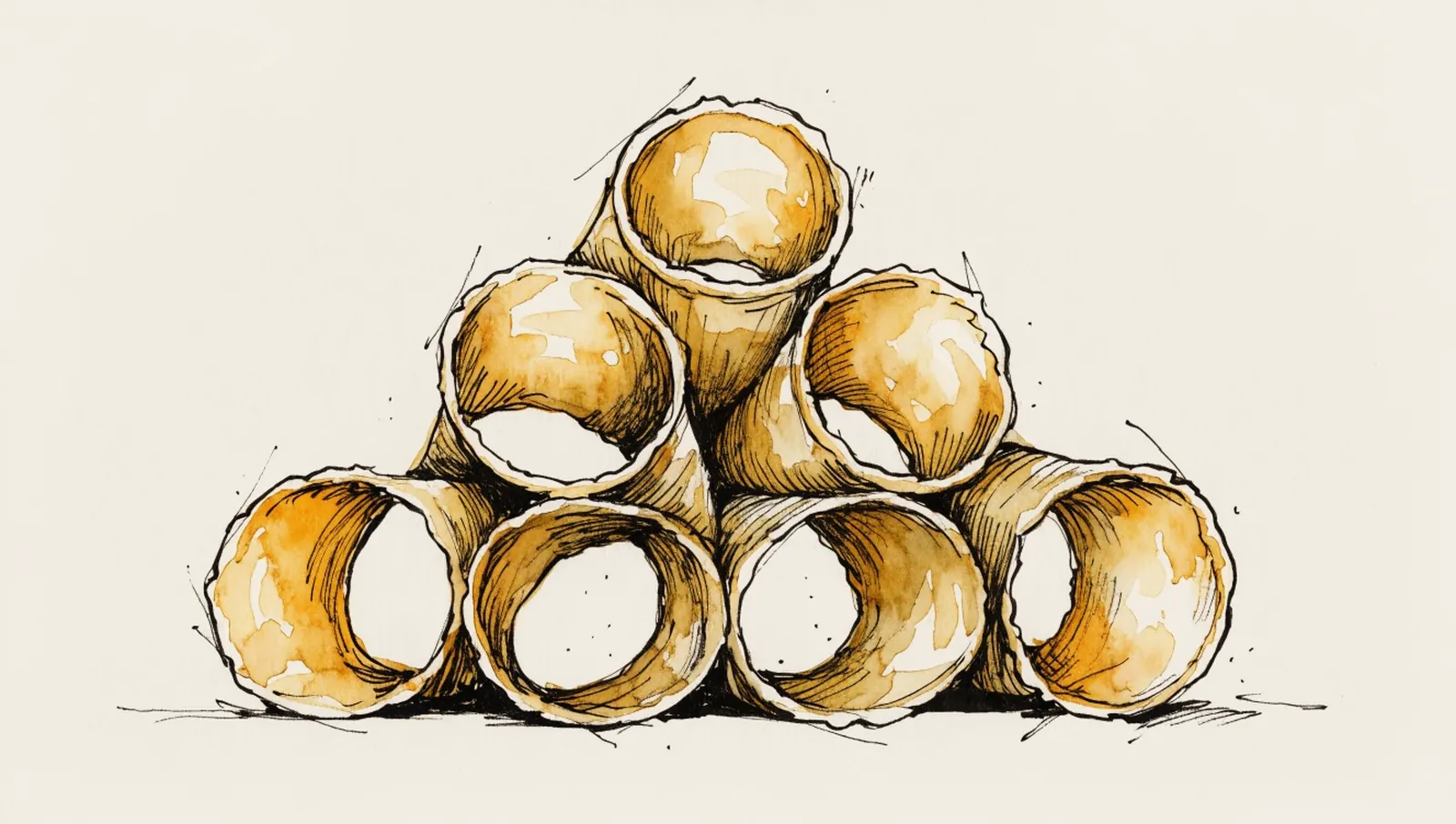
Paccheri are very large smooth pasta tubes from Campania, roughly four centimetres across and the same long, traditionally served with heavy meat or seafood sauces or stuffed and baked. Buying well means reading the same Italian quality signals the rest of the site covers.
They are the shape that collapses on the plate, and that collapse is deliberate rather than a fault.
What paccheri are
Paccheri are short wide tubes of durum wheat pasta, smooth-walled, from Campania and specifically the Naples area.
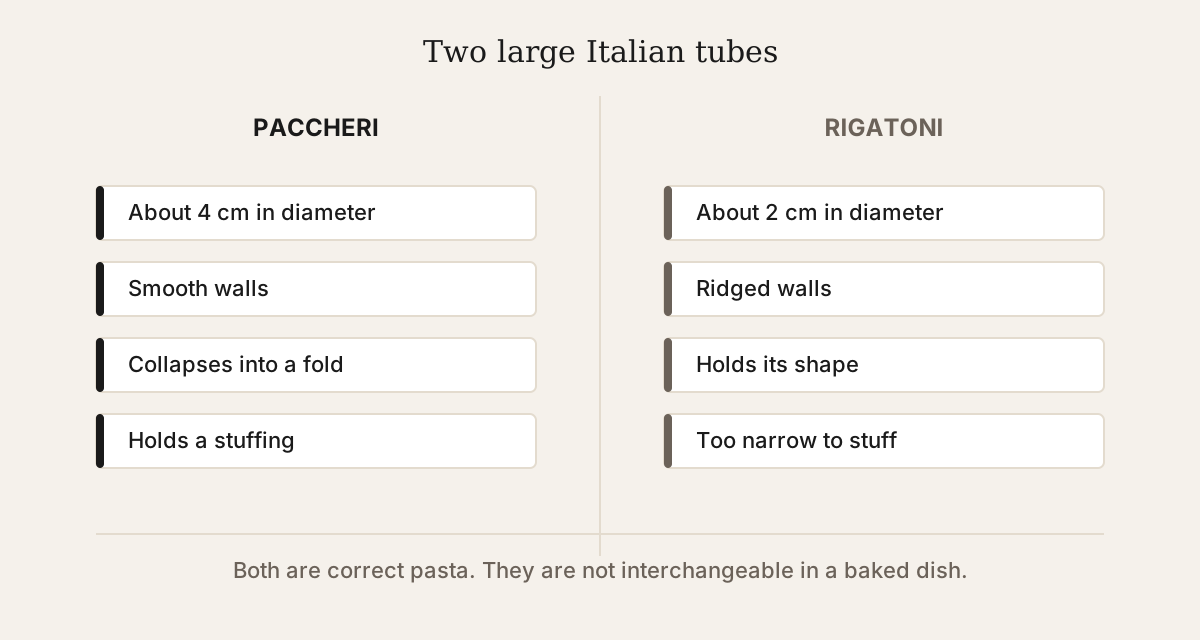
They are about four centimetres in diameter and roughly as long, which is substantially larger than rigatoni.
The walls are smooth rather than ridged, unlike rigatoni, though a ridged version called paccheri rigati exists.
They collapse when cooked, flattening into open ribbons. This is expected.
They are a Campanian shape, historically associated with Gragnano.
What they are for
Paccheri are built for heavy sauces and for stuffing, and they are wrong for anything light.
Ragù and meat sauces fill the tubes and cling to the interior.
Seafood sauces, particularly with clams, mussels or a whole crustacean, are the Neapolitan tradition.
Stuffed and baked with ricotta or a meat filling, standing upright in a dish.
They are useless with a light oil dressing, which slides straight through them.
They are not a substitute for rigatoni in a baked dish, since the larger tube holds far more filling and cooks differently.
Why they collapse, and why it is fine
A cooked paccheri tube flattens because the wall is thin relative to the diameter, and the collapse is what lets sauce coat the inside.
The wall cannot support the diameter once hydrated, so the tube folds.
The fold traps sauce in a way an intact tube would not.
Broken tubes are a different matter. Collapse is a fold along the length; breakage is a shattered ring, and that is usually rough handling or overcooking.
Baked preparations keep their shape better, since the filling supports the wall.
How to buy them
Look for bronze-extruded paccheri from Gragnano, and check the tubes are intact in the box.
Gragnano IGP is the protected designation for pasta from that town, and it is the reference point for the shape.
Bronze extrusion matters more here than on most shapes, because a smooth wide tube sheds sauce badly without a rough surface.
Hold the box up. Broken tubes settle to the bottom and a box with a layer of fragments has been handled badly.
Checked on 13 August 2026, United States listings for imported paccheri clustered between roughly five and twelve dollars for a 500 gram box. Counting rule: a listing counts when it is an imported Italian dried paccheri. That describes what was visible on that date and is not a recommendation of any seller.
Gragnano, and what the designation covers
Pasta di Gragnano carries an IGP designation, and what it protects is the process and the place rather than the shape.
Gragnano is a town near Naples whose pasta industry dates to at least the sixteenth century, built on a combination of local spring water and a climate suited to slow air drying.
The IGP requires durum wheat semolina and local water, bronze extrusion, and slow drying at low temperature over many hours.
It does not restrict the shape. Paccheri, spaghetti, penne and dozens of others are all made under it.
A box reading Pasta di Gragnano IGP tells you the process was followed. A box reading simply made in Gragnano does not.
Other excellent producers exist outside Gragnano, and the designation is a floor rather than a ceiling.
The other very large shapes
Paccheri sit in a small family of oversized tubes and rings, and they are frequently confused with one another.
Calamarata are rings rather than tubes, cut short so they resemble squid rings, and they are the shape most often mistaken for paccheri.
Mezzi paccheri are the same diameter cut to half the length, and they are easier to handle and less prone to breaking.
Candele are very long tubes, snapped by hand before cooking, traditionally used with Neapolitan ragù.
Cannelloni are similar in diameter and sold specifically for stuffing, usually with a thinner wall and often made from egg pasta.
Rigatoni are not in this family despite the visual resemblance, being roughly half the diameter and ridged.
What a good one looks like on the plate
A well-made paccheri holds a firm bite at the fold and carries visible sauce inside the tube.
The fold should stay pliable rather than tearing, which indicates the pasta was not overcooked.
Sauce should be inside as well as outside. A tube that comes to the plate dry inside was not tossed in the pan.
The surface should look matte if it was bronze extruded, and it should hold a visible film of sauce.
A slight chalkiness at the very centre of the wall is the sign of correct doneness in a thick pasta and disappears within a minute of resting in sauce.
Where to buy them in the United States
Imported paccheri are stocked by Italian grocers, by online specialist retailers and increasingly by general supermarkets.
Checked on 13 August 2026, a United States search for the shape returned specialist Italian importers, general grocery retailers and recipe publishers on the first page. Counting rule: a result counts as a seller when it offers dried paccheri for purchase. Sellers were present on that rule, which describes that search on that date and is not a recommendation of any seller.
Italian grocers carry it reliably and are usually cheaper than online specialists for the same brand.
General supermarkets stock it inconsistently, and where they do it is usually a single mainstream brand rather than a Gragnano producer.
Buy a box rather than bulk. Loose paccheri from a bin arrive broken.
Check the country of origin, since the shape is now made outside Italy and the wheat and drying differ.
How to cook them
Use a wide pan rather than a tall pot, cook them loose, and handle them with a spider rather than a colander.
A wide pan stops them stacking and sticking to one another, which is the main cooking failure.
Plenty of water and a gentle boil. A rolling boil knocks the tubes against each other and breaks them.
Stir rarely and gently, with a wooden spoon rather than tongs.
Lift them out with a spider. Tipping a pot into a colander is what breaks most paccheri.
Undercook by a minute and finish in the sauce, as with any dried pasta.
Stuffing and baking them
For a baked dish, parboil well short of done, stand the tubes upright, and fill them before saucing.
Parboil three or four minutes only. They will finish in the oven and a fully cooked tube will not stand.
Stand them on end in a deep dish, packed closely so they support each other.
Fill with a piping bag or a small spoon; the diameter is generous enough that this is easier than with cannelloni.
Sauce over the top and bake covered, so the exposed pasta edges do not dry out.
The name, and what it says about the shape
Paccheri takes its name from a Neapolitan word for a slap, which describes the sound and the character of the shape rather than being decorative.
Paccaro is a slap with an open hand in Neapolitan dialect, and the plural names the pasta. The reference is to the noise they make: A cooked pacchero landing on a plate, or on another pacchero, slaps rather than lands quietly, because it is a wide tube of soft cooked dough.
It also carries a sense of largeness and bluntness, which suits a shape that is deliberately oversized against every other tube pasta.
A folk explanation attaches it to smuggling, the story being that oversized tubes concealed cheaper foreign pasta inside them. It is repeated widely, it is unsourced, and this site records it as folklore rather than as history. The sound-based derivation needs no such story.
Storage
Dried paccheri keep two to three years airtight, and the risk is breakage rather than staling.
Store the box upright or transfer to a rigid container.
Do not decant into a bag. Bagged paccheri break under their own weight.
They stale rather than spoil, losing aroma over years.
Frequently asked questions
What is the difference between paccheri and rigatoni?
Size and surface. Paccheri are roughly four centimetres in diameter with smooth walls; rigatoni are about half that and ridged. Paccheri collapse when cooked and rigatoni hold their shape. They are not interchangeable in a baked dish, since paccheri hold far more filling.
Why do my paccheri fall apart?
Collapse along the length is normal and expected, because the wall is thin relative to the diameter. Shattering into fragments is not, and it usually comes from a hard rolling boil, tipping the pot into a colander, or overcooking. Cook them at a gentle boil in a wide pan and lift them out with a spider.
What sauce goes with paccheri?
Heavy ones. Meat ragù, seafood sauces with clams or mussels, or a thick tomato sauce with plenty of body. A light oil-based dressing runs straight through the tubes and leaves them naked, which is the one thing the shape does badly.
Can I substitute rigatoni for paccheri?
For a sauced dish, reasonably well, accepting that the eating experience differs considerably. For a stuffed and baked dish, less so, because rigatoni are too narrow to fill comfortably and hold a fraction of the filling. Cannelloni are closer for stuffing.
Are paccheri from Naples?
They are Campanian and associated particularly with Gragnano, the pasta town near Naples whose dried pasta carries an IGP designation. The name is Neapolitan dialect for a slap, describing the sound the cooked tubes make landing on a plate.
CalItalia Food covers Italian ingredients: what they are, how to tell a good one from an ordinary one, and where to buy them in the United States.