
Bronze Die Pasta: What the Rough Surface Actually Does
Why bronze-extruded pasta looks chalky, holds sauce better, and costs more. How to judge it against teflon-extruded pasta in the box before you buy, and on the plate.
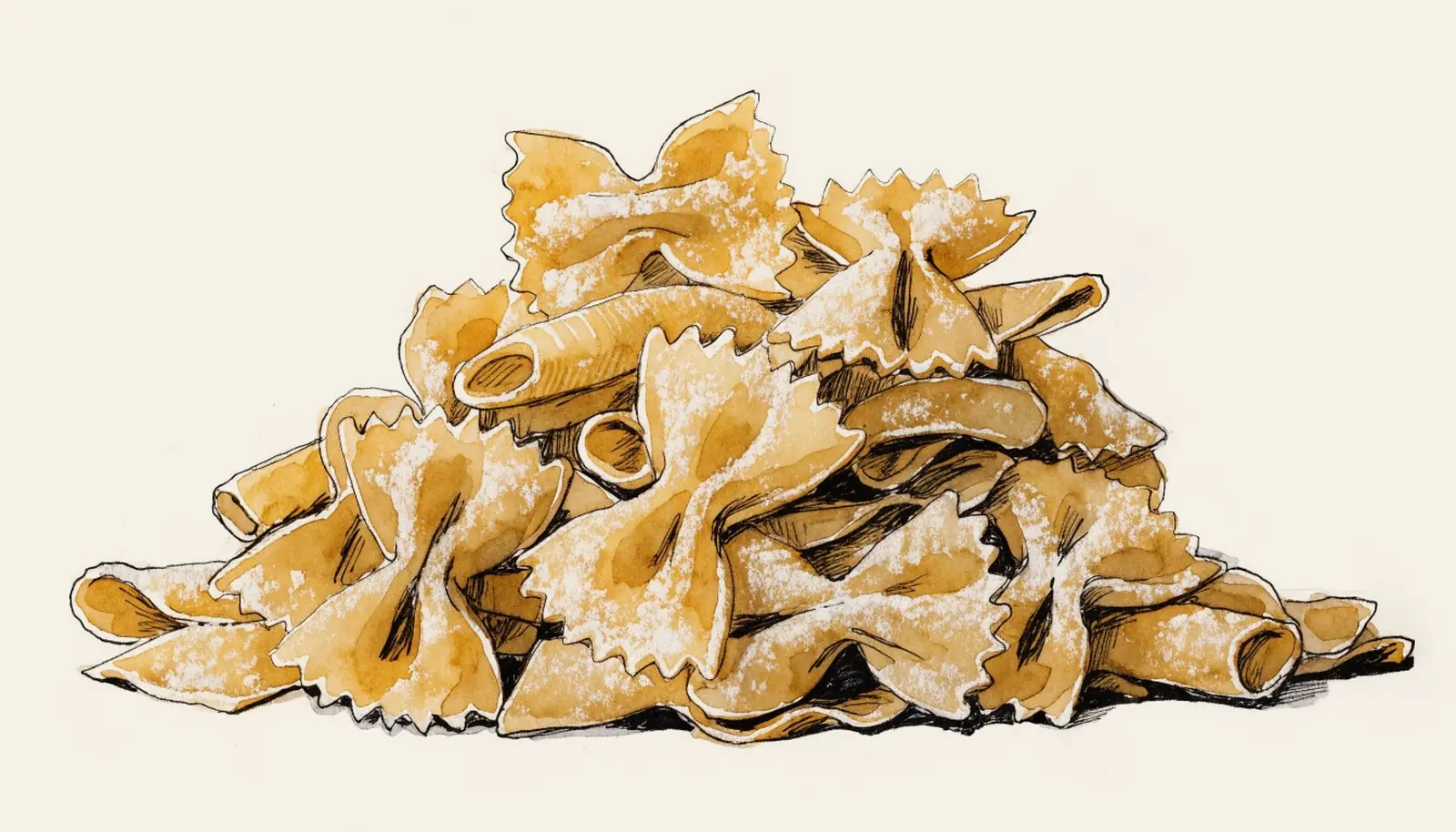
Bronze die pasta is pasta extruded through a bronze mould rather than a teflon-coated one, which tears the dough surface as it passes and leaves it rough and chalky instead of smooth and glossy. It is a case of an Italian quality marker you can judge by eye.
The rough surface is the entire point, and it is the one pasta quality marker visible through the packaging before you buy.
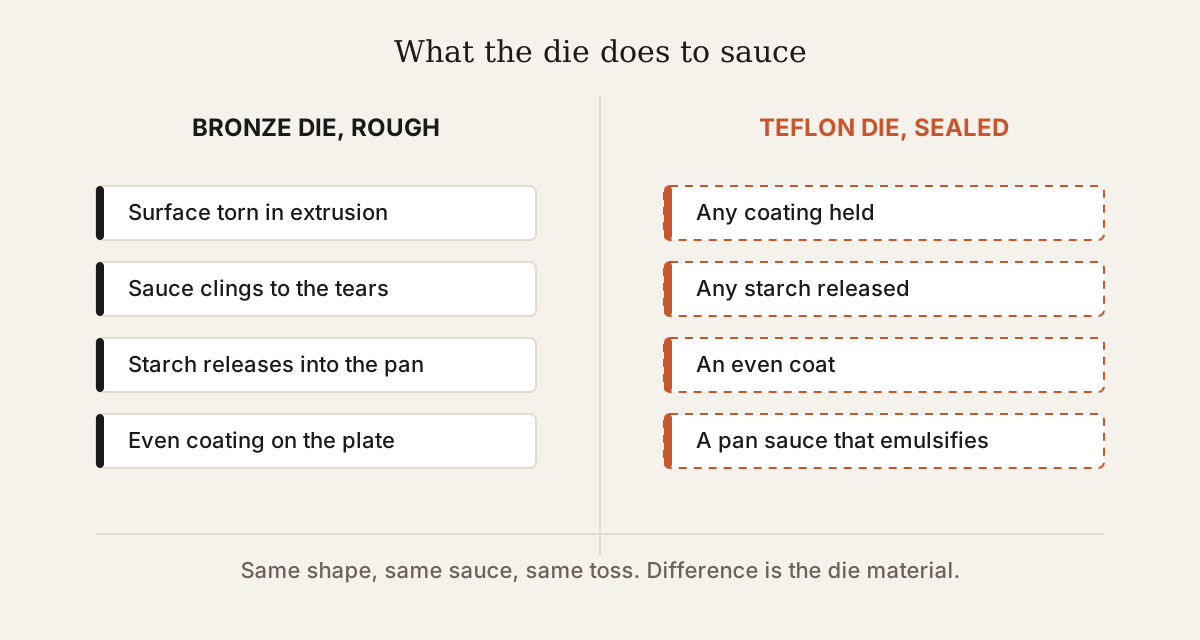
What the die actually does
The die is the mould the pasta dough is forced through, and its material decides the texture of the finished surface.
Bronze is comparatively soft and grippy. Dough passing through it drags, and the surface tears microscopically.
Teflon-coated dies are slick. Dough slides through cleanly and emerges with a sealed, glossy surface.
The shape is identical either way. A penna is a penna; only the surface differs.
Bronze dies wear out and need replacing far more often than teflon ones, which is part of the cost difference.
Extrusion is slower through bronze, which is the other part.
Why the rough surface matters
A torn surface holds sauce where a sealed one sheds it, and it also changes how the pasta cooks.
Sauce clings to the tears rather than sliding off, so the same quantity of sauce coats more thoroughly.
Starch releases more readily into the cooking water and into the sauce during the final toss, which is what emulsifies a pan sauce.
The bite is slightly different. Bronze pasta has a marginally softer exterior and a firmer interior at the same cooking time.
It absorbs a little more water, so cooking times run slightly longer than the box suggests for a comparable teflon shape.
How to tell in the shop
Bronze pasta looks chalky, pale and matte; teflon pasta looks yellow, smooth and slightly shiny.
Look for the matte, floury appearance. A box of bronze-extruded pasta looks dusty even when it is not.
Colour reads paler and less uniformly golden.
The label usually says so, as trafilata al bronzo or bronze-drawn, because producers charge for it. The origin wording beside it is covered in what Made in Italy means on a label.
Run a thumb over a piece where the packaging allows. Bronze feels like fine sandpaper.
A shiny yellow surface means teflon, whatever else the box claims.
What it does not tell you
Bronze extrusion is one quality marker among several, and on its own it does not make a pasta good.
Wheat quality matters more. A bronze-drawn pasta made from poor semolina is worse than a teflon one made from good.
Drying is the other half. Slow drying at low temperature preserves flavour and protein structure; fast high-temperature drying does not, and the box rarely says which was used.
Bronze extrusion is now common at every price level, including supermarket own-brands, so it no longer signals a premium product by itself.
The combination is what to look for: bronze die, slow drying, and a named durum wheat.
What it should cost
Bronze-extruded dried pasta in the United States generally runs above commodity pasta and well below fresh.
Checked on 13 August 2026, United States listings for imported bronze-drawn dried pasta clustered between roughly four and nine dollars for a 500 gram box, with artisanal single-estate producers above that. Counting rule: a listing counts when it is an imported Italian dried pasta whose packaging states bronze extrusion. That describes what was visible on that date and is not a recommendation of any seller.
Commodity pasta sits far below it, typically one to two dollars for the same weight.
Price above roughly ten dollars a box is usually buying a named wheat variety or a small producer rather than the extrusion method alone. Senatore Cappelli is one such wheat.
How to cook it
Salt the water heavily, undercook slightly, and finish the pasta in the sauce.
Use less water than instinct suggests. Starch concentration is what makes bronze pasta work, and drowning it in water dilutes the advantage.
Pull it a minute early and finish it in the pan with the sauce and a ladle of the cooking water.
Toss vigorously. The released starch and the torn surface emulsify into a coating sauce, which is the whole reason to buy it.
Do not rinse it. Rinsing removes exactly the starch you paid for.
Storage
Dried pasta keeps two to three years in an airtight container, and bronze pasta is no more fragile than any other.
Keep it dry and dark. Humidity is the only real enemy.
The rough surface sheds a little flour in the box, which is normal rather than a sign of damage.
It does not spoil, it stales, losing aroma over several years.
Frequently asked questions
Is bronze die pasta actually better?
It holds sauce better, which is a genuine and demonstrable advantage, and it is only one of several quality factors. Wheat quality and drying temperature matter at least as much and are harder to see on a box. A bronze-drawn pasta from poor semolina dried fast at high heat is not better than a well-made teflon-extruded one.
How can I tell if pasta is bronze extruded?
Look at the surface. Bronze pasta is matte, pale and chalky, and feels faintly like fine sandpaper. Teflon-extruded pasta is smooth, glossy and more uniformly yellow. Most producers who use bronze dies say so on the box, since it justifies a higher price.
Why does bronze die pasta cost more?
Bronze dies wear out much faster than teflon ones and have to be replaced, and extrusion through bronze runs slower, so output per hour is lower. Both raise the cost per box. The gap has narrowed as the method has spread to supermarket own-brands.
Does bronze pasta take longer to cook?
Slightly, because the rougher surface absorbs a little more water. The difference is usually under a minute. The more useful habit is to pull any pasta a minute before the box time and finish it in the sauce, which matters more than the extrusion method.
Is all Italian pasta bronze extruded?
Most Italian pasta is not bronze extruded. Teflon extrusion dominates industrial production in Italy as everywhere else, because it is faster and cheaper. Bronze extrusion is a deliberate choice a producer makes and advertises.
CalItalia Food covers Italian ingredients: what they are, how to tell a good one from an ordinary one, and where to buy them in the United States.