
Provolone: The Rennet Decides the Sharpness, Not the Age
A stretched-curd DOP cheese sold as dolce and piccante. Why the animal the rennet came from makes it sharp, how Italian provolone differs from the American deli cheese, and how to judge and use it.
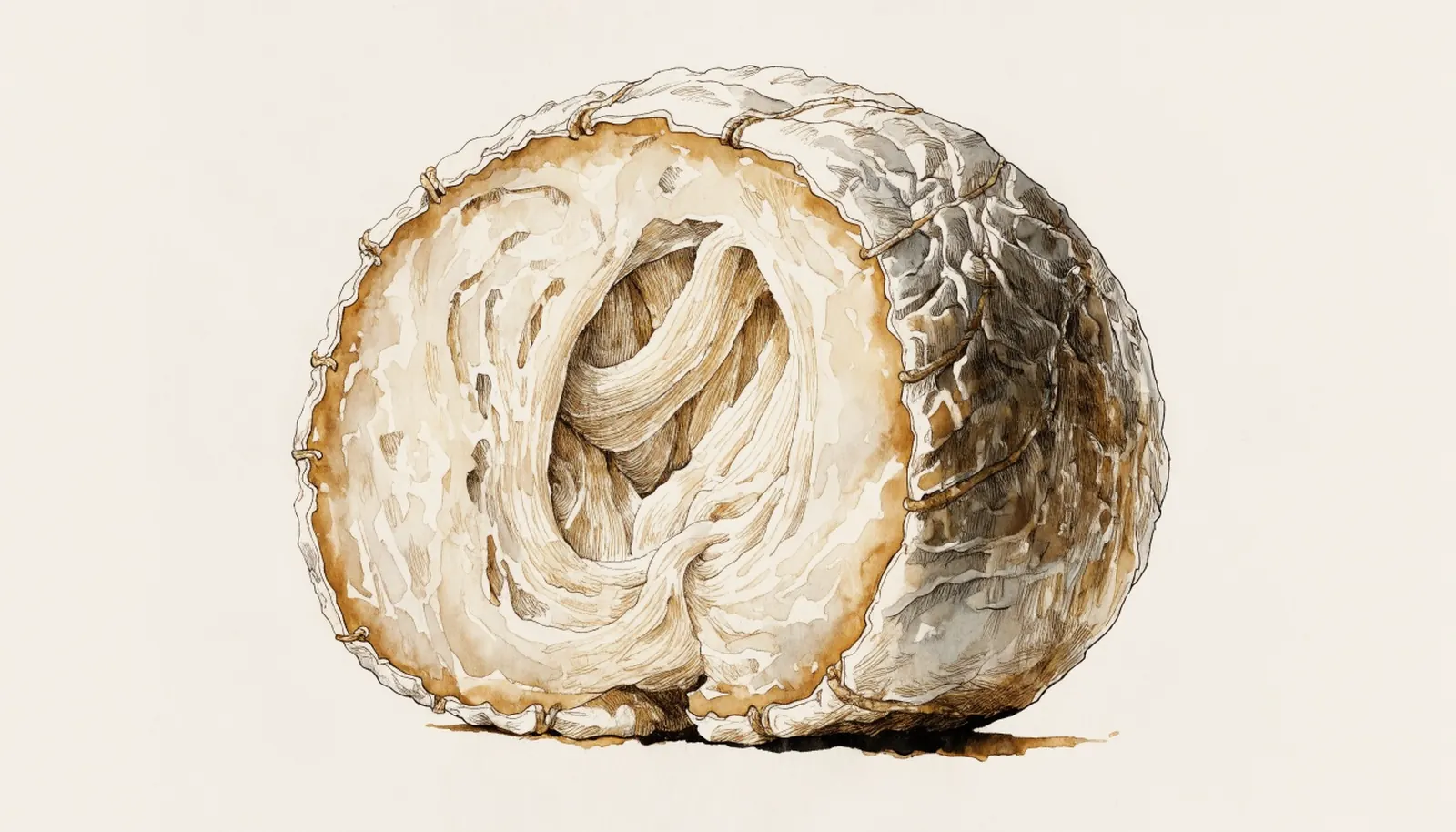
Provolone is a stretched-curd cow’s-milk cheese from northern Italy, hung in rope slings to age and sold in two forms, dolce and piccante. The difference between them is usually explained as a matter of age, and the larger factor is which animal the rennet came from. It is also one of the Italian names most thoroughly borrowed by American producers.
That detail is on almost no shelf label and it explains why a piccante provolone tastes sharp in a way that simply ageing a dolce would never produce.
What provolone actually is
Provolone is made by acidifying cow’s milk, ripening the curd, then working it in hot water until it stretches, forming it into large shapes and hanging it to age.
It is a pasta filata cheese. The stretched-curd family also holds mozzarella, scamorza, caciocavallo and provola, and the stretching gives all of them a layered, slightly fibrous structure.
The shapes are distinctive and functional. Pears, cylinders, cones and long salami forms, all bound with rope and hung, which is how they were aged before shelving.
Provolone Valpadana DOP is the northern protected version, from the Po valley, and it is the one most often meant.
Provolone del Monaco DOP is a separate and rarer designation from the Monti Lattari near Naples, made from raw milk and aged much longer.
It ages far longer than mozzarella despite the shared method, from a couple of months to well over a year.
Why the rennet is what makes it sharp
Provolone dolce and piccante diverge at the coagulation stage rather than in the ageing room.
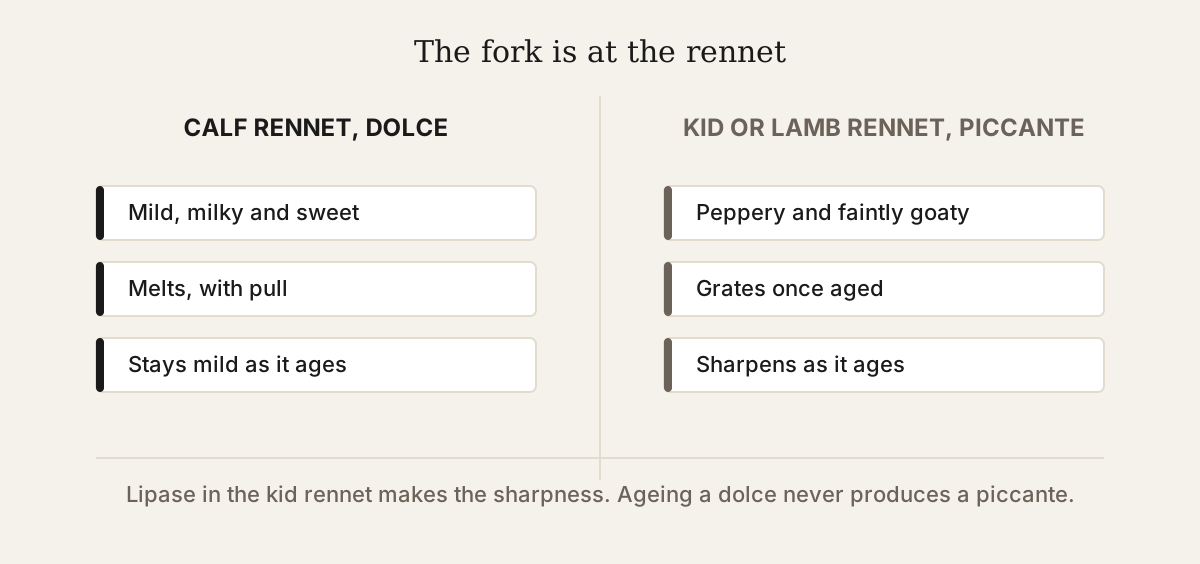
Dolce uses calf rennet. The resulting cheese is mild, milky and sweet, and it stays that way.
Piccante uses kid or lamb rennet, and specifically a paste form that carries lipase, an enzyme that breaks down milk fat.
Lipase is what produces the sharpness. Broken-down fats yield the peppery, faintly goaty pungency that defines piccante, and that flavour is a product of enzyme activity rather than of time alone.
Ageing amplifies it rather than creating it. A piccante held longer gets sharper because the lipase has had longer to work; a dolce held longer mostly gets drier and firmer.
So you cannot make a piccante by ageing a dolce, which is the practical consequence and the reason the two are decided at the start.
The same mechanism explains pecorino’s piquancy, which also comes from lamb rennet, so the two cheeses share a source of sharpness despite different milks.
Italian provolone against the American deli cheese
Provolone is one of the Italian cheeses most thoroughly naturalised in the United States, and the American product is its own thing.
American deli provolone is overwhelmingly mild. It is a smooth, pale, gently flavoured sandwich cheese, and it is what most Americans mean by the word.
It is frequently smoked, which is not part of the Italian tradition and is a distinct American development.
Some American product is labelled picante or sharp and is usually still much milder than an Italian piccante.
Checked on 13 August 2026, the first page of United States results for provolone returned major American deli and Wisconsin producers alongside reference material, which describes that search on that date rather than recommending any seller. The dominance of domestic producers in that result set is itself a fair description of the category here.
None of this makes the American cheese fake. It is a real product with its own century of history in American delis, and the useful question is which one you want rather than which is authentic.
How to judge a piece
Judge it on the paste, then the rind, then the smell.
The paste should be pale straw and close-textured, with a faint layered structure from the stretching visible on a broken edge.
It should be firm without being rubbery. A squeaky, bouncy texture indicates a very young cheese.
Small eyes are acceptable, large irregular holes are not, and cracks through the paste suggest it has dried out.
The rind should be thin and smooth, often with the marks of the hanging rope, and free of cracks.
Piccante should smell sharp and faintly goaty; dolce should smell of milk and little else. If a cheese sold as piccante smells of nothing much, it was made with calf rennet.
Look for the DOP mark if you want the protected northern version, since provolone without it may come from anywhere.
What it should cost
Expect roughly 10 to 20 dollars a pound in the United States for domestic provolone, and 18 to 32 for imported Italian DOP.
The gap reflects scale rather than quality alone. American provolone is made in enormous volume; Provolone Valpadana crosses an ocean in far smaller quantities.
Provolone del Monaco is considerably more expensive and genuinely scarce here, being a small raw-milk designation aged well past a year.
Very cheap sliced provolone is a commodity sandwich cheese, which is a fair thing to buy for a sandwich and is not the DOP.
How to use it
Eat dolce in a sandwich or on a board, and use piccante where sharpness is wanted, grated or in pieces.
Dolce’s mildness makes it a supporting cheese; piccante’s pungency makes it a seasoning, closer in role to a hard grating cheese than to a sandwich one.
Dolce melts well and is a good cheese for a toasted sandwich or a baked dish, since the stretched curd gives it pull.
Piccante grates once it is aged enough and is used over pasta in southern Italy in the way pecorino is elsewhere.
Serve either at room temperature on a board, where dolce in particular reads as flat when cold.
It is the classic sandwich cheese alongside capocollo and mortadella, which is a legitimate and excellent use of the mild version.
Storage
Wrapped in paper inside a loose bag, refrigerated, two to three weeks for a piece of dolce and longer for piccante.
Paper rather than plastic film, so the cut face does not go slick.
Rewrap after each use.
Surface mould on a firm cheese can be cut away and the rest is sound.
Piccante keeps better than dolce, being drier and more acidic, which is the general rule for any aged against young cheese.
Do not freeze it. The stretched-curd structure turns crumbly and the melting quality is lost.
Frequently asked questions
What is the difference between provolone dolce and piccante?
Provolone dolce is made with calf rennet and is mild, milky and sweet. Piccante is made with kid or lamb rennet in a paste form carrying lipase, an enzyme that breaks down milk fat and produces a sharp, peppery, faintly goaty flavour. Ageing intensifies the difference but does not create it, so a dolce held longer will never become a piccante.
Is American provolone real provolone?
American provolone is a genuine cheese with its own long history in United States delis, made by the same stretched-curd method, and it is not the Italian DOP. It is much milder than Italian provolone, frequently smoked, which is not an Italian practice, and even versions labelled sharp are usually gentler than a true piccante. Provolone Valpadana DOP is the protected northern Italian cheese.
Why is provolone hung on a rope?
Provolone is hung in rope slings because that is how it was aged before shelving, and the practice continued because it suits the cheese. Air circulates on all sides of a hanging cheese, drying it evenly, and the large pear, cone and cylinder shapes exist to be supported that way. The rope marks visible on a rind are a sign of traditional ageing.
Is provolone the same as caciocavallo?
Provolone and caciocavallo are both stretched-curd cheeses from the same family and are different products. Caciocavallo is southern Italian, traditionally made in a distinctive teardrop shape tied in pairs, and is usually made from a different milk mix and aged differently. Provolone in its protected form is northern, from the Po valley. The shared method makes them relatives rather than substitutes.
Can I substitute provolone for mozzarella?
Provolone can substitute for mozzarella in cooked dishes since both are stretched-curd cheeses that melt with a pull, and the result will be firmer, saltier and more flavoured. Provolone has far less moisture, so it will not flood a dish the way fresh mozzarella can. Going the other way, mozzarella will read as bland where provolone’s flavour was doing the work.
CalItalia Food covers Italian ingredients: what they are, how to tell a good one from an ordinary one, and where to buy them in the United States.